By using this site, you agree to our Privacy Policy and our Terms of Use. Close

Forums - Politics - Official 2020 US Election: Democratic Party Discussion

Mnementh said:
SpokenTruth said:

Update: Colorado Senator Michael Bennet has officially declared his candidacy for the Democratic Party.

We are now awaiting an official announcement from Governor Steve Bullock from Montana.  Pending announcement sometime between 5/13 and 5/19.

I don't feel both have a good chance to still make it to the debates. Stacey Abrams on the other hand could.

I wish she had gotten in a LOT earlier. At this point it would probably be a waste to get in. She could make it to the debates, but likely wouldn't emerge the nominee, or even come close. There's just too big a field right now. If she'd gotten in before Kamala Harris, she might have a genuine chance. That said, she has declared that she isn't running for President, and is instead running for Georgia Senate. And to be quite honest, that's exactly where we need her. Georgia is looking to be competitive for the first time in...decades at this point I think? And we need the strongest candidate possible. That would be Abrams. Also, just think about what happens if 2020 has a Senate with a blue Georgia? I don't see that Senate being run by Republicans. A down ballot where we win Georgia is a down ballot that results in our getting control the Senate and House and Presidency. And Abrams is someone I would absolutely trust to get positive things done in a blue Senate under a Dem President. Less Manchin types, less Schumer types, more Abrams types, that's what we need from the Senate's Dem caucus.

Edit: nevermind, I misread that, she's NOT running for Senate. Damn it Stacey. There goes our chances in Georgia. I maintain she has no chance running for president and as she's already pretty well known would probably only hurt her brand by running for president since she's going to likely lose badly.

Last edited by HylianSwordsman - on 03 May 2019

Around the Network
SpokenTruth said:
HylianSwordsman said:

What definition is being applied to the 22 that describes all of them but doesn't describe any of the rest of the 236? What's the cutoff point here? Or are you saying that the 22 are the ones that filed with the FEC? If so, what defines who gets put on the list of 236?

That's part of the problem.  There is no established definition.  What likely is being utilized is a mix of government service and name recognition.  If you're already in government (as all of these 22 major candidates are or were except Yang and Williamson) and/or if you have sufficient name recognition prior to announcing your candidacy, then that may be how they determine 'major'.  It probably helps if you have an official campaign (staff, website,

As for the other 214 Democratic candidates (236 total minus our 22 'majors'), they are simply those that have filed with the FEC as a Democratic candidate.  But again, this happens every election. 

Wait, so how did you decide who to put in this thread as major? Your first post doesn't say how it was determined, and I notice you left Richard Ojeda off the official "drop out" list, even though he declared, hired staff, has previous government experience, got mainstream media attention, had people in this forum (not this thread, he dropped out before this thread) talking about him, and I even got fundraising emails and text banks from him. That doesn't qualify as a major candidate dropping out?


HylianSwordsman said:
SpokenTruth said:

That's part of the problem.  There is no established definition.  What likely is being utilized is a mix of government service and name recognition.  If you're already in government (as all of these 22 major candidates are or were except Yang and Williamson) and/or if you have sufficient name recognition prior to announcing your candidacy, then that may be how they determine 'major'.  It probably helps if you have an official campaign (staff, website,

As for the other 214 Democratic candidates (236 total minus our 22 'majors'), they are simply those that have filed with the FEC as a Democratic candidate.  But again, this happens every election. 

Wait, so how did you decide who to put in this thread as major? Your first post doesn't say how it was determined, and I notice you left Richard Ojeda off the official "drop out" list, even though he declared, hired staff, has previous government experience, got mainstream media attention, had people in this forum (not this thread, he dropped out before this thread) talking about him, and I even got fundraising emails and text banks from him. That doesn't qualify as a major candidate dropping out?

All media have slightly differing lists of 'major' candidates. In the list I made for my post you can see it:
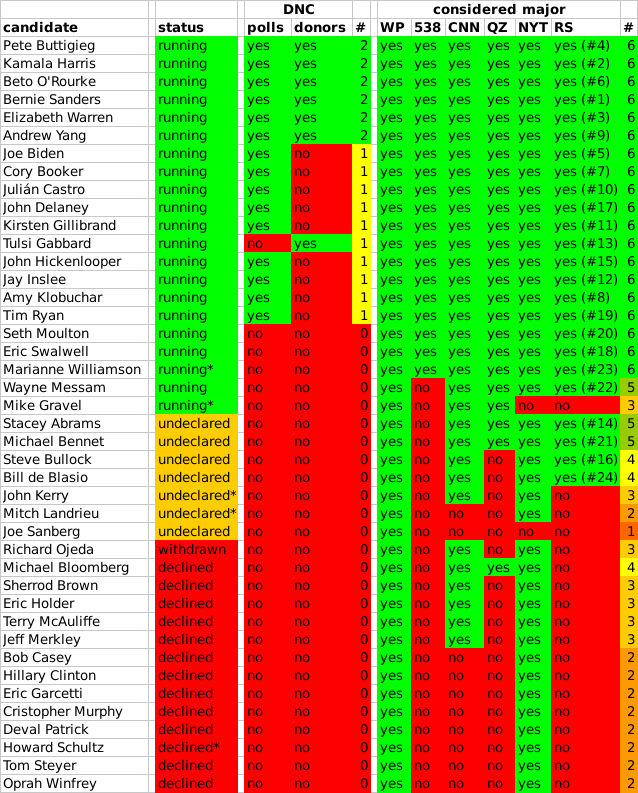
You can see for instance, that Mike Gravel is counted major only by Wikipedia, CNN and Quartz. It is further complicated by the fact, that undeclared candidates are often included in such lists. For the ones I looked at, only Wikipedia and Fivethirtyeight had a definition of major that was communicated (the other media might have a definition, but I didn't saw it).

Wikipedia says: "In addition to having filed with the Federal Election Commission to run for president in the Democratic Party primary in 2020 and having confirmed this by an official campaign announcement, the major candidates in this table below have either: ( a ) held public office; ( b ) been included in a minimum of five independent national polls; or ( c ) received substantial media coverage."

Obviously c itself needs further definition of "substantial", but the other two are pretty clear.

Fivethirtyeight includes everyone as major, who fits the criteria for the debates as published by the DNC and additionally candidates for who at least six out of ten questions can be answered with yes. These question include four about serious running (formally declared a campaign not only exploratory committee, is running to win, has hired at least three paid staff, is campaigning outside home state), two about public office (held public office, held public office of one of these: president, vice president, governor, U.S. Senate, U.S. House, mayor of a city of at least 300,000 people, member of a presidential Cabinet), and four questions about public impact (included in half the polls, gets half media coverage of candidates qualifying for the debates, half the google search traffic, at least one endorsement of the ones tracked by 538).

The other media outlets have as I said no clear definition, but there are some things that seem to be universally accepted:

  • as the DNC has published clear rules for qualifying for the debates, pretty much everyone is including candidates qualifying for these
  • most often people are included that held elected office in congress, governours or mayors of big cities
  • often included are cabinet members of former presidents
  • sometimes included are members of state senate or state house and DNC officials (Richard Ojeda as State Senator of West Virginia meets this criteria for instance)
  • if the candidate got endorsements of some of the former mentioned office holders this often helps too
  • most publications include candidates that are included in major polls
  • coverage in other media, social media traffic and Google searches are often helpful

These are the unofficial criteria I see often qualifying candidates. With this said, most of the candidates (who filed with the FEC) are not covered based on that, including for instance:

Of the candidates usually counted as major only two are actually outside the circle of politician which are counted because of their previous elected offices, that are Marianne Williamson and Andrew Yang. This shows that candidates which don't start as U.S. senators, U.S. representatives, governors or former secretaries (or at least DNC officials, state senators/representatives or mayors) have a hard time to join the 'major' club.


3DS-FC: 4511-1768-7903 (Mii-Name: Mnementh), Nintendo-Network-ID: Mnementh, Switch: SW-7706-3819-9381 (Mnementh)

my greatest games: 2017, 2018, 2019, 2020, 2021, 2022, 2023, 2024

10 years greatest game event!

bets: [peak year] [+], [1], [2], [3], [4]

Dems have damaged themselves a lot with the 3 year long russiagate circus. Americans are utter tired of it just want to let it go. An example of this disaster is the latest poll dems had to shut down:

https://www.zerohedge.com/news/2019-05-05/senate-dems-shocked-their-own-poll-showing-70-prefer-kavanaugh-over-rbg


SpokenTruth said:
HylianSwordsman said:

Wait, so how did you decide who to put in this thread as major? Your first post doesn't say how it was determined, and I notice you left Richard Ojeda off the official "drop out" list, even though he declared, hired staff, has previous government experience, got mainstream media attention, had people in this forum (not this thread, he dropped out before this thread) talking about him, and I even got fundraising emails and text banks from him. That doesn't qualify as a major candidate dropping out?

His lack of appearance on my dropped list is simply because he dropped before I made the list.  Looks like he filed on Nov 11, 2018 and then suspended it on Jan 25, 2019.  I'll add him to the suspended section.

For the record, that wasn't meant to sound so accusatory. I just noticed his absence and wondered if there was a methodology you were using to decide that. I wish there were an easy way to define the criteria, but I understand that there really just isn't and I'm pretty happy with the list as is. It's only going to improve more as it becomes clear who is a real contender and who isn't.


Around the Network

It doesn't matter which Democrat candidate wins, none is going to be able to beat Trump!


Mnementh said:
HylianSwordsman said:

Wait, so how did you decide who to put in this thread as major? Your first post doesn't say how it was determined, and I notice you left Richard Ojeda off the official "drop out" list, even though he declared, hired staff, has previous government experience, got mainstream media attention, had people in this forum (not this thread, he dropped out before this thread) talking about him, and I even got fundraising emails and text banks from him. That doesn't qualify as a major candidate dropping out?

All media have slightly differing lists of 'major' candidates. In the list I made for my post you can see it:

You can see for instance, that Mike Gravel is counted major only by Wikipedia, CNN and Quartz. It is further complicated by the fact, that undeclared candidates are often included in such lists. For the ones I looked at, only Wikipedia and Fivethirtyeight had a definition of major that was communicated (the other media might have a definition, but I didn't saw it).

Wikipedia says: "In addition to having filed with the Federal Election Commission to run for president in the Democratic Party primary in 2020 and having confirmed this by an official campaign announcement, the major candidates in this table below have either: ( a ) held public office; ( b ) been included in a minimum of five independent national polls; or ( c ) received substantial media coverage."

Obviously c itself needs further definition of "substantial", but the other two are pretty clear.

Fivethirtyeight includes everyone as major, who fits the criteria for the debates as published by the DNC and additionally candidates for who at least six out of ten questions can be answered with yes. These question include four about serious running (formally declared a campaign not only exploratory committee, is running to win, has hired at least three paid staff, is campaigning outside home state), two about public office (held public office, held public office of one of these: president, vice president, governor, U.S. Senate, U.S. House, mayor of a city of at least 300,000 people, member of a presidential Cabinet), and four questions about public impact (included in half the polls, gets half media coverage of candidates qualifying for the debates, half the google search traffic, at least one endorsement of the ones tracked by 538).

The other media outlets have as I said no clear definition, but there are some things that seem to be universally accepted:

  • as the DNC has published clear rules for qualifying for the debates, pretty much everyone is including candidates qualifying for these
  • most often people are included that held elected office in congress, governours or mayors of big cities
  • often included are cabinet members of former presidents
  • sometimes included are members of state senate or state house and DNC officials (Richard Ojeda as State Senator of West Virginia meets this criteria for instance)
  • if the candidate got endorsements of some of the former mentioned office holders this often helps too
  • most publications include candidates that are included in major polls
  • coverage in other media, social media traffic and Google searches are often helpful

These are the unofficial criteria I see often qualifying candidates. With this said, most of the candidates (who filed with the FEC) are not covered based on that, including for instance:

Of the candidates usually counted as major only two are actually outside the circle of politician which are counted because of their previous elected offices, that are Marianne Williamson and Andrew Yang. This shows that candidates which don't start as U.S. senators, U.S. representatives, governors or former secretaries (or at least DNC officials, state senators/representatives or mayors) have a hard time to join the 'major' club.

That's an excellent breakdown! I like 538 as a conservative estimate of the people who are probably major contenders for the long haul, while Wikipedia is obviously an exhaustive list and the others are in between, though honestly the list we have in the OP is probably the best.


darkrulier said:
It doesn't matter which Democrat candidate wins, none is going to be able to beat Trump!

I recall the last time being surprised by the results of an election.


What I fear, is that it doesn't matter who wins, at least not for the 2 first years. Why, you ask? Well, because chances are slim, that the Democrats can also reconquer the Senate - and they will certainly block everything the Democrats will try to get through.

It's true that 22 Republican states will be electing new Senate representatives - but 20 of them are in deep republican states, so chances are slim that Democrats can get any of those seats. That just leaves 2 seats to conquer, but they need 3 to reach a 50/50 split.


Mayor Pete seems to be very well liked by pretty much everyone that gets to know him. His problem atm is that not many people know him yet, but that should be fixed after some time of campaigning and the debates. I truly think he has a chance of being the democratic candidate, and honestly, I think he's one of the most likely to win against Trump.