
By using this site, you agree to our Privacy Policy and our Terms of Use. Close

Forums - Politics - More evidence that rights-based ethical systems have flawed foundations.

badgenome said:
richardhutnik said:

A rights-based ethics system frames arguments for right and wrong around how much rights are upheld.  The system has a much more absolutist view than that of the likes of Utilitarianism, and the measure of it is that rights don't get violated.  Other frameworks/systems have other measures, like one based on virtue and how close things correspond to ideal states of being and behavior.

So, you are judging the situation, if rights based on what here?  What right do you feel that the individuals have at the funeral which is superior to that of the WBC's right of free speech that WBC claims it has.

Rights should be the foundation of a good ethical system, not the totality of it. Why do you insist that a system of ethics based on rights cannot take into account one single other thing? That seems unnecessarily and impractically rigid.

A problem with saying rights should be THE foundation of any good ethical system is that you have no basis for determing which things are rights, and which or not, and which rights have greater priority.  You can either then arbitrarily just pick them, or declare as Locke had they are given by God and inalienable.  And this inalienable is a stronger position than just picking them, or saying they are alienable because that means they can be traded in a market and exchanged for something else.  At that point, you come up with a relativist market that is close to Utilitarianism, and reduces ethical decisions to financial calculations, which undermines a strength of rights-based systems, that means the rights are fairly clear and non-negotiable.

Now, saying that an ethical-based system is based around, and operates on the basis of upholding rights doesn't mean that a person making ethcal decisions needs to be only informed by a rights-based ethical system to make ethical decisions.  One can end up know the weaknesses of rights-based ethical systems, and while favoring it, lean on other system of ethics to make decisions.  Of course, the risks in doing this is to end up not making sound ethical decisions, but ones based on personal preferences.



Around the Network

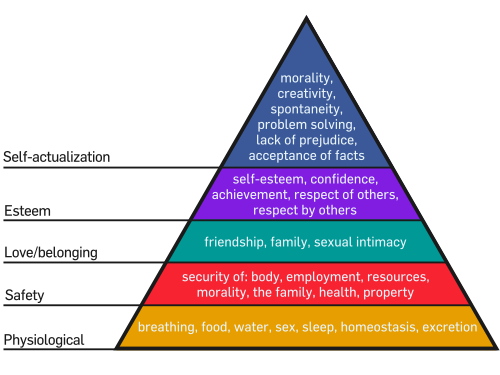
The way I see it, a heirarchy of rights should follow something similar to Maslow's Heirarchy of Needs:


So, naturally, one's right to live is a greater right than someone else's right to body or health, for instance, and definitely higher than someone's right to self-esteem (thus, abortion, even in cases of rape or incest, would be wrong).

However, this also places gay rights (as far as marriage goes) and religious rights on the same level ("right to the lack of prejudice" vs "right to morality"). So coming up with a solution to those issues would still be a dilemma.


 SW-5120-1900-6153

richardhutnik said:

Of course, the risks in doing this is to end up not making sound ethical decisions, but ones based on personal preferences.

But all systems of ethics ultimately boil down to personal preference anyway. The established schools of thought were created by philosophers in their own images, and people basically just pick and choose what ethics that they personally find to be the most appealing.

Still, it's really not as hard as you're making it out to decide how rights should be prioritized. If liberty and self-ownership are the most fundamental rights,  everything else flows from that. Therefore human interaction should be voluntary and free of violence and coercion, and anything that requires the initiation of coercion - such as that needed to enforce the claims that you have a right to things provided by others or that you have the right not to hear disagreeable opinions - is wrong.


richardhutnik said:

I had stated that one of the issues with a rights-based ethics system is disagreement on what constitutes rights vs what doesn't.  I believe I also said that you can have other ethical systems based on something else, and the system still have rights.  The problems are issues with prioritizing and inclusion, and the difficulties resolving.  There is also a failure to account for outcomes of behaviors and utilizing these outcomes in determing the right decision or even prioritizing. Other systems don't have this issue, but have others.

There is a catalog on rights, as with a rules based system you have a catalog of rules. The human-rights-charta is such a catalog. You haven't shown, that the human rights have conflicts, that aren't resolvable with priorities usually applied to them. You only could make up other rights that no one ever had in a rights-catalog to show that it doesn't work.

I show you, that no rules-based-system can work, the way you apply your argument:

The rule "Don't follow any rule!" is a valid rule. As this contradicts a rule-based ethical system a rules-based ethical system cannot work.


3DS-FC: 4511-1768-7903 (Mii-Name: Mnementh), Nintendo-Network-ID: Mnementh, Switch: SW-7706-3819-9381 (Mnementh)

my greatest games: 2017, 2018, 2019, 2020, 2021, 2022, 2023, 2024

10 years greatest game event!

bets: [peak year] [+], [1], [2], [3], [4]

richardhutnik said:

A problem with saying rights should be THE foundation of any good ethical system is that you have no basis for determing which things are rights, and which or not, and which rights have greater priority.  You can either then arbitrarily just pick them, or declare as Locke had they are given by God and inalienable.

The argument you cannot determine which things are rights can be pointed at every other foundation of society. You have no system to declare which rules are good rules for instance.

Naturally you pick some (and Lockes position of rigts given by god is nothing else as that he has picked some). And that's not that hard. Most of the world has agreed on human rights for more than 50 years now.

And if you think that is a weakness of rights, tell me which base of ethics isn't done by picking some things over overs? You always bring up Utilarism. But it is hard to determine the value of things. Usually it is picked. Along the lines of: a human life ios worth more than a bread.


3DS-FC: 4511-1768-7903 (Mii-Name: Mnementh), Nintendo-Network-ID: Mnementh, Switch: SW-7706-3819-9381 (Mnementh)

my greatest games: 2017, 2018, 2019, 2020, 2021, 2022, 2023, 2024

10 years greatest game event!

bets: [peak year] [+], [1], [2], [3], [4]

Around the Network
Mnementh said:

richardhutnik said:

 I had stated that one of the issues with a rights-based ethics system is disagreement on what constitutes rights vs what doesn't.  I believe I also said that you can have other ethical systems based on something else, and the system still have rights.  The problems are issues with prioritizing and inclusion, and the difficulties resolving.  There is also a failure to account for outcomes of behaviors and utilizing these outcomes in determing the right decision or even prioritizing. Other systems don't have this issue, but have others.

There is a catalog on rights, as with a rules based system you have a catalog of rules. The human-rights-charta is such a catalog. You haven't shown, that the human rights have conflicts, that aren't resolvable with priorities usually applied to them. You only could make up other rights that no one ever had in a rights-catalog to show that it doesn't work.

I show you, that no rules-based-system can work, the way you apply your argument:

The rule "Don't follow any rule!" is a valid rule. As this contradicts a rule-based ethical system a rules-based ethical system cannot work.

That's sorta what i've been thinking this whole time.

It's like saying "A vegetarian who eats all fruits can't work because it can be argued Chicken is a fruit!"

I mean... you can argue that... but there isn't any real basis or truth behind it.


badgenome said:
richardhutnik said:

Of course, the risks in doing this is to end up not making sound ethical decisions, but ones based on personal preferences.

But all systems of ethics ultimately boil down to personal preference anyway. The established schools of thought were created by philosophers in their own images, and people basically just pick and choose what ethics that they personally find to be the most appealing.

Still, it's really not as hard as you're making it out to decide how rights should be prioritized. If liberty and self-ownership are the most fundamental rights,  everything else flows from that. Therefore human interaction should be voluntary and free of violence and coercion, and anything that requires the initiation of coercion - such as that needed to enforce the claims that you have a right to things provided by others or that you have the right not to hear disagreeable opinions - is wrong.

Personal preferences in this context means that a person rigs the ethical decision-making so that it comes out to benefit the person doing this all the time.  A good system of ethics will causes everyone to yield from time to time, and restrain them as needed.  It will also cause them to act with better character.


Mnementh said:

richardhutnik said:

A problem with saying rights should be THE foundation of any good ethical system is that you have no basis for determing which things are rights, and which or not, and which rights have greater priority.  You can either then arbitrarily just pick them, or declare as Locke had they are given by God and inalienable.

The argument you cannot determine which things are rights can be pointed at every other foundation of society. You have no system to declare which rules are good rules for instance.

Naturally you pick some (and Lockes position of rigts given by god is nothing else as that he has picked some). And that's not that hard. Most of the world has agreed on human rights for more than 50 years now.

And if you think that is a weakness of rights, tell me which base of ethics isn't done by picking some things over overs? You always bring up Utilarism. But it is hard to determine the value of things. Usually it is picked. Along the lines of: a human life is worth more than a bread.

I would go with what Hayek wrote on the subject of tradition and morals developed in a society.  He argued such evolved over time, reaching conclusions individuals alone couldn't reach by pure intellect.  These arose as a bunch of proven rules of thumb, and actually likely not a system at all. Values and temperments in society also arose this way. 

I would say here that, in this, in a fully functioning society, the idea of rights came much later, starting with the likes of Locke.


badgenome said:
richardhutnik said:

If the entire basis of human interaction is to be left alone, you have little in the way of human action.  There is no such thing as love in this system either.  And there is nothing in this that manages to help people who want to change.  There is no call to do good or serve others.  It is entirely self-focused.  There are no Good Samaritans either. And that which people consider to be noble is gone.  In the world you have, Superman would go in to business for himself, do celebrity route, become famous, and people would end up dying.  

I didn't say that it's the entire basis of human interaction, just that it's the right you have. Every negative right boils down to just that. So you have the right to speak freely, and that right shall not be infringed upon no matter how unpopular your ideas are. However, you do not and cannot have the right to a forum from which to express your ideas if it means that someone else has to provide that forum for you.

Likewise, just because some freeloader decides that free birth control is a "right" doesn't make it a right.

Where is the room for good Samaritanship in a system in which all charity (and the responsibility to do charitable works for those who believe in such a thing, like Christians) has been made the domain of the government?

Still in the domain of the individual. The state still needs people to execute good works, even if the government is ultimately footing the bill, see: Peace Corps, Americorps.


Monster Hunter: pissing me off since 2010.

Mr Khan said:
badgenome said:
richardhutnik said:

If the entire basis of human interaction is to be left alone, you have little in the way of human action.  There is no such thing as love in this system either.  And there is nothing in this that manages to help people who want to change.  There is no call to do good or serve others.  It is entirely self-focused.  There are no Good Samaritans either. And that which people consider to be noble is gone.  In the world you have, Superman would go in to business for himself, do celebrity route, become famous, and people would end up dying.  

I didn't say that it's the entire basis of human interaction, just that it's the right you have. Every negative right boils down to just that. So you have the right to speak freely, and that right shall not be infringed upon no matter how unpopular your ideas are. However, you do not and cannot have the right to a forum from which to express your ideas if it means that someone else has to provide that forum for you.

Likewise, just because some freeloader decides that free birth control is a "right" doesn't make it a right.

Where is the room for good Samaritanship in a system in which all charity (and the responsibility to do charitable works for those who believe in such a thing, like Christians) has been made the domain of the government?

Still in the domain of the individual. The state still needs people to execute good works, even if the government is ultimately footing the bill, see: Peace Corps, Americorps.

A person with an ethical system that involves a sense of duty, and not just "things are fine if I leave everyone alone" are more likely to end up doing things like volunteering.