By using this site, you agree to our Privacy Policy and our Terms of Use. Close

Forums - Politics - Do you consider yourself more left or right wing?


I am...

More left leaning 52 61.90%
 
More right leaning 32 38.10%
 
Total:84
rapsuperstar31 said:
angrypoolman said:

Before I had kids, I was on the right. Now that I have kids, I am on the far right.

Should be the opposite since the The far right are destroying the planet and the national debt that your kids, eventual grand kids, and great grand kids will eventually have to pay.  You're also teaching your kids that you would rather have a convicted felon, a sexual assaulter, and more than likely something far far worse on Epstein island in office.

yeah thats true. good points. im a little more left now after reading this post. 


Around the Network
CourageTCD said:
curl-6 said:

The alt right engages in cancel culture too, absolutely, nowadays though I find most of the restrictions on expression come from the alt left.

I simply believe people should be treated equally regardless of things like race or gender; the solution to discrimination is to stop discriminating.


The way you phrased, Curl, it seemed like you were defending equality. But were you actually defending it or you meant equity?

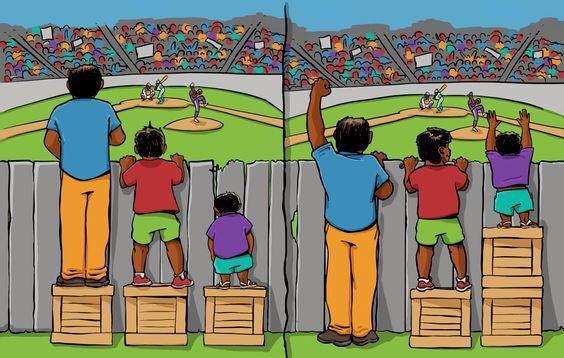
On the picture on the left, they are all being treated equally, but this doesn't help the one in need. On the right image, the three kids were not treated equally but they can do what they wanna do, they are happy. On the right image we have equality and on the equity.  

Equity vs equality is an interesting topic. I think the two concepts are mutually exclusive: equity is same results (which necessitates different opportunity), while equality is same opportunity (which necessitates different results).

But you can use these principles in various different ways. So, while I typically strongly disagree with equity, it is usefull enough and makes sense to me to have a higher tax rate the higher your income is. Highering quotas though, that is vile and should be outlawed everywhere.


I think the concept of "everybody should be treated equally" works best if we held all social institutions to that standard and not just the state and large corporations. 

I am not a luck egalitarian but I think they make a good case for why everybody isn't "treated equally" in nominally liberal-"democratic" societies. People inherit inequalities, and if we are serious about holding people to their choices and having results depend solely on their choices, then much needs to be done to eliminate this inherited inequality. 

But of course, that is not very popular. So institutions do the next best thing, they try to make-up for their inherited inequalities by giving extra opportunities to those who did not inherit favorably with the consideration that "inheritance x same choices" can give different results, if the first product is different. 

The right-wing extols this inheritance because they believe that certain groups are superior to others. The actual left-wing aims to reduce these inheritances either directly or eliminate their impact on consequential inequalities. The center tries to balance the two, aiming for whichever policies are least objectionable. 


The latest survey from Germany is funny in regards to the topic of raising taxes on the rich. Overall, 65% of respondents were in favor of raising these taxes. The baffling thing is that among conservative voters, 66% were in favor of it, so even they performed above the average; just makes you wonder why they keep voting a party that repeatedly and explicitly takes the position of no higher taxes for the rich. It was fans of the far-right who dragged it all down with only a minority of them being in favor of higher taxes for the rich despite far-right voters being the poorest people on average and the most dependent on social security programs.


Legend11 correctly predicted that GTA IV will outsell Super Smash Bros. Brawl. I was wrong.

RolStoppable said:

The latest survey from Germany is funny in regards to the topic of raising taxes on the rich. Overall, 65% of respondents were in favor of raising these taxes. The baffling thing is that among conservative voters, 66% were in favor of it, so even they performed above the average; just makes you wonder why they keep voting a party that repeatedly and explicitly takes the position of no higher taxes for the rich. It was fans of the far-right who dragged it all down with only a minority of them being in favor of higher taxes for the rich despite far-right voters being the poorest people on average and the most dependent on social security programs.

That's because everyone consider "rich" as the top-10 or so people with highest fortune, not top 10 percent of earners. Also, many of the poorest understand that raising taxes isn't going to make their situation any better. When taxes are being raised, everything becomes more expensive. 


Ei Kiinasti.

Eikä Japanisti.

Vaan pannaan jalalla koreasti.


Nintendo games sell only on Nintendo system.

Around the Network
zorg1000 said:
curl-6 said:

The US is something of an outlier among the developed world because they have a hard right government at present.

If you treat people the same regardless of race or gender, then equality will arise naturally from the fact that no race or gender is actually superior.

Sure, but I also brought up examples of individuals, not the US government, employing cancel culture tactics about anything they perceive as “woke”, which by now just means “things I don’t like”. My point is free speech isn’t a left/right thing.

But again, what you’re saying sounds good in theory but it doesn’t actually address the issue and ignores that people aren’t treated the same. If the government doesn’t step in and help groups that are being discriminated against, who will? Pretending that racism, sexism & xenophobia don’t exist doesn’t help anything.

Also, you still haven’t given examples of white men being punished for being white men.

As I said, the alt right does employ cancel culture too, but in my experience the majority of it comes from the alt left, particularly in terms of weaponizing things like the legal system, HR, social media, and other institutions to silence opposing views.

Discrimination does exist, obviously, and there are and should be interventions against it, such as businesses not being allowed to say "no black people served here" or "we only hire men" or a school not being allowed to say only let in white students. Anti-discrimination laws exist in pretty much every Western nation, as they should.

An example in my view would be say quotas that insist on hiring a non-white person over a white person purely on the grounds of race, or on a less institutional level, just the pervasive "white people are evil, if you're white you're not allowed to have an opinion" attitude of the alt left. 


curl-6 said:

As I said, the alt right does employ cancel culture too, but in my experience the majority of it comes from the alt left, particularly in terms of weaponizing things like the legal system, HR, social media, and other institutions to silence opposing views.

Discrimination does exist, obviously, and there are and should be interventions against it, such as businesses not being allowed to say "no black people served here" or "we only hire men" or a school not being allowed to say only let in white students. Anti-discrimination laws exist in pretty much every Western nation, as they should.

How do you think anti-discrimination laws should be enforced? 

For example, how do you solve discrimination that isn't explicit, but has the same effect via proxy metrics? To go further, when a hiring manager doesn't choose applications because the names are obviously of a particular ethnic-group, how does the state become aware of this and intervene? 

The general mindset of the left is that the state isn't very effective at addressing these sorts of discrimination, especially when they involve implicit bias and the discriminator isn't even consciously aware that they are acting discriminatorily. 

The solution proposed is to change the culture, to be more "woke" -- if you will -- aware of implicit prejudices/biases so that individuals and not just institutional policy act to ameliorate general discriminatory trends. 

What you see as "silencing opposing views" often is about making particular settings more neutral for marginalized people. Every institution and association has its norms of conduct. 

This isnt to say white people, or any other historically dominant class should be made to feel less than, but that rather when a dominant group is told it needs to share society the feeling is a sense of loss in that group. This is a basis of the far right reaction to social change towards a more egalitarian and individual-oriented society. 


Center , leaning a little to the right.


sc94597 said:
curl-6 said:

As I said, the alt right does employ cancel culture too, but in my experience the majority of it comes from the alt left, particularly in terms of weaponizing things like the legal system, HR, social media, and other institutions to silence opposing views.

Discrimination does exist, obviously, and there are and should be interventions against it, such as businesses not being allowed to say "no black people served here" or "we only hire men" or a school not being allowed to say only let in white students. Anti-discrimination laws exist in pretty much every Western nation, as they should.

How do you think anti-discrimination laws should be enforced? 

For example, how do you solve discrimination that isn't explicit, but has the same effect via proxy metrics? To go further, when a hiring manager doesn't choose applications because the names are obviously of a particular ethnic-group, how does the state become aware of this and intervene? 

The general mindset of the left is that the state isn't very effective at addressing these sorts of discrimination, especially when they involve implicit bias and the discriminator isn't even consciously aware that they are acting discriminatorily. 

The solution proposed is to change the culture, to be more "woke" -- if you will -- aware of implicit prejudices/biases so that individuals and not just institutional policy act to ameliorate general discriminatory trends. 

What you see as "silencing opposing views" often is about making particular settings more neutral for marginalized people. Every institution and association has its norms of conduct. 

This isnt to say white people, or any other historically dominant class should be made to feel less than, but that rather when a dominant group is told it needs to share society the feeling is a sense of loss in that group. This is a basis of the far right reaction to social change towards a more egalitarian and individual-oriented society. 

If I knew how to solve all discrimination and inequality, I'd have a Nobel peace prize; it's a complex problem and there is no easy solution.

I simply believe that treating people better or worse based on traits they cannot control such as their skin colour or their sex is fundamentally wrong; it only perpetuates division as people see others being treated differently for being white/black/male/female which creates resentment and thus further fuels racism/sexism.


curl-6 said:

If I knew how to solve all discrimination and inequality, I'd have a Nobel peace prize; it's a complex problem and there is no easy solution.

I simply believe that treating people better or worse based on traits they cannot control such as their skin colour or their sex is fundamentally wrong; it only perpetuates division as people see others being treated differently for being white/black/male/female which creates resentment and thus further fuels racism/sexism.

I agree, there are no easy solutions. But changing culture to 1. become more aware of implicit biases based on background (aka: "become more woke") and 2. actively integrate marginalized peoples into common socio-economic institutions do work as difficulteffective solutions to reduce inequalities based on these categories. So any critique of them would have more weight if there were viable alternatives.  

I am not convinced that the right-wing resentment comes from treating people differently, but rather from the fact that what were club goods and services increasingly have become public ones available to everyone. It's not very different from say 1832 U.K Conservatives being angry that The Reform Act of 1832 made political institutions more equally inclusive by including more people of relatively marginalized classes. And yes, the effect is that many of those Conservatives loss political-economic resources they (or their ancestors) previously guarded for centuries, in the same way historically dominant classes (white, men, etc) lose previously guarded socio-economic resources when their club goods and services become more public - but that is an effect of reforming or restructuring institutions so that people who were previously excluded are more equally included. 

Treating people as individuals who are independent of their backgrounds or the groups they're embedded in would make sense in a society where everyone was born with the same opportunities and all results came from their own chosen decisions. Unfortunately, that doesn't describe our real-world societies. In our real-world the social institution of inheritance allows historical injustices to propagate beyond their historical period. In order to correct the effects of those historical injustices you either eliminate inheritance(s) and give people equal opportunities upon birth or you aim to holistically consider the opportunities individuals inherited due to certain groups they're embedded in when considering the merits of their choices continuously throughout your interactions in life. 

And this makes practical sense too, to consider background. A poor person who has had fewer opportunities like tutoring and motivate parenting who achieves the same test scores as a wealthier person with more resources of this kind, likely had to make very different (merit-worthy) choices to achieve the same result. Likewise, when it comes to other marginalized classes. So it's not merely a matter of "treating people better or worse" due to their status in a social category, but rather what they have achieved despite a lack of inherited opportunities.