By using this site, you agree to our Privacy Policy and our Terms of Use. Close

Forums - Microsoft - Cloud Processing won't mean a thing for the Xbone


The Cloud will...

Significantly improve games 63 12.57%
 
Improve some games somewhat 65 12.97%
 
Might be used well here and there 101 20.16%
 
Merely PR BS 271 54.09%
 
Total:500

Question for anyone more knowledgeable in the ways of Cloud - is it possible to run game instance both locally and in cloud, with cloud version being streamed and displayed first and if latency rises over certain threshold to seamlessly switch to local version (which would look uglier, but will have required latency)?

I was looking at this pic of nVidia Grid:
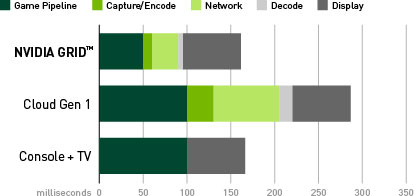


and if I read it correctly, by making rendering time shorter they are making up (or at least trying to) for all the network and encode/decode picture latencies.


Around the Network
SvennoJ said:
Machiavellian said:
Removed for sanity


Yes, I get where the cloud computing, or rather distributed rendering comes in. (essentially an sli setup but on seperate servers)
Once you're rendering on the server you can distribute it as much as you like with all kinds of exotic and new rendering techniques. (Although having 4 servers rendering at full capacity per 1 client is no way to stay in business)
However it has the same drawback as Gaika, added lag from input to end  result. There is no direct feedback possible as the client has to send the input to the server to receive the corresponding result much later.

I'm trying to think of ways how cloud compute can increase the performance of games without introducing lag. Basically anything the user can manipulate with an immediate effect (view point, interactions with the world and npcs) has to be handled locally.
Their idea of using it for a surveillance station is something that works, not time critical. The server can make beautifully ray-traced custom made cut scenes, all party members present in their correct outfits. (Assuming you have enough bandwidth not to get ugly compression artifacts)
Other then that I don't see how you can get away with cloud based rendering without sacrificing response time.

I agree that cloud compute at this point in time cannot be leverage for things that are immediate to the gamer without sacrificing something.  It will be a challenge to see how developers can combine the two techs from the local resources to the cloud.  I really do believe that in 2 years we will see a lot of innovative schemes that combine the two to produce something we have not witness today.


Question

So if ur internet goes down, ur gonna lose all that cloud processing and ur games stop working cause they cant process all the data?


HoloDust said:
Question for anyone more knowledgeable in the ways of Cloud - is it possible to run game instance both locally and in cloud, with cloud version being streamed and displayed first and if latency rises over certain threshold to seamlessly switch to local version (which would look uglier, but will have required latency)?

I was looking at this pic of nVidia Grid:


and if I read it correctly, by making rendering time shorter they are making up (or at least trying to) for all the network and encode/decode picture latencies.

Yes this would be possible to run an instance of a game both on the cloud and locally.  One thing people have been looking into is how Sony will do their download a game and be able to play it immediately.  One solution would be to have the game streamed from Giakai so the player can play instantly and have the game download in the background.  Once enough of the game is on the PS4, it would run the game at the point where the gamer is at and stop the Gaikai stream.  I thought this was a great Ideal but at least currently, This will not be the case at launch.


Vashyo said:
Question

So if ur internet goes down, ur gonna lose all that cloud processing and ur games stop working cause they cant process all the data?


The developer would need to condition for this situation.  They would need to revert to local rendering of the scene or throw away imcompleted data from the cloud and switch to local processing.  I believe in the early stages this is how things will go.  I would not be surprised if we see online only games where you know if you do not have a decent net connection, you will not have a good experience.


Around the Network

Lets wait and see, Cloud Processing sure will not be a big thing from the beginning but in a few years who knows? Only Microsoft knows what their Cloud Processing really is able to perform and if this thing really can enhance Xbox one's power gradually.


HoloDust said:
Question for anyone more knowledgeable in the ways of Cloud - is it possible to run game instance both locally and in cloud, with cloud version being streamed and displayed first and if latency rises over certain threshold to seamlessly switch to local version (which would look uglier, but will have required latency)?


You have hit a very important nail right on it's head.


HoloDust said:
Question for anyone more knowledgeable in the ways of Cloud - is it possible to run game instance both locally and in cloud, with cloud version being streamed and displayed first and if latency rises over certain threshold to seamlessly switch to local version (which would look uglier, but will have required latency)?

I was looking at this pic of nVidia Grid:


and if I read it correctly, by making rendering time shorter they are making up (or at least trying to) for all the network and encode/decode picture latencies.

So if I read that picture correctly for a 10 fps game (100 ms per frame) NVidia grid rivals local rendering.
Nice deception, you only have 33ms per frame at 30 fps, NVidia grid still adds another 40ms on top. They would need to render in -7ms to match normal responsiveness, maybe with some exoctic quantum time travel tech :)

It shouldn't be too hard to have the game running locally as well. As long as the cloud is streaming it doesn't actually have to render anything, only keep the game state up to date. There will be a slight hickup when it switches over.

What MS actually proposed to do is have graphical enhancements prepared by the cloud, while keeping the game running normally on the system. The only examples they gave was for better lighting (light shafts disappearing or shadows going fuzzy when the connection fails) or cloth dynamics (I guess flags and curtains stop moving in the wind on failure)


SvennoJ said:
HoloDust said:
Question for anyone more knowledgeable in the ways of Cloud - is it possible to run game instance both locally and in cloud, with cloud version being streamed and displayed first and if latency rises over certain threshold to seamlessly switch to local version (which would look uglier, but will have required latency)?

I was looking at this pic of nVidia Grid:


and if I read it correctly, by making rendering time shorter they are making up (or at least trying to) for all the network and encode/decode picture latencies.

So if I read that picture correctly for a 10 fps game (100 ms per frame) NVidia grid rivals local rendering.
Nice deception, you only have 33ms per frame at 30 fps, NVidia grid still adds another 40ms on top. They would need to render in -7ms to match normal responsiveness, maybe with some exoctic quantum time travel tech :)

It shouldn't be too hard to have the game running locally as well. As long as the cloud is streaming it doesn't actually have to render anything, only keep the game state up to date. There will be a slight hickup when it switches over.

What MS actually proposed to do is have graphical enhancements prepared by the cloud, while keeping the game running normally on the system. The only examples they gave was for better lighting (light shafts disappearing or shadows going fuzzy when the connection fails) or cloth dynamics (I guess flags and curtains stop moving in the wind on failure)


Yeah, if I understand correctly, those 100ms for game pipeline are really the upper limit - it seems they are not alone in that approach that requires servers to render at several times the required framerate to make up for network latency (bold claims from these folks too):

http://www.ciinow.com/2013/01/the-truth-about-latency-in-cloud-gaming/


As for MS, I know what they proposed is not this, their model is co-processing to assist local proccessing, but I was just wondering if this is viable alternative in the future - pretty much cloud streaming as we know it today, but with local (uglier) backup in case the network is unstable/slow.



HoloDust said:


Yeah, if I understand correctly, those 100ms for game pipeline are really the upper limit - it seems they are not alone in that approach that requires servers to render at several times the required framerate to make up for network latency (bold claims from these folks too):

http://www.ciinow.com/2013/01/the-truth-about-latency-in-cloud-gaming/


As for MS, I know what they proposed is not this, their model is co-processing to assist local proccessing, but I was just wondering if this is viable alternative in the future - pretty much cloud streaming as we know it today, but with local (uglier) backup in case the network is unstable/slow.

Interesting article, too bad they fail to mention what the display lag was in their test.
I remember this excellent Eurogamer article on lag http://www.eurogamer.net/articles/digitalfoundry-lag-factor-article
They removed the display lag in their tests by using a CRT monitor. The lowest lag they could get was 50ms in the xmb, 67ms for 60fps games, and 133ms for 30fps games. However they could only measure in frames, no 240fps camera to get exact latency. Still CiiNow's 133ms for SF IV is double that what Eurogamer measured for SF IV.

But they are right that cloud gaming (streaming version) can rival consoles that struggle to maintain 30fps. A powerful server that can render a frame in 5ms (200fps) has upto 60ms extra compared to a double buffered 30fps game. Great for most of this gen's games, but consoles are (hopefully) moving the goal post to 60fps. Those 67ms 60fps games will be a lot harder to match.