SvennoJ said:
HoloDust said:
Question for anyone more knowledgeable in the ways of Cloud - is it possible to run game instance both locally and in cloud, with cloud version being streamed and displayed first and if latency rises over certain threshold to seamlessly switch to local version (which would look uglier, but will have required latency)?
I was looking at this pic of nVidia Grid:
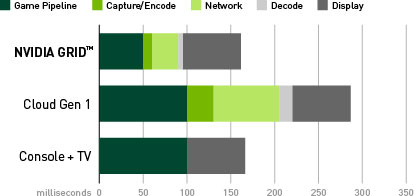
and if I read it correctly, by making rendering time shorter they are making up (or at least trying to) for all the network and encode/decode picture latencies. |
So if I read that picture correctly for a 10 fps game (100 ms per frame) NVidia grid rivals local rendering.
Nice deception, you only have 33ms per frame at 30 fps, NVidia grid still adds another 40ms on top. They would need to render in -7ms to match normal responsiveness, maybe with some exoctic quantum time travel tech :)
It shouldn't be too hard to have the game running locally as well. As long as the cloud is streaming it doesn't actually have to render anything, only keep the game state up to date. There will be a slight hickup when it switches over.
What MS actually proposed to do is have graphical enhancements prepared by the cloud, while keeping the game running normally on the system. The only examples they gave was for better lighting (light shafts disappearing or shadows going fuzzy when the connection fails) or cloth dynamics (I guess flags and curtains stop moving in the wind on failure)
|
Yeah, if I understand correctly, those 100ms for game pipeline are really the upper limit - it seems they are not alone in that approach that requires servers to render at several times the required framerate to make up for network latency (bold claims from these folks too):

http://www.ciinow.com/2013/01/the-truth-about-latency-in-cloud-gaming/
As for MS, I know what they proposed is not this, their model is co-processing to assist local proccessing, but I was just wondering if this is viable alternative in the future - pretty much cloud streaming as we know it today, but with local (uglier) backup in case the network is unstable/slow.








 Currently Online


