






xl-klaudkil said:
You know how much forest are getting destroyed to make your soya beans Billions of insects massacared for it. Vegans are hypocritz |
While I don't disagree that vegans are mostly hypocrites, there are vast differences in the type of meat and produce:
The carbon footprint of a Big Mac is approximately 2.35kg CO2e, which is comparable to driving about 7.88 miles in an average car. The majority of this impact comes from the beef patty, which accounts for about 2.11kg of the total emissions.
A kilogram of popular cheeses like cheddar can produce the equivalent 6.5 to 12.8 kg of CO2e. Harder cheeses have a larger footprint than softer, water-rich cheeses, and cheese generally has a higher carbon footprint than other proteins like chicken and pork.
And while Tofu, nuts and Coconuts have a lower carbon footprint, you are correct:
Soybean production's most significant impact is deforestation, particularly in the Amazon and Cerrado regions of South America, as large areas are cleared for cultivation. This leads to biodiversity loss and high greenhouse gas (GHG) emissions due to land-use change.
(However over 75% of Soy Beans are used for animal feed...)
Coconut farming poses a severe threat to biodiversity on tropical islands. Coconut trees are less efficient at producing oil per hectare than oil palm, requiring more land to meet demand, which drives deforestation in unique, biodiverse ecosystems.
Nut production generally has a lower GHG emission and land use impact than animal proteins. However, certain nuts, particularly almonds and pistachios grown in water-stressed regions like California, have an extremely high water footprint.
There's no way around it, humans run on protein, got to get it somewhere.
(The Recommended Dietary Allowance (RDA) for protein is a modest 0.8 grams of protein per kilogram of body weight, or 0.36 grams per pound)
However the most environmentally friendly sources of protein are:
The most environmentally friendly protein sources are nuts, peas, and beans, with nuts having the lowest carbon footprint per 100g of protein at approximately 0.26kg CO2e. Peas emit about 0.4kg CO2e per 100g of protein, while beans are also very low-impact.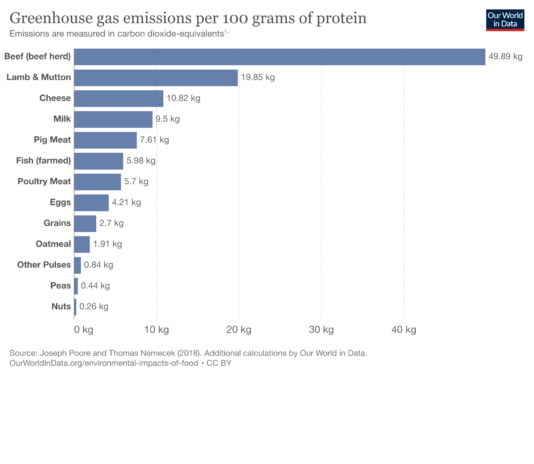
Compared to driving:
100 grams of beef protein is equivalent to driving 124.7 miles (average passenger car emits 400 grams per mile)
100 grams of Nuts protein is equivalent to driving 0.65 miles.
The average price for 400 grams of beef varies significantly, but generally ranges from about $13 to $26 (Beef has about 25% protein)
The average price for 500 grams (about 1.1 lbs) of nuts in the US generally ranges from $10 to $30 (Avg 6 grams per ounce = 21% protein)
100 grams of protein is enough to sustain humans up to 125 kg / 275 pounds.
A broccoli salad with fresh peppers and cashews is delicious. Of course add cheese, raisins, dressing, it all adds up, but beef is indisputably much worse. Even though beef cattle only get to live 18 to 24 months on average, they still only convert approximately 4% of the feed protein to edible beef protein, making them 25 times less 'efficient' by default, compared to simply eating the source protein. (Going up to 175 times less efficient compared to eating nuts for protein)
But land use is a big factor as well. Also a reason why methanol is not a good alternative to fossil fuels.
Does that all put the 312g to produce a physical game into perspective :p (1 Big Mac ~ 7.5 games ~ 42.7 hours of streaming)


















 Currently Online