By using this site, you agree to our Privacy Policy and our Terms of Use. Close

Forums - Nintendo - Why do you think Nintendo has survived so long as a platform holder?

JackHandy said:
curl-6 said:

It sounds as though your mind is made up and you won't accept any evidence to the contrary.

There was no sudden change in the audience going from 2016 to 2017; no large demographic shift of any kind that would explain the entire market suddenly deciding to like Nintendo games again. What changed was that Nintendo went from offering a terrible system to a desirable one, hence the games tied to those systems became far more successful, it's as simple and self-evident as that.

I am more than willing to have my mind changed, but I need something more compelling than that.

Basically, your premise is the system sells the game. Mine is the game sells the system. Case in point: if we're going to go with the idea that consoles sell games, then we're also going to go with the idea that something like fifty-million people were looking at Mario Kart 8 when it launched and thinking, Man... I would love to get that game, but that system... it's just so horrible. I personally have trouble buying into that logic. It's just too big a number; too big a leap.

Generations of people come and go. Attitudes change. During the PS2 era, every game Nintendo launched was considered kiddy and not taken seriously by the majority of the gaming community. Now, those same games are considered by younger generations who weren't around then to be utter masterpieces, which speaks directly to my point.

People changed.

Nintendo didn't.

That is exactly what happened though; Mario Kart 8 was a great game trapped on a console nobody wanted. It was like selling a delicious meal in a restaurant that's filthy and crawling with cockroaches in a shitty part of town, it doesn't mean people don't like the meal, they're just put off by the surrounding factors.

The alternative theory is that over 50 million people all magically changed their minds about Nintendo games overnight for no reason; this simply doesn't hold up to a moment of logical scrutiny.

If it was the audience's attitude that changed, then the change would have happened gradually over time. Instead it changed instantly, and the the fact this sudden change happened exactly when a desirable new Nintendo console came out shows that it was the Switch that caused the change.



Around the Network
Doctor_MG said:

I'm not being disingenuous stating that you emphasize the mobile components while excusing (or even outright ignoring) home console features because that's literally what you continue to do in this very response.

Also, notice that I said marketing is a "factor" and that my argument goes beyond marketing (e.g. home console features, intention of design, etc). You in this very post argue against some of my other points as to why I think the console is a hybrid, yet go on to say that my "only argument" is that Nintendo says it is, so it must be true. Which tells me one of two things. 1) you are becoming emotionally reactive in your responses to this topic and/or 2) you are purposefully trying to use poor debating tactics to undermine my argument (i.e. strawman). Either way, Im not interested in seeing this thread derailed. So I'm ending my response here. You can think what you'd like. I disagree for the reasons I've listed above.

What home console features?

Phenomajp13 said:

Two player gaming on the go lmao! @Doctor_MG This is hilarious lol. Bro is working overtime to be dishonest. Does any prior Nintendo handheld even support splitscreen multiplayer? Splitscreen multiplayer and motion controls align with home consoles for obvious reasons and Switch has them front and center because it's a portable home console according to Nintendo. That's what they call it and they believe what it offers out of box makes it so and the market responded by purchasing Nintendo's vision. 

So it really doesn't make sense to see someone claim they know what Switch was designed by Nintendo to be because Nintendo already told us, which makes you automatically wrong. 

Edit: Reminder you said "it's designed primarily as a mobile device", while Nintendo themselves told us its a portable home console. So no, you don't get to tell us what Nintendo "primarily" designed it to because it "primarily" being a mobile device was never stated. Portable Home Console is what they said! 

I never mentioned split screen.

And whilst prior home fixed consoles had split screen gaming, you couldn't exactly do it at a park bench on a random table.

Phenomajp13 said:

A quote straight from Nintendo's website. Nintendo Switch is designed to fit your life, transforming from home console to portable system in a snap.

Again, I have empirically provided evidence that what for-profit companies state is not always truthful.

Companies put profits first.


--::{PC Gaming Master Race}::--

curl-6 said:
JackHandy said:

I am more than willing to have my mind changed, but I need something more compelling than that.

Basically, your premise is the system sells the game. Mine is the game sells the system. Case in point: if we're going to go with the idea that consoles sell games, then we're also going to go with the idea that something like fifty-million people were looking at Mario Kart 8 when it launched and thinking, Man... I would love to get that game, but that system... it's just so horrible. I personally have trouble buying into that logic. It's just too big a number; too big a leap.

Generations of people come and go. Attitudes change. During the PS2 era, every game Nintendo launched was considered kiddy and not taken seriously by the majority of the gaming community. Now, those same games are considered by younger generations who weren't around then to be utter masterpieces, which speaks directly to my point.

People changed.

Nintendo didn't.

That is exactly what happened though; Mario Kart 8 was a great game trapped on a console nobody wanted. It was like selling a delicious meal in a restaurant that's filthy and crawling with cockroaches in a shitty part of town, it doesn't mean people don't like the meal, they're just put off by the surrounding factors.

The alternative theory is that over 50 million people all magically changed their minds about Nintendo games overnight for no reason; this simply doesn't hold up to a moment of logical scrutiny.

If it was the audience's attitude that changed, then the change would have happened gradually over time. Instead it changed instantly, and the the fact this sudden change happened exactly when a desirable new Nintendo console came out shows that it was the Switch that caused the change.

No, I'm not making the claim that the same gamers changed, although it's obvious there was a little of that. I'm arguing that a new generation of gamers (Gen Z) bought into Nintendo in a way that we haven't seen since the SNES. That it became cool to play Nintendo games again.

I do not believe systems sell games like you do. I believe it's the other way around and always has been.


JackHandy said:

I am more than willing to have my mind changed, but I need something more compelling than that.

Basically, your premise is the system sells the game. Mine is the game sells the system

Hardware sells software too. For example, if you can only play portable because you spend a lot of time commuting doesn't matter if the best game ever released is in a stationary console, because your gaming habits needs a portable device

When I got my Switch before my PS4 was simply a matter of "which one I will play more?", because at that time I used to stay weekends in another house, and a portable device came really handy here

Switch inherited the audience of 3DS, I say that because I was a 3DS owner who didn't really care at all for Wii U. Switch was in part a continuation of the games I enjoyed in 3DS

I believe many people simply didn't have the money to buy 3DS, Wii U, Vita, Xbox One and PS4 at the same time (even if you bought all systems you might not have the money to keep regular purchases to all them), so choices were made. Vita bombed hard because people prefered 3DS, while Wii U bombed hard because people prered PS4 and Xbone

Now there is only a single Sony and Nintendo systems it's easier to have both (albeit I believe, at the expense of Xbox), so their sales don't cannibalize as hard as last gen 


JackHandy said:
curl-6 said:

That is exactly what happened though; Mario Kart 8 was a great game trapped on a console nobody wanted. It was like selling a delicious meal in a restaurant that's filthy and crawling with cockroaches in a shitty part of town, it doesn't mean people don't like the meal, they're just put off by the surrounding factors.

The alternative theory is that over 50 million people all magically changed their minds about Nintendo games overnight for no reason; this simply doesn't hold up to a moment of logical scrutiny.

If it was the audience's attitude that changed, then the change would have happened gradually over time. Instead it changed instantly, and the the fact this sudden change happened exactly when a desirable new Nintendo console came out shows that it was the Switch that caused the change.

No, I'm not making the claim that the same gamers changed, although it's obvious there was a little of that. I'm arguing that a new generation of gamers (Gen Z) bought into Nintendo in a way that we haven't seen since the SNES. That it became cool to play Nintendo games again.

I do not believe systems sell games like you do. I believe it's the other way around and always has been.

It did become cool to play Nintendo games again, and that shift happened for a reason; because Nintendo released a new system that was cool, desirable, trendy, and convenient.

It's not that the Switch benefitted from Gen Z randomly deciding to buy into Nintendo, rather it was the Switch that caused Gen Z to buy into Nintendo on a massive scale by revitalizing the brand's appeal.


Around the Network
Phenomajp13 said:

I never mentioned split screen.

And whilst prior home fixed consoles had split screen gaming, you couldn't exactly do it at a park bench on a random table.

Phenomajp13 said:

A quote straight from Nintendo's website. Nintendo Switch is designed to fit your life, transforming from home console to portable system in a snap.

Again, I have empirically provided evidence that what for-profit companies state is not always truthful.

Companies put profits first.

@Pemalite Edit: I messed something up.

I shouldn't have said splitscreen but this is another feature Nintendo Switch offers that I doubt any prior Nintendo handheld offers because its a hybrid. 

I meant shared screen local multiplayer which you absurdly implied the joycons were designed for on the go multiplayer just because you can't accept Switch was designed to be home console as well. On the go multiplayer with the joycons could only mean two players sharing the Switch screen such as Super Smash Bros. Funny enough, Super Smash Bros is on 3DS yet likely doesn't offer the ability for two players on one system multiplayer like joycons allow on Switch. 3DS doesn't even sale additional controllers because it was designed to be "primarily" mobile. 

What Nintendo says matters because you are the one putting words in their mouth insisting you know what Switch was primarily designed for when Nintendo said otherwise ie home console and portable console. Splitscreen multiplayer and shared screen multiplayer are home console features that Switch offers while GB, GBA, DS, and 3DS likely don't offer these features for obvious reasons. 

Last edited by Phenomajp13 - on 10 October 2025

JackHandy said:

Generations of people come and go. Attitudes change. During the PS2 era, every game Nintendo launched was considered kiddy and not taken seriously by the majority of the gaming community. Now, those same games are considered by younger generations who weren't around then to be utter masterpieces, which speaks directly to my point.

The first generation Nintendo published games with M for mature games? Sorry I do not buy into that logic one bit. The GameCube era was another example of the point others is trying to make. The GameCube did not lack games of that kind with Metroid Prime, Multiple Resident Evils ect. However the GameCubes design was very kiddy, purple lunchbox.


JackHandy said:

No, I'm not making the claim that the same gamers changed, although it's obvious there was a little of that. I'm arguing that a new generation of gamers (Gen Z) bought into Nintendo in a way that we haven't seen since the SNES. That it became cool to play Nintendo games again.

I do not believe systems sell games like you do. I believe it's the other way around and always has been.

Gen Z (age 13-28 now) only really bought into Nintendo in their 20s.


Where Wii U failed was in convincing parents to buy the system for their kids. It smelled like an extension of the Wii, not a new system. Parents were more inclined to by their kids a 3ds/2ds.

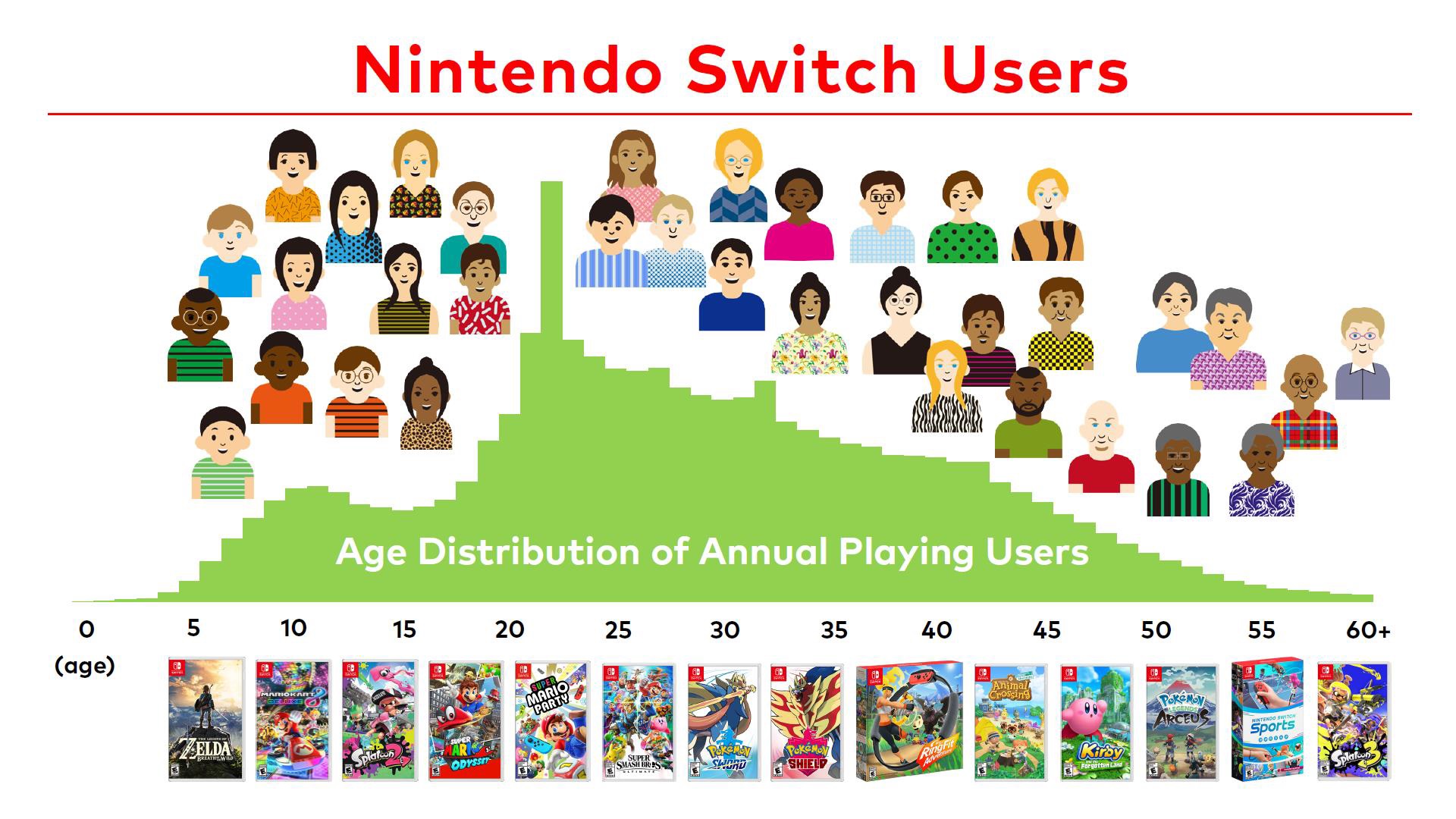
As you see from the graph, age 10 to 20 is still the most 'allergic' to Nintendo. Teenagers. 

Switch was seen as cool again, thanks to marketing, pretending its a console too, and already having a great library from the WiiU to start with. Open world Zelda helped a lot as well of course (34m sales)

Momentum creates success, lack of it failure. WiiU had a terrible start, confusing marketing (TV remote !?) and sales died. Switch the opposite, started with great momentum with one of the best launch line-ups ever, but more importantly combining the mobile and console market in one, to start with a much bigger snowball rolling downhill. 

Better description is Switch got gamers to buy into handhelds again like the DS, since Switch is matching DS sales. DS was on the market from 2004 to 2014, 3DS only sold half that, 3D seen as an expensive gimmick.

It's not that 2011 (3ds release) to 2017 gamers suddenly didn't like Nintendo, they didn't like the hardware. Plus parents had all bought into the Wii at the time, not jumping to get the 3ds for their kids. Wii's momentum also hurt 3ds' momentum, but mostly '3D' did.

Having the most desirable games still isn't enough to sell badly perceived / overpriced hardware. See PS3's launch. Momentum from a previous generation is no guarantee for future success. 

Yet in the end, it's the familiar games that keep Nintendo in business. The WiiU still had the games, just needed a more desirable system to cash in on them. MK8 went from 8.4 million (62% attach rate) on Wii-U to over 68 million (44% attach rate) on Switch. 

So indeed, games sell systems, but undesirable systems are a limiting factor. 


curl-6 said:
JackHandy said:

I am more than willing to have my mind changed, but I need something more compelling than that.

Basically, your premise is the system sells the game. Mine is the game sells the system. Case in point: if we're going to go with the idea that consoles sell games, then we're also going to go with the idea that something like fifty-million people were looking at Mario Kart 8 when it launched and thinking, Man... I would love to get that game, but that system... it's just so horrible. I personally have trouble buying into that logic. It's just too big a number; too big a leap.

Generations of people come and go. Attitudes change. During the PS2 era, every game Nintendo launched was considered kiddy and not taken seriously by the majority of the gaming community. Now, those same games are considered by younger generations who weren't around then to be utter masterpieces, which speaks directly to my point.

People changed.

Nintendo didn't.

That is exactly what happened though; Mario Kart 8 was a great game trapped on a console nobody wanted. It was like selling a delicious meal in a restaurant that's filthy and crawling with cockroaches in a shitty part of town, it doesn't mean people don't like the meal, they're just put off by the surrounding factors.

The alternative theory is that over 50 million people all magically changed their minds about Nintendo games overnight for no reason; this simply doesn't hold up to a moment of logical scrutiny.

If it was the audience's attitude that changed, then the change would have happened gradually over time. Instead it changed instantly, and the the fact this sudden change happened exactly when a desirable new Nintendo console came out shows that it was the Switch that caused the change.

You're all forgetting that the problem with the Wii U wasn't the games or the system, it was the marketing. If we asked the common folk what the Wii U was even as late as in 2017, they would have said it was a controller for the Wii, because the marketing was that bad. Really a shame, because the console was fantastic.


IcaroRibeiro said:
JackHandy said:

I am more than willing to have my mind changed, but I need something more compelling than that.

Basically, your premise is the system sells the game. Mine is the game sells the system

Hardware sells software too. For example, if you can only play portable because you spend a lot of time commuting doesn't matter if the best game ever released is in a stationary console, because your gaming habits needs a portable device

When I got my Switch before my PS4 was simply a matter of "which one I will play more?", because at that time I used to stay weekends in another house, and a portable device came really handy here

Switch inherited the audience of 3DS, I say that because I was a 3DS owner who didn't really care at all for Wii U. Switch was in part a continuation of the games I enjoyed in 3DS

I believe many people simply didn't have the money to buy 3DS, Wii U, Vita, Xbox One and PS4 at the same time (even if you bought all systems you might not have the money to keep regular purchases to all them), so choices were made. Vita bombed hard because people prefered 3DS, while Wii U bombed hard because people prered PS4 and Xbone

Now there is only a single Sony and Nintendo systems it's easier to have both (albeit I believe, at the expense of Xbox), so their sales don't cannibalize as hard as last gen 

I got on the 3DS late into the console's lifecycle because I really wanted to play Fire Emblem Fates and the game was unplayable on Citra at the time, and Pokémon RBY coming out in the VC only influenced even more my decision. I never owned a handheld before that. Both the games and piracy of a current gen system not working for me were what made me get the real deal to play what I wanted to play.

And both Vita and 3DS bombed because of price, but Nintendo quickly cut the price of the 3DS and invested heavily on supporting it with great games, while Sony just blamed phones for the sales and quickly stopped supporting the Vita. And as I mentioned above, Wii U failed mainly because the marketing should be a case study of what not to do in marketing courses.