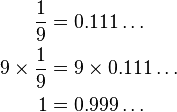
There are many reasons why I can say that .999... does not equal 1 and why every proof I've seen does not work.
If 0.999... is equal to 1, you acknowledge that you do not understand infinity because it is a concept, not a number. 0.999 and any number that "approaches" a value but never reaches it is infinite and is not an actual number.
You can always add another 9 to the list, yes. However, it never stops. It keeps going, but it never reaches 1 either.
I can disprove the geometric series argument, the 1/3 and the 9/9's argument. The geometric series argument is disproved by the fact that if you try representing the series visually, you can actually see that there will always be a space that is not taken up with each new set. In just pure math, that space will continue to get smaller and smaller, but will always exist as well.
Now for the 1/3 and 9/9's argument, you would have to redefine the way we count our decimals.
If we only counted to 2 before going to the next place, you can represent 1/3 as 0.1
If we only counted to 8 before going to the next place, you can represent 1/9 as 0.1
then 3/3 = 1 and 9/9 = 1.
With .999... as it is gathered from infinite series, for the first example it would be written as 0.222...
and for the second it would be written as 0.888...
Due to that fact, you can see why those arguments do not work. 0.999... will still be represented as an infinitely continuing decimal, no matter how you put it. Because it represents a concept of something that continually gets closer to 1 and never does.
I don't know how clearly I am presenting this, but I know that 0.999... does not equal 1.
It is also impossible to visualize 0.999... just as it is impossible for you to visualize infinity. It is as good as 1 in that regard, but in the end they are still different things.