By using this site, you agree to our Privacy Policy and our Terms of Use. Close

Forums - Gaming - Manufacture and shipping of physical games is "100 times more carbon-intensive" than digital, new study finds

curl-6 said:

Beaten to it, but yeah on a scale of "how much does this fuck the planet" physical copies of games barely registers at all compared to say AI, data centers, transportation, etc.

Giving up physical games to save the Earth would be like giving up sandwiches to lose weight while still drinking soft drinks and eating McDonalds every day.

A food analogy was also the first to come to my mind but a little different than yours.

It's like the futuristic idea of, "we should just take pills with all the vitamins we need, instead of eating food like we do now, because it would be so much more efficient that way, etc, etc."

Hmmm... how bout.... No.


PS1   - ! - We must build a console that can alert our enemies.

PS2  - @- We must build a console that offers online living room gaming.

PS3   - #- We must build a console that’s powerful, social, costs and does everything.

PS4   - $- We must build a console that’s affordable, charges for services, and pumps out exclusives.

PRO  -%-We must build a console that's VR ready, checkerboard upscales, and sells but a fraction of the money printer.

PS5   - ^ -We must build a console that’s a generational cross product, with RT lighting, and price hiking.

PRO  -&- We must build a console that Super Res upscales and continues the cost increases.

Around the Network

If I rephrase the quote, I'd go for: "physical media has a lower carbon footprint than driving your SUV to the store" or something.

Meanwhile, I left a window open in the other room overnight...


Yea? Soo?


Regardless, physical is on its way out. Only we online forum boomers still care about it somewhat.


haxxiy said:

Regardless, physical is on its way out. Only we online forum boomers still care about it somewhat.

"Gen Z are the leading consumers of vinyl, drawn to it for the experience of collecting and listening to physical media as an escape from the digital world."

Physical will shrink further but won't disappear. 


Anyway gaming is still one of the lowest carbon footprint 'activities' compared to driving anywhere for sports / hiking etc. Also still one of the cheapest forms of entertainment. 

I love mountain biking, have a $4K full suspension bike ordered for next year and drive 40 km to get to fun and challenging trails. 
Favorites are https://www.thehydrocut.ca/ https://www.tpmbc.com/
The carbon footprint of a mountain bike primarily comes from its manufacturing, with a typical range of 120 kg to 250 kg CO2e (more for E-Bikes)

Before getting back into mountain biking I did a lot of road cycling. Over $1K a year in maintenaince plus the waste of bi-yearly new tires, parts like new chain / brake pads etc, oil, patch kits, and extra food consumed ;)
The carbon footprint of a single bicycle tire is estimated to be between 4 and 8 kg CO2e,

Even regularly running from home costs several pairs of running shoes a year...
The carbon footprint of a pair of running shoes typically ranges from 10.5 to 25 kg CO2e (carbon dioxide equivalent), with an average of about 14 to 17.75 kg CO2e.
(About 51 physical games)

Save the planet, stay in bed...


Humans just need to learn how to live sustainably. Ditching physical games for digital isn't a solution.

Oh and if you have the AC on to keep your room cool while gaming:

In 2022, cooling was responsible for an estimated 1 billion tonnes of CO2 from electricity and an additional 720 million tonnes of CO2 equivalent from HFC leaks, representing about 3.2% of total global greenhouse gas emissions. 

That's probably up as well as summers only get hotter.

Now winter is coming again:

In places like Canada, natural gas is the largest source of residential heating emissions, with one home using a gas furnace emitting about two tonnes of CO2 per year. (about 6,400 physical games worth a year)

A PS5 or Desktop works as a space heater as well ;)


Around the Network

I'd love to know the carbon footprint and total waste generation of the servers needed to store the digital games on the digital shops of each videogame producer. Specially considering that those servers are online and consuming energy 24/7 365 days a year, while my physical copies, once manufactured, don't generate emissions and can last decades (my NES games are 40 years old already, and still working perfectly...).


SvennoJ said:

"Gen Z are the leading consumers of vinyl, drawn to it for the experience of collecting and listening to physical media as an escape from the digital world."

Physical will shrink further but won't disappear. 

That's still a shrinking potential market vs. older generations, though. I dare say it could be more monetized among younger cohorts only because radio is more prevalent among the old.
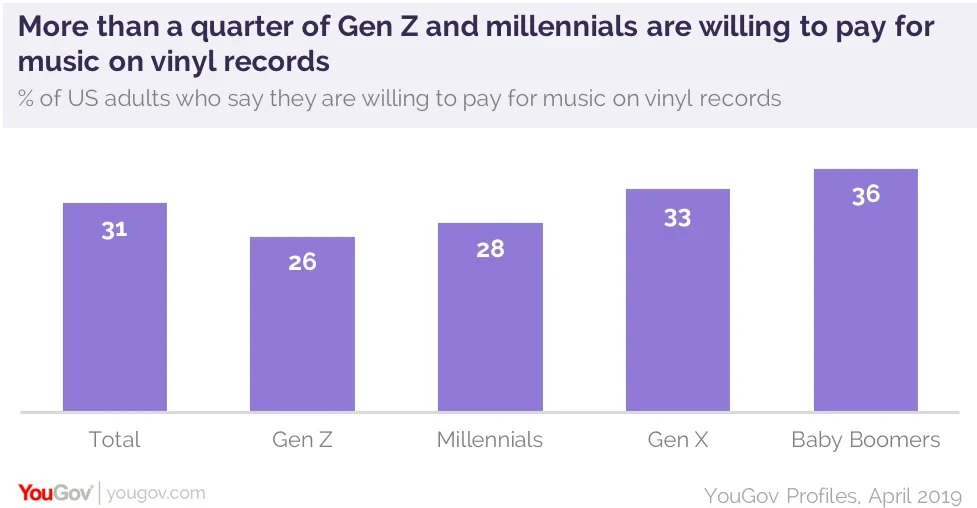
I wouldn't be surprised if Gen Alpha and beyond are even less willing to engage with physical, as their very definitions of 'retro' are different.


SvennoJ said:
Cerebralbore101 said:

https://www.gamesindustry.biz/manufacture-and-shipping-of-physical-games-is-100-times-more-carbon-intensive-than-digital-new-study-finds

It takes 312 grams of carbon to make a physical disc, according to this article and math. Your typical SUV makes 4.6 (4.6 million grams) metric tons of carbon every single year, according to the U.S. Environmental Protection Agency. So according to math it takes 14,743 discs to equal driving an SUV for one year. In other words buying physical game discs contributes absolutely nothing to global warming compared to driving an SUV everyday. 

The above article is a prime example of trying to blame consumers for pollution when in truth it is done by billion dollar corporations. Read this article about how carbon footprints were invented by BP to shift blame onto consumers. https://countercurrents.org/2021/06/the-fallacy-of-our-carbon-footprint/

Oh! And best of all, it has the added benefit of acting as pro-digital-only propaganda. A single PS5 disc and case takes up 0.0122 cubic feet of space. I own thousands of physical games and would STILL need to fill

EVERY

SINGLE

SQUARE FOOT

of my apartment with PS5 game discs to pollute 87% as much pollution as a single SUV does in a year. 

Carbon footprint of streaming is 55 grams per hour, playing that game for 6 hours is a lower carbon footprint than watching / playing streamed content.

Lol the article admits it as well
"As a whole, physical video games may still be less carbon intensive than their digital counterparts – but their ultimate impact should not be underestimated."


Yep, it's just deflection, whataboutism while AI and crypto carbon footprints are magnitudes worse, mostly from electricity use.

If you want to be a 'green' gamer, buy a Switch, don't stream, don't play online, unplug when not in use. And still it won't make any difference compared to a daily commute to an air conditioned office.


And if you're concerned about discs ending up in landfills:

Since it was just last week

Halloween contributes to a significant carbon footprint due to disposable costumes and decorations, excessive candy wrappers, and decaying pumpkins in landfills. The production and disposal of single-use items create waste and emissions, while decomposing pumpkins release methane, a powerful greenhouse gas.

https://www.dal.ca/news/2024/10/31/halloween-environment-tips-expert.html

But there’s a growing awareness around the holiday’s environmental impact. From the mountains of pumpkin waste (about 1 billion pounds ending up in landfills each year in the U.S.) to the millions of kilograms of textile waste generated by costumes, Halloween’s fun comes at a significant cost to the planet.

You know what else releases methane, tons and tons and tons of it? Cattle farms. Made for you, meat eaters. Your dietary choice matters.


haxxiy said:
SvennoJ said:

"Gen Z are the leading consumers of vinyl, drawn to it for the experience of collecting and listening to physical media as an escape from the digital world."

Physical will shrink further but won't disappear. 

That's still a shrinking potential market vs. older generations, though. I dare say it could be more monetized among younger cohorts only because radio is more prevalent among the old.

I wouldn't be surprised if Gen Alpha and beyond are even less willing to engage with physical, as their very definitions of 'retro' are different.

It's 6 years later now, new data suggests otherwise:

https://www.musicweek.com/labels/read/vinyl-alliance-says-gen-z-is-now-the-driving-force-behind-the-format-s-popularity/091294

The proportion of people listening to physical music (vinyl, cassette and CDs) is greatest amongst those aged 18 to 24, based on research by Key Production. 

A new report from the Vinyl Alliance has explored why Gen-Z is embracing the format – including integrating it into their digital lives.

The survey of more than 2,500 vinyl fans worldwide found that over a quarter (76%) of Gen-Z vinyl fans buy records at least once a month, with eight in 10 (80%) owning a record player. 

With nearly 30% declaring themselves as a ‘die-hard collector’, the report says Gen-Z vinyl fans are committed to regularly buying records and actively listening to them – rather than to keep just as collectible items.

Unlike Millennials or Gen-X, Gen-Z were born and raised during vinyl’s mainstream downturn during the mid-2000s (in favour of CDs, MP3 and streaming). The Vinyl Alliance says Gen-Z has adopted the format, giving a new meaning to vinyl culture. Gen-Z is the first ‘digital native’ generation to use social media to further their interest in records, collecting, set-ups and more.

The report shows half (50%) of the respondents collect vinyl as it provides a break from digital life, more than both Millennials (49%) and Gen-X (34%). Gen-Z is more likely (61%) than Millennials (53%) and Gen-X (27%) to replace digital habits with vinyl listening to improve their mental well-being. 


For the spirit of this thread:

The carbon footprint of music streaming is significant on a global scale due to energy consumption by data centers, internet infrastructure, and user devices, even though per-hour emissions are lower than physical formats like vinyl or CDs. The impact comes from the massive volume of streaming data and the energy needed for powering and cooling servers, transmitting data, and running end-user devices.

An hour of streaming produces approximately 55g of emissions. This is significantly lower than the emissions for physical formats:

A CD produces around 172g of CO2e.
A vinyl record produces about 2.2kg of CO2, The carbon footprint of one vinyl record is roughly equivalent to streaming about 40 hours of music.

Although streaming has a lower per-unit footprint, the sheer volume of global streaming adds up. In 2021, Spotify's total CO2 emissions from end usage and cloud storage alone were over 70,000 tons. When considering all streaming services globally, the total emissions are substantial, highlighting the environmental impact of this convenience 

    And the cool thing about Vinyl is, you don't even need electricity to listen to them. Battery powered, still works when the power goes out ;) (Or one of those old time wind up ones with a big horn lol)

    I'm sticking to CDs though as I mostly listen to music while driving.


    Edit: Looked fine in Edit mode, not sure why it turned into a huge mess after posting :p

    Last edited by SvennoJ - on 06 November 2025

    SvennoJ said:
    haxxiy said:

    That's still a shrinking potential market vs. older generations, though. I dare say it could be more monetized among younger cohorts only because radio is more prevalent among the old.

    I wouldn't be surprised if Gen Alpha and beyond are even less willing to engage with physical, as their very definitions of 'retro' are different.

    It's 6 years later now, new data suggests otherwise:

    https://www.musicweek.com/labels/read/vinyl-alliance-says-gen-z-is-now-the-driving-force-behind-the-format-s-popularity/091294

    The proportion of people listening to physical music (vinyl, cassette and CDs) is greatest amongst those aged 18 to 24, based on research by Key Production. 

    A new report from the Vinyl Alliance has explored why Gen-Z is embracing the format – including integrating it into their digital lives.

    The survey of more than 2,500 vinyl fans worldwide found that over a quarter (76%) of Gen-Z vinyl fans buy records at least once a month, with eight in 10 (80%) owning a record player. 

    With nearly 30% declaring themselves as a ‘die-hard collector’, the report says Gen-Z vinyl fans are committed to regularly buying records and actively listening to them – rather than to keep just as collectible items.

    Unlike Millennials or Gen-X, Gen-Z were born and raised during vinyl’s mainstream downturn during the mid-2000s (in favour of CDs, MP3 and streaming). The Vinyl Alliance says Gen-Z has adopted the format, giving a new meaning to vinyl culture. Gen-Z is the first ‘digital native’ generation to use social media to further their interest in records, collecting, set-ups and more.

    The report shows half (50%) of the respondents collect vinyl as it provides a break from digital life, more than both Millennials (49%) and Gen-X (34%). Gen-Z is more likely (61%) than Millennials (53%) and Gen-X (27%) to replace digital habits with vinyl listening to improve their mental well-being. 


    For the spirit of this thread:

    The carbon footprint of music streaming is significant on a global scale due to energy consumption by data centers, internet infrastructure, and user devices, even though per-hour emissions are lower than physical formats like vinyl or CDs. The impact comes from the massive volume of streaming data and the energy needed for powering and cooling servers, transmitting data, and running end-user devices.

    • An hour of streaming produces approximately
      5555
      55
      g of emissions.
    • This is significantly lower than the emissions for physical formats:
      • A CD produces around
        172172
        172
        g of
        CO2cap C cap O sub 2
        𝐶𝑂2
        .
      • A vinyl record produces about $2.2kg of
        CO2cap C cap O sub 2
        𝐶𝑂2
        .
      • The carbon footprint of one vinyl record is roughly equivalent to streaming about 40 hours of music.
    • Although streaming has a lower per-unit footprint, the sheer volume of global streaming adds up.
    • In 2021, Spotify's total
      CO2cap C cap O sub 2
      𝐶𝑂2
      emissions from end usage and cloud storage alone were over 70,000 tons.
    • When considering all streaming services globally, the total emissions are substantial, highlighting the environmental impact of this convenience


    And the cool thing about Vinyl is, you don't even need electricity to listen to them. Battery powered, still works when the power goes out ;) (Or one of those old time wind up ones with a big horn lol)

    I'm sticking to CDs though as I mostly listen to music while driving.

    I'm so thankful you are in this thread. Always funny to see someone that spends a lot of time on a subject absolutely demolish BS related to that subject.