



By using this site, you agree to our Privacy Policy and our Terms of Use. Close

Forums - Gaming - Prediction - PS3-PS4 and X360-XOne last big performance spec leap

thismeintiel said:
Bofferbrauer2 said:

No offense, but those specs for a hypotetical PS5 are bullshit

1. 15 TFlops will be very hard to cool in a console, even in 7nm. But more to the point is the size of the necessary Graphics chip, which even in 7nm would be quite a lot bigger than the ones in PS4 Pro and XOX. This would make it very expensive to produce - too expensive for a console.

2. 28 GB is in Computer terms a very odd number and would need a very wierd connection (like 224bit compared to the more even 192bit or 256bit). Additionally this would be very expensive even if the RAM prices would normalize again. Finally, it's just too much for a console, 16Gbyte it will most probably be, possibly 24 if we're really lucky, but not 28.

3. Ryzen 12core (and probably 24 threads) are way too much. Most game engines can't handle more than 4 threads efficiently, 6-8 threads is the limit. The problem is not that there's no wish to use more threads, but to actually being able to parallelise the workload enough to fill them all. Also, again, too big of a chip for a console, half of it would be much better.

The problem stems from willing to compare Desktop PC hardware to console hardware. But since Consoles are much more limited in cooling, consumption, part size and price range, it's actually much closer to look at the mobile market, more specifically gaming laptops, especially those considered desktop replacements.

Just for comparision, the PS4 Graphics part has 1.8 TFlops. At the same time the 7970M was out for gaming Laptops and had 2.1 TFlops. PS4 Pro: 4.2 TFlops, R9 395M: 3.7 TFlops (the RX 485M is clocked much lower (almost 200Mhz)  than it's predecessor to limit consumption and thus actually has less power, would it have had the same clock speed it would have been more or less as fast as the Pro)

I definitely agree with 2 and 3. The PS5 is more than likely to get 16GB of GDDR6 RAM, with possibly 1-2 GB of DDR3/4 dedicated to the OS.  And I'm thinking Sony will go with a 8 core Ryzen APU.  That's going to be a big leap over the Jaguar, and probably help them achieve B/C with the PS4 much easier.  

Where I disagree is 1.  While I believe 12-12.5 Tflops is more likely, 15 isn't out of the question.  I think the purpose of the Pro was twofold.  One was to take advantage of a budding 4K market.  But, the 2nd one was to allow their engineers to experiment in making a console that needed better cooling and had a larger power draw.  I think they are more than capable of putting a 12 Tflops, and even a 15Tflops, GPU in something the size of the Pro.

Keep in mind that to reach 12.5 TFlops, the RX Vega 64 has to be running at top speed of 1550Mhz - which it can't keep on most Graphics cards without throttling to not exceed it's power draw target of 295W. A console graphics chip needs to run at clock speeds much closer to it's sweet spot, which in Vegas case is in the 1100-1200Mhz range, at which point it's doing less than 10 TFlops. So in order to achieve 15 TFlops the chip would need to become both bigger (expensive) and have it's sweet spot at much higher clock speeds. Unless they can reach that while consuming less than 150W, which is half of what it consumes right now, 15 TFlops won't be possible. Considering that Polaris didn't manage to half the consumption of Hawaii for the same calculation speed while being 2 GCN Architectures and a jump from 28 to 14nm ahead, I have a hard time believing this to happen.

The 12TFlops you're expecting are far more manageable, hence why I'm expecting about as much. In any case, due to diminishing returns however, the visible difference between Pro and 5 will be pretty small in most cases


Around the Network

If Sony and Microsoft go Nvidia (Volta GPU or better) that would wreck the base PS4 and Xbox One by some margin.


Bofferbrauer2 said:

Keep in mind that to reach 12.5 TFlops, the RX Vega 64 has to be running at top speed of 1550Mhz - which it can't keep on most Graphics cards without throttling to not exceed it's power draw target of 295W. A console graphics chip needs to run at clock speeds much closer to it's sweet spot, which in Vegas case is in the 1100-1200Mhz range, at which point it's doing less than 10 TFlops. So in order to achieve 15 TFlops the chip would need to become both bigger (expensive) and have it's sweet spot at much higher clock speeds. Unless they can reach that while consuming less than 150W, which is half of what it consumes right now, 15 TFlops won't be possible. Considering that Polaris didn't manage to half the consumption of Hawaii for the same calculation speed while being 2 GCN Architectures and a jump from 28 to 14nm ahead, I have a hard time believing this to happen.

The 12TFlops you're expecting are far more manageable, hence why I'm expecting about as much. In any case, due to diminishing returns however, the visible difference between Pro and 5 will be pretty small in most cases

RX Vega 64 only has a die size of 486mm^2@14nm and PS4 Pro APU has a die size of ~348mm^2@16nm so 15 TFlops is very possible with 7nm (even better, 5nm will probably be ready for next gen consoles) and EUV ... 


thismeintiel said:

I definitely agree with 2 and 3. The PS5 is more than likely to get 16GB of GDDR6 RAM, with possibly 1-2 GB of DDR3/4 dedicated to the OS.  And I'm thinking Sony will go with a 8 core Ryzen APU.  That's going to be a big leap over the Jaguar, and probably help them achieve B/C with the PS4 much easier.  

Where I disagree is 1.  While I believe 12-12.5 Tflops is more likely, 15 isn't out of the question.  I think the purpose of the Pro was twofold.  One was to take advantage of a budding 4K market.  But, the 2nd one was to allow their engineers to experiment in making a console that needed better cooling and had a larger power draw.  I think they are more than capable of putting a 12 Tflops, and even a 15Tflops, GPU in something the size of the Pro.

For every node shrink, its safe to expect in doubling in processing power. This is assuming that the general architecture remains the same.

PS4 shrinking from 28nm to 14/16nm... basically reesulted in 2 times the GPU and the ability to run the CPU and GPU at a slightly higher clock. 

Now if we take the PS4pro as a base and shrink from 14nm to 7nm, we basically will be going from 36 GPU cores to 72 cores. Coupled with running that at a higher clock than what we have in the PS4pro currently, we realistically will have anywhere between 10TF-12TF. But thats a straight swap.... without doubt there will be various optimizations or improvements in the chip design so that could very well be as much as 12.5 to 13.5TF when its all said and done.

But as I said earlier, there is a lot more to a generational jump than just having a beefier CPU and GPU.

Memory is very important. Particularly HBM. 16GB of HBM with a with bandwiths as high as 512GB/s would be a very big deal in a console. And I also believe that the next gen consoles will come with two seperate memory pools. 16GB of HBM for the games and 4GB of LPDDR4 for the OS (yes the same kinda ram used in smartphones today).

Then we have the the hard drive, having the consoles natively support and ship with m.2 SSDs will totally change how gme engines are designed.

Next gen isn't gong to be about resolution as this gen has been..... its going to be about everything else.


Hopefully future hardware features more balanced CPU/GPU combinations, current gen systems feel somewhat held back by their feeble CPUs in my opinion.


Around the Network
hinch said:

If Sony and Microsoft go Nvidia (Volta GPU or better) that would wreck the base PS4 and Xbox One by some margin.

Discrete GPU? What CPU will they be using?


Bofferbrauer2 said:

2. 28 GB is in Computer terms a very odd number and would need a very wierd connection (like 224bit compared to the more even 192bit or 256bit). Additionally this would be very expensive even if the RAM prices would normalize again. Finally, it's just too much for a console, 16Gbyte it will most probably be, possibly 24 if we're really lucky, but not 28.

The Playstation 4 actually has 256MB of DDR3 in conjunction with the 8GB of GDDR5, the Pro took the DDR3 memory pool to 1GB.
Which is what I think he was alluding to... 24GB of main memory (384bit bus like Scorpio...) And 4GB for background tasks/OS and the like.

So they would both have their own buses.

fatslob-:O said:

Higher resolution textures do have an advantage but there would be less need for them if we had a good LOD system or texture stitching system in place ...

Even games like Mario Kart DS, which had a screen resolution of 256×192 used textures for landscapes and such that were 1024x1024 pixels.

fatslob-:O said:

Higher resolution textures do have an advantage but there would be less need for them if we had a good LOD system or texture stitching system in place ... 

DCC only helps wih framebuffer compression. You can compress normal maps with texture compression. Lightmaps are a bad idea going into the future of global illumination and shadow map compression is not a realistic idea ... 


Delta Colour Compression does reduce bandwidth demands though, which means there is more room for say... Texturing.

Correct you can compress normal maps with texture compression, depending on compression algorithm of course, not all texture compression schemes do compress normal maps.

Lightmaps are probably going to stay for the immediate future.

Shadow map compression is already happening in 3dc+

fatslob-:O said:

Both are currently bad ideas ... 

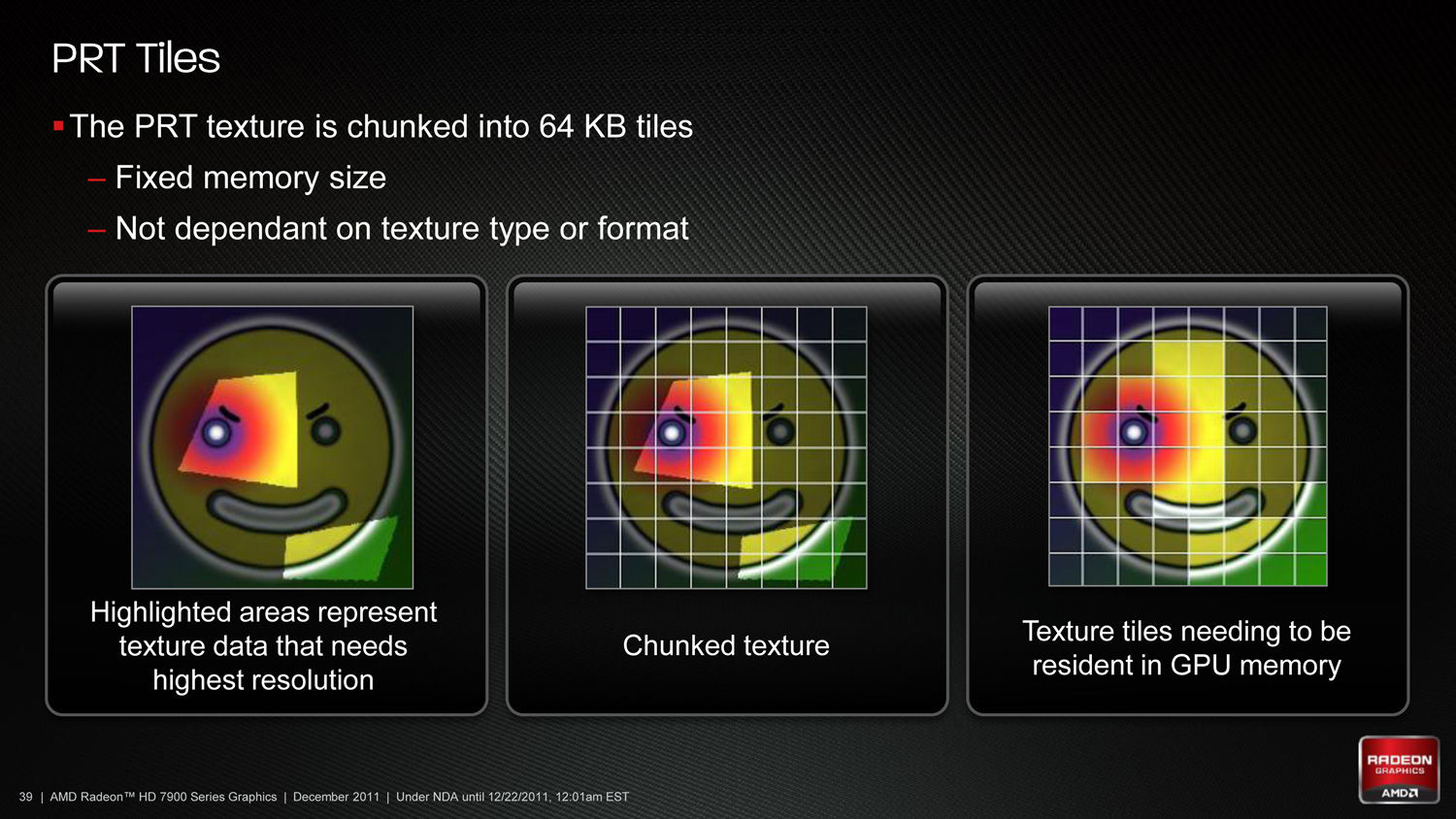
With megatextures you you have to manually do texture filtering in the pixel shader and that can get expensive if you include aniotropic filtering and with PRTs you're stalling a lot ... 

Well. There are caveats like with any technology.
AMD does have hardware support for Partially Resident Textures and the concept is sound.


Even the latest doom game used Partially Resident Textures... And that game not only looked fantastic... But it ran silky smooth even on average hardware.

hinch said:

If Sony and Microsoft go Nvidia (Volta GPU or better) that would wreck the base PS4 and Xbox One by some margin.


nVidia is unlikely ever to happen again.

Intrinsic said:

Memory is very important. Particularly HBM. 16GB of HBM with a with bandwiths as high as 512GB/s would be a very big deal in a console. And I also believe that the next gen consoles will come with two seperate memory pools. 16GB of HBM for the games and 4GB of LPDDR4 for the OS (yes the same kinda ram used in smartphones today).

Do you undestand how many stacks of HBM would be required to achieve 16GB? And how much bandwidth it would actually offer? ;)

GDDR6 though is likely going to be the memory technology of choice for next-gen consoles... People always get crazy ideas of what technology is going to end up in the next gen (Like people claiming NX was going to be faster than the PS4 Pro or Scorpio was going to have Ryzen) and are often incorrect. Why? Cost. Or their lack of knowledge about costs.
GDDR6 is cheaper than HBM and will likely be the memory of choice.


www.youtube.com/@Pemalite

fatslob-:O said:
Bofferbrauer2 said:

Keep in mind that to reach 12.5 TFlops, the RX Vega 64 has to be running at top speed of 1550Mhz - which it can't keep on most Graphics cards without throttling to not exceed it's power draw target of 295W. A console graphics chip needs to run at clock speeds much closer to it's sweet spot, which in Vegas case is in the 1100-1200Mhz range, at which point it's doing less than 10 TFlops. So in order to achieve 15 TFlops the chip would need to become both bigger (expensive) and have it's sweet spot at much higher clock speeds. Unless they can reach that while consuming less than 150W, which is half of what it consumes right now, 15 TFlops won't be possible. Considering that Polaris didn't manage to half the consumption of Hawaii for the same calculation speed while being 2 GCN Architectures and a jump from 28 to 14nm ahead, I have a hard time believing this to happen.

The 12TFlops you're expecting are far more manageable, hence why I'm expecting about as much. In any case, due to diminishing returns however, the visible difference between Pro and 5 will be pretty small in most cases

RX Vega 64 only has a die size of 486mm^2@14nm and PS4 Pro APU has a die size of ~348mm^2@16nm so 15 TFlops is very possible with 7nm (even better, 5nm will probably be ready for next gen consoles) and EUV ... 

Don't forget the PS4 Pro APU includes the CPU, and the Jaguar CPU is very small. A Ryzen-based CPU part would be much bigger even with just half the cores

5nm will be problematic unless the PS4 releases 2021 earliest. While 5nm will probably start production in 2019-2020, the yield rates will be atrocious at first, so not really financially viable. As for EUV, well it's initial investment will be enormous and somehow the fab has to make that money back, which means more expensive wafers and thus more expensive chips. It's actually the main reason by now EUV hasn't been implemented yet, the technical difficulties have been largely solved now.

In any case, TDP will be a problem with Vega, maybe Navi can change that, but I doubt it personally


The spec leaps will always continue to slowly decrease until some kind of new tech is available other than silicon. They are worthwhile however, based on the newest available tech at that point in time, for a reasonable price. This is another reason for the mid gen refreshes. Getting customers used to this now and not expecting huge increases like before, are necessary for the hardware gaming companies going forward.

Just look at the performance leaps and launch gaps based on approximate performance of PS consoles.
PS1 0.2Gflops, PS2 6.0Gflops, PS3 225Gflops, PS4 1850Gflops, which leaves you with:
PS1-PS2=30X (5 yrs NA)
PS2-PS3=38X (6 yrs NA)
PS3-PS4=08X (7 yrs NA)

PS3 should never have been as powerful and expensive as it ended up being at launch. It should have been closer to 125Gflops and $400, which would make more sense based on console hardware history. Apply that and:
PS1-PS2=30X (5 yrs NA)
PS2-PS3=21X (6 yrs NA)
PS3-PS4=15X (7 yrs NA)

The next theoretical jump from PS4 to PS5, based on this more reasonable "125Gflop PS3", should put
PS4-PS5=11X (20350Gflops) with an 8 year gap and launch date of 2021.

If PS were to actually try for a 2021 PS5 launch, 4 years from now, with solid 7nm and possibly 5nm in production, on top of new CPU/GPU/APU advancements, a 20Tflop PS5 console just may be possible. Whether it can hit $400 is another story. It may end up $500, but by then with inflation, that may not seem too much, considering we've already seen a 2013 and 2017 XB console launch at $500.

Whether PS wants to try and ride Pro out until 2021, or launch a "PS4k" to bridge the gap between Pro and PS5, or flat out launch PS5 earlier around 2019/2020 and just deal with an even smaller performance leap once again, we can only speculate. Based solely on the numbers though, if PS were to follow "what PS3 should have been", they would most likely be able continue the same hardware trend they have been since PS1.

The more I think about it, based on the locomotive of greatness that is the PS4, I'm starting to think a 2019 E3, PS4k reveal/launch at $400, with a 9Tflop performance spec is quite possible (based on 7nm and PS4 tech). Then launch the PS5 (20Tflop) with new tech, late 2021 for $500, or 2022 for $400. XB1X should be able to last another 4 years, so a 2021 PS5 just seems to make more and more sense.


PS1   - ! - We must build a console that can alert our enemies.

PS2  - @- We must build a console that offers online living room gaming.

PS3   - #- We must build a console that’s powerful, social, costs and does everything.

PS4   - $- We must build a console that’s affordable, charges for services, and pumps out exclusives.

PRO  -%-We must build a console that's VR ready, checkerboard upscales, and sells but a fraction of the money printer.

PS5   - ^ -We must build a console that’s a generational cross product, with RT lighting, and price hiking.

PRO  -&- We must build a console that Super Res upscales and continues the cost increases.

EricHiggin said:

PS3 should never have been as powerful and expensive as it ended up being at launch. It should have been closer to 125Gflops and $400, which would make more sense based on console hardware history.

The PS3 as is was very close in power to the 360 despite launching a year later.