By using this site, you agree to our Privacy Policy and our Terms of Use. Close

Forums - Nintendo - Does anybody know the wiis max polygon performance?

shams said:
The Wii has a quite different memory layout as well.

The 1T-SRAM that the Wii uses internally is lightning fast, has no delays - and has a significant bus route to the VRAM. I think program code + textures (guess) reside in this part of memory. Its biggest advantage is high memory density, and very low power consumption (using 1 "transistor" instead of 6 - in normal SRAM).

It also has a 3MB VRAM/texture cache - no idea if system memory (the 1T-SRAM) can be used as a substitute for VRAM in any form). This small VRAM is my biggest criticism of the design - give it 8MB or 16MB, and its a much more versatile and powerful device.

The VRAM is embedded within the GPU (internal memory), while I believe the 1T-SRAM is embedded within the CPU (may be wrong here - Wiki says GPU?) - making it very fast and small to manufacture.

It also has a "normal" 64MB of external memory (much slower, wait states, etc..) that can be used as a cache, sound, game data and so on.

As always, Wikipedia is a great place for info:

Wii specs:
http://en.wikipedia.org/wiki/Wii#Technical_specifications

GC specs (Wii definitely based around):
http://en.wikipedia.org/wiki/Nintendo_GameCube#Central_processing_unit

...etc...

Other things to consider are that the die size of the Hollywood and Broadway is half the die size of the Flipper and Gekko even though the move from the 180nm process to the 90nm process should have quartered the processors; this implies that the Hollywood and Broadway have (roughly) twice as many transistors as the Filpper and Gekko.

The most likely improvements to the Broadway processor is a larger level 2 cache, a faster bus, and the addition of a few specialized instructions; this would result in far fewer cache misses, less of a performance hit from a cache miss, and generally a much more efficient processor.

Personally, I believe that Nintendo doubled the number of pixel pipelines on the Hollywood processor moving to 8 pixel piplines with 1 texture unit each, and improved the TEV unit; this would have (combined with the clock speed increase) trippled the pixel and texel performance, and would have boosted the Wii's ability to do texture and lighting effects.


Regardless of whether people agree with my analysis or not, the most telling thing about how well the Wii performs is that it has games which look as nice (or better) than many Gamecube games that were struggling at 30fps while the Wii games are locked at 60fps. If you took a company which really understood the design of the Gamecube/Wii (like Factor 5), that wanted to push the Wii as hard as they could at 30fps, they would be able to produce something fairly impressive.



Around the Network
shams said:
The Wii has a quite different memory layout as well.

The 1T-SRAM that the Wii uses internally is lightning fast, has no delays - and has a significant bus route to the VRAM. I think program code + textures (guess) reside in this part of memory. Its biggest advantage is high memory density, and very low power consumption (using 1 "transistor" instead of 6 - in normal SRAM).

It also has a 3MB VRAM/texture cache - no idea if system memory (the 1T-SRAM) can be used as a substitute for VRAM in any form). This small VRAM is my biggest criticism of the design - give it 8MB or 16MB, and its a much more versatile and powerful device.

The VRAM is embedded within the GPU (internal memory), while I believe the 1T-SRAM is embedded within the CPU (may be wrong here - Wiki says GPU?) - making it very fast and small to manufacture.

It also has a "normal" 64MB of external memory (much slower, wait states, etc..) that can be used as a cache, sound, game data and so on.

As always, Wikipedia is a great place for info:

Wii specs:
http://en.wikipedia.org/wiki/Wii#Technical_specifications

GC specs (Wii definitely based around):
http://en.wikipedia.org/wiki/Nintendo_GameCube#Central_processing_unit

...etc...

 The wii also has gddr3 external ram. I have specs for it just not detailed past clock speeds and ram types.


RolStoppable said:

Satoru Iwata said:

"I suppose I could give you a list of the technical specs. I believe you would like that, but I won't for a simple reason; they really don't matter. The time when horsepower alone made an important difference is over."

And that's the reason why you won't find official specs and/or performance numbers for the Wii anywhere.


 Quote for truth


 “In the entertainment business, there are only heaven and hell, and nothing in between and as soon as our customers bore of our products, we will crash.”  Hiroshi Yamauchi

TAG:  Like a Yamauchi pimp slap delivered by Il Maelstrom; serving it up with style.

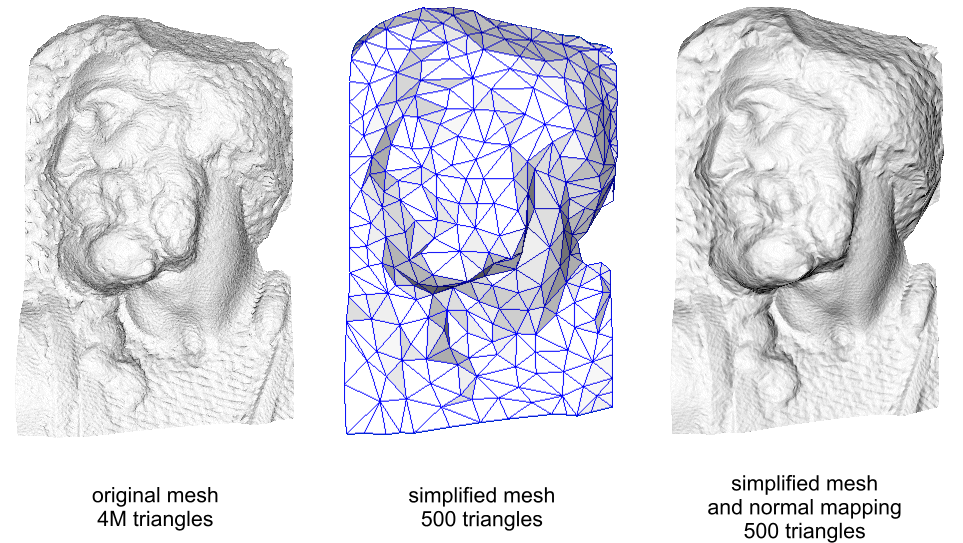
Some people here have mentioned normal mapping and how it helps to create great graphics without increasing the number of polygons. I just found this sample image which shows the power of that technique. The image on the left was rendered with 4 million polygons (without normal mapping), and the one on the right was rendered with 500 polygons only, using normal mapping.

The picture with fewer polygons actually looks better than the other one, even though it has 0.0125% of the number of polygons. Hopefully, this will help you put those benchmarks into perspective. Raw numbers are almost meaningless in terms of graphical power, especially when they're taken in isolation.



My Mario Kart Wii friend code: 2707-1866-0957

Nice picture.

In SMG normal mapping is evident in Bowser's rough Skin...


 “In the entertainment business, there are only heaven and hell, and nothing in between and as soon as our customers bore of our products, we will crash.”  Hiroshi Yamauchi

TAG:  Like a Yamauchi pimp slap delivered by Il Maelstrom; serving it up with style.

Around the Network

Good example, games nowadays seem to look as good as developers are willing to work for, SMG looked better then some of the 360 games I played, just the style mapping and everything put together just put some of the 360 titles to shame, theres no way for the Wii to truly beat 360 graphically, but it's got the power to keep on the heels of the stronger consoles if the developers put forth the effort.


MaxwellGT2000 - "Does the amount of times you beat it count towards how hardcore you are?"

Wii Friend Code - 5882 9717 7391 0918 (PM me if you add me), PSN - MaxwellGT2000, XBL - BlkKniteCecil, MaxwellGT2000

blaydcor said:
Specs are usually nonsense; RE4 had far beyond the GC's maximum polygon count, for example

 Rogue Squadron 2 surpassed the GC's "maximum" polygon count and it was launch title. RS2 pushed 13.2 million polys at 60fps with all effects enabled. RS3 pushed 20 million at 60fps with all effect enabled. No X-box title pushed more polygons than RS2 btw. Well there was Ralli racing game, Rallsport Challenge? That pushed the same number of polys as RS2 but it only did so at 30fps. In fact Lucasarts was going to port RS2 and RS3 to X-box but Factor 5 couldn't get it up and running on. Both the X-box and GC had advantages over each other, the biggest advantage for the GC was the ability of it to twice the lights and texture layers on a single pass as the X-box.


well i heard the wii weren't 729MHz, those were early dev kits specs, I saw it well documented that Wii had 1.1GHz...


Why not add me on msn... ish_187@hotmail.co.uk

- - - > ¤ « ~ N i n t e n d o ~ » ¤ < - - -
Games purchased since December 30th 2006:
GBA:The Legend of Zelda:The Minish Cap
DS:Lunar Knights, Pokemon Diamond, The Legend of Zelda: Phantom Hourglass ,Call of Duty 4: Modern Warfare, Hotel Dusk:Room 215, Mario vs DK 2: March of the Mini's and Picross DS
PS2: Devil May Cry 3:Dante's Awakening, Shadow of the Colosuss, Sega Mega Drive Collection, XIII , Sonic Mega Collection,Fifa 08 and Fifa 09.
GC:Fight Night Round 2
Wii VC:Super Mario 64 ,Lylat Wars ,Donkey Kong Country 2: Diddy's Kong Quest, Super Castlevania IV, Sonic the Hedgehog 2, Streets of Rage, Kirby's Adventure, Super Metroid, Super Mario Bros. 3, Mega Man 2Street Fighter 2 Turbo: Hyper Fighting,Wave Race 64 and Lost Winds

Wii: Sonic and the Secret Rings, Godfather:Blackhand Edition, Red Steel, Tony Hawks Downhill Jam, Eledees, Rayman Raving Rabbids, Mario Strikers Charged Football,Metroid Prime 3: Corruption, Super Mario Galaxy,House of the Dead 2 and 3 Return, Wii Fit, No More Heroes and Super Smash Bros. Brawl.

X360: Spider Man
PS3:
Resistance: Fall of Man


shams said:
The Wii has a quite different memory layout as well.

1) The 1T-SRAM that the Wii uses internally is lightning fast, has no delays - and has a significant bus route to the VRAM. I think program code + textures (guess) reside in this part of memory. Its biggest advantage is high memory density, and very low power consumption (using 1 "transistor" instead of 6 - in normal SRAM).

2) It also has a 3MB VRAM/texture cache - no idea if system memory (the 1T-SRAM) can be used as a substitute for VRAM in any form). This small VRAM is my biggest criticism of the design - give it 8MB or 16MB, and its a much more versatile and powerful device.

3) The VRAM is embedded within the GPU (internal memory), while I believe the 1T-SRAM is embedded within the CPU (may be wrong here - Wiki says GPU?) - making it very fast and small to manufacture.

4) It also has a "normal" 64MB of external memory (much slower, wait states, etc..) that can be used as a cache, sound, game data and so on.

As always, Wikipedia is a great place for info:

Wii specs:
http://en.wikipedia.org/wiki/Wii#Technical_specifications

GC specs (Wii definitely based around):
http://en.wikipedia.org/wiki/Nintendo_GameCube#Central_processing_unit

...etc...

1) You are right my friend. 1T-SRAM has the advantage of VERY low latency compared to, let's say traditional DDR or Rambus RAM.

2) But remember that the 3MB figure is speculation. That's what the GC had, and unexperienced people may think that for full backwards compatibility it would need to be exactly like it was in the past, but that's not the case.

3) The 1T-SRAM is in the GPU package, and I believe this one would be used for audio, buffer, game data, etc. If you look at the layout, it seems that the CPU has full access to the GPU package, while it had to go through it to access the GDDR3 RAM (read: increased latency)

4) But don't forget this 'normal' external memory is GDDR3 RAM, which could EASILY be set to over 1000Mhz effective transfer rate. It would be an absolute waste to set it at anything less than that.

This is the motherboard of the Wii. Consider that nobody outside the industry knows the Hollywood's actual layout, what you see there is speculation (read: it could be in different order, swapped between the chips, teamed differently, etc.)

Yes, I created that myself.


As noted by fazz, it's not all about how many polys you use, it's about what you do with them. According to this Level Up article, the Wii is about on par with the Xbox:

http://blog.newsweek.com/blogs/levelup/archive/2007/05/08/geek-out-xbox-uber-boss-robbie-bach-takes-a-shot-at-nintendo-s-underpowered-wii-does-he-manage-to-score-a-bulls-eye-or-just-shoot-himself-in-the-foot.aspx

The GameCube was a well-designed, easy to work with game console. It was more powerful than the PS2 and only slightly less so than the original Xbox (even though the GC was clocked a lot slower than the Intel/Nvidia behemoth). So instead of going back to the drawing board, Nintendo leveraged that great design and die shrunk the original GC hardware and increased the clock speed by a multiple of 1.5 while in 'Wii mode'. (I'm sure the system goes back to the original clock speeds when playing GameCube games to ensure complete compatibility.)

All in all, the Wii is powerful enough for running nice looking games in SD resolutions. (A lot of the horse power in the 360 and PS3 is used up just because the games are running at a higher resolution. I'd love to know how much power is required/'wasted' to run the same game at SD versus HD resolutions.)


Numbers are like people. Torture them enough and you can get them to say anything you want.

VGChartz Resident Thread Killer