By using this site, you agree to our Privacy Policy and our Terms of Use. Close

Forums - Politics - Popular Conservative Austerity argument Debunked?

Thank god! Austerity is a terrible solution to the debt problem. It just sends countries into a negativity spiral they cant get out from. The more taxes you have the less money people have to buy goods and therefore taxes on purchasable goods goes down. In the end, the countries doesnt grow, maybe even recedes economically and the states doesnt get any more revenue from taxes.
Its a ridiculous solution that could never and wont even work. Actually economics already told you that the best way to overcome crisis times is to invest, creating more jobs and therefore more revenue through taxes.

But, if you ask me, this wasnt about growth or debt, this was because some people wanted to profit from this by sending countries into difficult situations where they can profit from by demanding unreasonable interest rates.


Around the Network
Kasz216 said:
Tigerlure said:
thranx said:
Things in the US still have not recovered. High unemployment. High underemployment. Beginning a new housing bubble. The education bubble will have to burst sometime. Dont see how you can say we have spent ourselves into the good times when we haven't, and we still have to pay it all back. Also dont know how you can say that austerity has failed when we aren't through the mess yet. I say its too early to call right now. Why dont we wait until we are actually paying of our debt, have a good unemployment % and underemployment is a thing of the past before we declare a winner.


They've been trying that in Europe for a few years. Where has it gotten them? Some of the countries are almost entering a recession again. Maybe a few years isn't enough time, but it certainly hasn't convinced me that austerity is helpful when you're already in a weak economy.


How about 20 years?  That's about how long Japan has been trying stimulus mesures in an attempt to kickstart GDP.  

http://seekingalpha.com/article/220703-japan-s-economy-shows-limits-of-keynesian-policies

Japan's been trying to spend there way out of trouble forever now.  Once their population gets a little older and there aren't enough conservative minded investors to buy government bonds... Japan will be facing a nigh inevitable crash of gigantic proportions.


The truth is... when your in a bad situation.  You CAN't get out of it.  Either by Spending or Austerity.

The biggest arrogance we have is that we can fix EVERYTHING.

We really can't.

The main difference is... spending can hide the numbers on the fundamentals.  Though the poor are still going to feel the burn.  Ask any of my customers where I work where the US Recovery is... they'll say it's nowhere

Despite the stagflation of the Japanese econmy for the past 20+ years, there are a few key differences between Japan and say the US and UK which in some ways cushions them or at least it has so far. The following 'pros' could become 'cons' in the near future though-

Pros- Japanese people save loads (like a lot of other Asian countries) and look after their parents in old age. Their state welfare state isn't anywhere near as big.

Cons- Japanese buisness could really do with that money being spent.

Pros- They are still a net exporter and export tons of goods to the rapidly growing East Asian market as well to Western Europe and the US.

Cons-  Being over releiant on exports means if the countries they export to suddeny can't afford to buy as much (i.e recession hit Europe) it could badly damage the economy.

Pros- Japanese society is largely homogenous. They have a large population and don't want nor feel the need to allow in immigrants which in the Western world businesses have used to stall inflation adjusted wage increases for the past few decades.

Cons- It's only a matter of time before Japan needs to open up it's borders unless Japanese people suddenly start having loads of babies.

Pros- Japanese productivity is legendary. Despite it's shringking working age population and negative demographic trends compared to practically every other developed country out there it still managed to grow it's economy with low unemployment.

Cons- Some of the so called employed are actually working for just a few hours a week so the modest unemployment statistics is quite misleading.


PDF said:
snyps said:
why are ppl defending debt in this thread?

keynes is why we have inflation, paul krugman is PR for the LENDERS, colbert is a paid actor, and few of you are economists.

Could you or I survive on debt? no.


You or I cannot borrow money at a rate as low as the United States Government can.  The deb threat is made up crisis largely is contributed to this by this man http://en.wikipedia.org/wiki/Peter_George_Peterson .    When you can borrow at a rate lower than estimated GDP growth, you should do that.  

It's like if I could borrow money at a rate lower than what I would make  off the interest by having that money.  I would be a fool not to borrow but I can't.   Private debt is a huge problem but that is different than what we are talking about here.


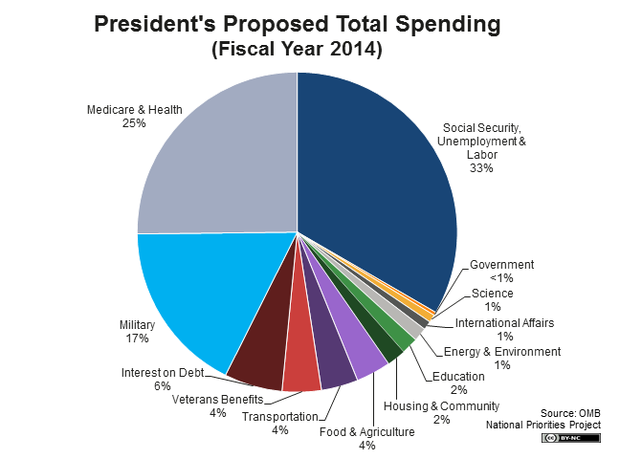
good point.  I think the interest rate of money borrowed by the us is below 2%.  However,  with this money being giving away, how much revenue do you suppose is generated directly or indirectly by this borrowed money?  Look at the chart below and see if you can point out which area creates revenue from borrowed money.  You're saying you gotta spend money to make money... so borrow to spend.


If revenue from borrowed money (indirectly and directly) is 2%.  Then the interest gets paid. But the money borrowed is spent and must be paid with taxes.  Some day.  By us. 


Mr Khan said:
Kasz216 said:
the2real4mafol said:
Kasz216 said:
the2real4mafol said:
dsgrue3 said:
Pemalite said:
Kasz216 said:

I'd point out that the UK's GDP gro
Even if you think the debt spending is making the difference... why kill yourself for 2%, building up a future huge disaster?  When you could have 1% and have a safer future?

Espiecally if nearly all that 1% is a boost soley due to government spending!


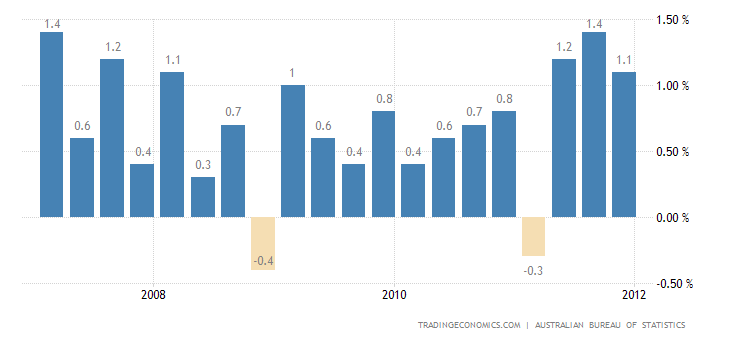
I wouldn't say *everywhere* Australia avoided recession during the global economic collapse and has maintained growth through the whole ordeal.

Sure?

Certainly looks like it dipped into a recession at a couple points.

Furthermore, any growth <2% is considered poor, let alone <1% which is anemic.

At least they are growing, we in the UK are amazed at .3% growth. How pathetic!! Sadly, it's the same across much of Europe too. We are just so screwed. Australia must at least maintain what it's got.

This graph is the UK's poor economy


Yeah... and a lot of Australia's growth in the past 20 years has been a huge commodities boost of raw matierials.

While the UK's GDP Growth has mostly all been in it's banking sector.   

The UK is honestly... doing strikingly well when you consider the main driver of their growth has been the same area that had a huge collapse.

It's not like you guys have huge swarths of untapped land and resources or even a lot of real estate. 

We need to update our infrastructure more than anything. We still use sewers from the Victorian ages for example and there are still many post-industrial scars that need to be rebranded and reused for something (its depressing seeing so many empty buildings in some areas!). Thank god we got the olympics which put some money in East London. and we also must re-diversify our economy, relying on mostly services can't be good. 

Upgrading the sewers is fine and all... that's not going to help the economy though.  Hell you'll probably lose jobs since i'm guessing those kind of sewers run better.

As for fixing post industrial scars... that's exactly what austerity plans are suppoesd to include.   Pro buisness reforms to attract buisness.

Since Austerity is  a lot like cutting costs at a faiing resteraunt.   All it does is buy you more time.


If we were looking at it through John Maynard Keynes perspective... Stimulus spending probably actually wouldn't be his first suggestion.   He'd likely find it a waste of money currently.  Why?  The United Kingdoms HUGE trade imbalance.   He would find it illogical to spend stimulus money when a lot of it would end up overseas and would first suggest trying to eliminate the trade balance.   He'd probably want to cut ties with the Euro.  He was for the Bancour, but that was back when the rich countries were the ones with the trade surpluses.

Afterall, how does a demand driven muliplier work, when the majority of the money we buy go back to foreign manufacturers and producers?    You go out an buy a bunch of Nintendo games with your stimulus money, and the majority of your money is going straight to Japan.

What would Keynes want... the government to spend... to give the rich incentives to invest in the USA and UK.

I'd suggest the Economic Consquences of Peace if you have time.  It's free because the publishing rights have expired.  (Oops, in the US.  You may want to check United Kingdom Copyright law before reading)

http://www.gutenberg.org/ebooks/15776

It'd likely give you a fuller understanding of Keynes.  

Well, not straight to Japan. International trade is not quite so seamless as that, such that demand in one market necessarily produces jobs in that market even if the demand were 100% for foreign made goods. Enough of a boost and NoA would have to hire people, or more Gamestop branches open and they hire more associates

Not that video games are entirely a product where increased demand creates more jobs, though. That's one of the real problems of demand-based economics: it was devised some 60 years before the information age, whereby content generation doesn't have to match the scale of demand, and only delivery networks have to expand. Unlike, say, GM, who rapidly reaches a bottleneck of how many cars they can sell should there be a surge in demand that they don't have enough factories or workers for.

There's still much to be said for demand economics (moreso than the giant tax-evasion scam that is supply-side economics, anyway), but the math complicates dramatically as the notion of "product" becomes more dynamic.

Yeah... though Gamestop hardly make anything on new games.  It's why they push used games so much.  Really, retail margins in general are lower then they've ever been.

To quote Keynes...  “A favorable balance, provided it is not too large, will prove extremely stimulating; whilst an unfavorable balance may soon produce a state of persistent depression"

He wrote this after the route of stimulating yourself out of a depression became the standard.


It's worth noting as well that Keynes was for Free Trade,(violently so) and Anti-Tariff.  So he wouldn't fall into the usual camps afraid of the trade deficit either.


He thought the only way out of the problem was to get rich people to invest in exportable goods.

As for Supply side economics being a tax evasion scheme... tax cuts are demand side policies.  Tax cuts are something Keynes would of supported... greatly.

To quote Keynes....

"Nor should the argument seem strange that taxation may be so high as to defeat its object, and that, given sufficient time to gather the fruits, a reduction of taxation will run a better chance, than an increase, of balancing the budget.  For to take the opposite view to-day is to resemble a manufacturer who, running at a loss, decides to raise his price, and when his declining sales increase the loss, wrapping himself in the rectitude of plain arithmetic, decides that prudence requires him to raise the price still more;—and who, when at last his account is balanced with nought on both sides, is still found righteously declaring that it would have been the act of a gambler to reduce the price when you were already making a loss.  ”

He actually saw such "Tax Avoidence schemes" as equally valid as stimulus spending.  Since he argued, they had the same effect.

Substantially the same argument also applies to a relief of taxation by suspending the Sinking Fund and by returning to the practice of financing by loans those services which can properly be so financed, such as the cost of new roads charged on the Road Fund and that part of the cost of the dole which can be averaged out against the better days for which we must hope. For the increased spending power of the taxpayer will have precisely the same favourable repercussions as increased spending power due to loan-expenditure; and in some ways this method of increasing expenditure is healthier and better spread throughout the community. If the Chancellor of the Exchequer will reduce taxation by £50,000,000 through suspending the Sinking Fund and borrowing in those cases where formerly we thought it reasonable to borrow, the half of what he remits will in fact return to him from the saving on the dole and the higher yield of a given level of taxation;—though, as I have pointed out above, it will not necessarily return to him in the same Budget. I strongly support, therefore, the suggestion which has been made that the next Budget should be divided into two parts, one of which shall include those items of expenditure which it would be proper to treat as loan-expenditure in present circumstances.


http://gutenberg.ca/ebooks/keynes-means/keynes-means-00-h.html


It's worth noting, that one of Keynes main reasons for supporting public works was that... by the government paying for stuff to be done.  Less people would be paid unemployment.   He would actually be against increases in unemployment, and money given "for free".  Instead wanting to put people to work, hopefully gettin something out of it that would of been going to the poor anyway, getting that money back and then getting some back in taxes.

In otherwords, "If we're paying someone $150 a week to be unemployed, why not pay them $300 a week anyway, since we're basically getting a deal... and since this $300 would be borrowed, taxes for unemployment would be lowered.  Meaning more spending power for tax payers."

Or in his direct words.

" If the dole was as great as a man's earnings when in work and was paid for by borrowing, there would be scarcely any repercussions at all. On the other hand, now that the dole is paid for by taxes and not by borrowing (so that a reduction in the dole may be expected to increase the spending power of the taxpayer), we no longer have to make so large a deduction on this head."

Of course... one could argue that we are facing such an issue since... a lot of government spending is based on borrowing... which he would of hated... and the huge trade deficit.


Even Keynes probably woud think we've done fucked up with our debt naturally so high in the first place and having a trade deficit.  Keynes was a big proponent of country self sufficency. 


So generally, if you support Keynsian economics.  You should support tax cuts just as much as any additional spending.  Becuase Keynes did.  Economic thought that doesn't is not in actuallity based on demand side economics or Keynsian economics but instead supported by political support or specific policies to help the poor trying to cloak itself in economic legitamicy.  Not that there is anything wrong with wanting to help the poor... but don't try to sell someone a fork by telling them it's a spoon.  Otherwise they're just going to be mad when they find they can't eat soup.


That the Bush tax cuts didn't work... nor the stimulus... isn't exactly surprising from a Keysnian perspective due to the aforementioned huge trade deficits.   If you don't think trade deficits matter... you shouldn't be a Keynsian but instead Neo-Classical in terms of economic belief.


PDF said:
snyps said:
PDF said:
snyps said:
why are ppl defending debt in this thread?

keynes is why we have inflation, paul krugman is PR for the LENDERS, colbert is a paid actor, and few of you are economists.

Could you or I survive on debt? no.


You or I cannot borrow money at a rate as low as the United States Government can.  The deb threat is made up crisis largely is contributed to this by this man http://en.wikipedia.org/wiki/Peter_George_Peterson .    When you can borrow at a rate lower than estimated GDP growth, you should do that.  

It's like if I could borrow money at a rate lower than what I would make  off the interest by having that money.  I would be a fool not to borrow but I can't.   Private debt is a huge problem but that is different than what we are talking about here.


good point.  I think the interest rate of money borrowed by the us is below 2%.  However,  with this money being giving away, how much revenue do you suppose is generated directly or indirectly by this borrowed money?  Look at the chart below and see if you can point out which area creates revenue from borrowed money.  You're saying you gotta spend money to make money... so borrow to spend.


If revenue from borrowed money (indirectly and directly) is 2%.  Then the interest gets paid. But the money borrowed is spent and must be paid with taxes.  Some day.  By us. 

We can borrow from the fed at a  much lower rate than 2%.  Lenders have been allowing us to borrow at nearly 0%

That being said the majority of the money we are borrowing are not being directly invested in entities that earn interest.  it is being invested in us as a country with future taxes playing the role of the interest rate.  With estimated GDP growth we will be more than capable of paying that debt with our future taxes without having to raise them.  (We as a country will have more money, so we will pay more in taxes). 

I am not supporting a runaway deficit and beleive there is wasteful spending.  I am also in support of going back to the Clinton era tax rates to better handle our deficit now.  It is wrong of us to say, here you go future generations I hope our math was right.

I am just pointing that rheotoric that we hear against borrowing is moslty false.  Like comparing national public debt to individuals private debt is not a fair comparison because of the low interest rates.  The real issue is not as much as focusing on our debt as it is ensuring that we continue to grow as a country to cover the debt.  The study that was just debunked was a popular one because it showed that debt ratio around 90% would cause our economy to stagnate.  This is now shown not to be true.  So it furthers the point that borrowing to kickstart the economy and keep it a float and paying it down when things are good seems the best way to move forward.

I think that's more or less a false narrative though when our GDP to debt ratio has constantly increased.  Even before the financial crisis.


and again, i'd point out... Demand side economics says that tax cuts are equal to stimulus spending.  So raising taxes would be just a negative an action as an equal amount of austerity.

Stimulus spending = The Bush tax cuts. (Per Keynes, well not the Bush tax cuts, but tax cuts.)

They should have the exact same effect.  Someone who thinks the Bush tax cuts didn't work should also think stimulus spending won't work


Around the Network
PDF said:
Kasz216 said:

I think that's more or less a false narrative though when our GDP to debt ratio has constantly increased.  Even before the financial crisis.


and again, i'd point out... Demand side economics says that tax cuts are equal to stimulus spending.  So raising taxes would be just a negative an action as an equal amount of austerity.

Stimulus spending = The Bush tax cuts. (Per Keynes, well not the Bush tax cuts, but tax cuts.)

They should have the exact same effect.  Someone who thinks the Bush tax cuts didn't work should also think stimulus spending won't work

Taxes was not the real point of my arguement other than the economy did fine under the Clinton era tax rates and it helps with the deficit.  In theory that point should be correct, I just don't think its what we see in the real world.

A runaway deficit  that continues to grow its GDP to debt ratio is bad but we are not in the financial trouble many would make you believe.  The mass spending is due to the reccession and couple wars, and in my opinion the spending in case of the recession was needed to keep us a float.  

My point of being able to borrow money at a rate that we will easily be able to pay back as long as the estimation for GDP growth is correct shows how misleading it is when people compare public and private debt.  A long with the fact that even if we reach a high GDP to debt ratio it now shows that it does not seem to impede economic growth.   So much of the rhetoric we hear is simply false or misleading.

Again though.. I showed why that wasn't the case, and a pointless arguement.

I mean, debt vs gdp isn't different from public and private debt.

For example.  It's why you get a Home Morgatge.

Your borrowing money... at interest, but what you save on rent, and the equity of the house makes it a good purchase.


Debt to GDP ratio's effecting growth really are relative to the size of the credit market you have... more importantly, the domestic credit market.  Again, if we were to look at Keynes.  He'd be HORRIFIED just how much of our creditors were foreign.   I doubt very much he'd actually want us to sell bonds and instead just fire up the printing press for EVERYTHING.


If you want to view WW2 as a success from a Keysnian perspective.  War Bonds play a huge part.  (Which... was Keynes idea FYI...)

You can't stay afloat in a leaky boat, and to try to before fixing the holes is madness.  This was the real heart of Keynes message.   One that was lost due to the fact that it wasn't really relevent to the powerful countries at the time.


This is why... desptie being cast as opposites.  Keynes and Hayek were great friends... and saw themselves as believing 98% the exact same thing.


PDF said:
Kasz216 said:

Again though.. I showed why that wasn't the case, and a pointless arguement.

I mean, debt vs gdp isn't different from public and private debt.

For example.  It's why you get a Home Morgatge.

Your borrowing money... at interest, but what you save on rent, and the equity of the house makes it a good purchase.


Debt to GDP ratio's effecting growth really are relative to the size of the credit market you have... more importantly, the domestic credit market.  Again, if we were to look at Keynes.  He'd be HORRIFIED just how much of our creditors were foreign.   I doubt very much he'd actually want us to sell bonds and instead just fire up the printing press for EVERYTHING.


If you want to view WW2 as a success from a Keysnian perspective.  War Bonds play a huge part.  (Which... was Keynes idea FYI...)

You can't stay afloat in a leaky boat, and to try to before fixing the holes is madness.  This was the real heart of Keynes message.   One that was lost due to the fact that it wasn't really relevent to the powerful countries at the time.


This is why... desptie being cast as opposites.  Keynes and Hayek were great friends... and saw themselves as believing 98% the exact same thing.

yeah, all I am getting is that if we are to assume personal private debt is like public as in the case of a Mortgage.  It is still a good idea to go in debt now for the sake of the long run.

Even with that.  Saving money on not paying rent and making money from tax payers is not the same thing.   It would be a better comparison if you found a CD that had an incredible  APY rate that was higher than your loan APR.  Then it would be smart to take the loan and put the money in the CD but people cannot find options that good.  People cannot borrow at near 0%.  If I could I would borrow tons of money and just invest.

As I understand it, spending in times of recession is the simple idea that the market takes to long to self correct and it is possible to speed things up with stimulus.  Giving a a kickstart to the economy.  Would have the economy recovered from Banks going bankrupt and US car companies disappearing? yeah I think it would but it would taken a very long time.  We can save a whole generation of economic suffering by government intervention.

If I am still missing the point I am sorry maybe I am out of my league.  I am an eager learner but I am not sure what your point really is.

Oh, i'm just putting down a general basis belief of Keynsianism before i explain why.... it doesn't work now, even according to keynsianism.


First off.... the APY of the CD isn't as great as you think. 


US government bond interst rates are currently at ~1.5%.


US GDP growth is currenty at ~2.5... HOWEVER.   Goverment taxes ~16% GDP.   So the government only recoups 0.4% on it's investment.


Now you COULD argue that they are borrowing collectivly... for us all.  And that eventually the entire nation is growing enough in wealth to pay everything off.


However THAT doesn't track... because of the afore mentioned private debt. (and depreciation, and plenty of other stuff)  Also while GDP may increase a nations net wealth may stay static... or decrease.  (As has been the case with the United States.)

So if you look at it from a "The US Citizens will help the government pay it back later"   You need to take into account that rather then growing.  Average net wealth often shrinks, even when GDP is growing. 

The money Keynes would say, is being lost to "Leakage".  Going overseas due to the USA's huge trade deficit.  Stimulus to him today would make about as much sense as pumping a bunch of water out of a sinking ship.   Without the holes being fixed, all you are doing is exhausting your ability to swim to shore.


I think Keynes would have said the stimulus wasn't large enough. He would have also detested the way it was implemented. I don't think he would have rejected it though. He would have championed it (as long as it was real stimulus, not pork). He would have wanted it to go to infrastructure, which he believed fueled economic growth. That was the basis of his theory. It has also been proven correct. If it weren't for the stimulus, the country more than likely would have gone into a deppression. Though I will never be able to prove it. Though the fact is, things have been slowly getting better. I personally think we as a country need to get rid of the tried but completely untrue and failed trickle down economics and policies we employ. We need to realize that investing in our children and our selves is the best answer to our problems. Not making sure our CEO's have golden parachutes for when they eventually run their corporation into the ground.


ShinmenTakezo said:

I think Keynes would have said the stimulus wasn't large enough. He would have also detested the way it was implemented. I don't think he would have rejected it though. He would have championed it (as long as it was real stimulus, not pork). He would have wanted it to go to infrastructure, which he believed fueled economic growth. That was the basis of his theory. It has also been proven correct. If it weren't for the stimulus, the country more than likely would have gone into a deppression. Though I will never be able to prove it. Though the fact is, things have been slowly getting better. I personally think we as a country need to get rid of the tried but completely untrue and failed trickle down economics and policies we employ. We need to realize that investing in our children and our selves is the best answer to our problems. Not making sure our CEO's have golden parachutes for when they eventually run their corporation into the ground.

I feel like you haven't read much Keynes....  read the above keynes primary sources.

According to Keynes "pork" works just fine.

According to Keynes "trickle down" economics work.

According to Keynes, stimulus will be useless if their is sufficent leakage in the form of trade deficits,


Kasz216 said:
ShinmenTakezo said:

I think Keynes would have said the stimulus wasn't large enough. He would have also detested the way it was implemented. I don't think he would have rejected it though. He would have championed it (as long as it was real stimulus, not pork). He would have wanted it to go to infrastructure, which he believed fueled economic growth. That was the basis of his theory. It has also been proven correct. If it weren't for the stimulus, the country more than likely would have gone into a deppression. Though I will never be able to prove it. Though the fact is, things have been slowly getting better. I personally think we as a country need to get rid of the tried but completely untrue and failed trickle down economics and policies we employ. We need to realize that investing in our children and our selves is the best answer to our problems. Not making sure our CEO's have golden parachutes for when they eventually run their corporation into the ground.

I feel like you haven't read much Keynes....  read the above keynes primary sources.

According to Keynes "pork" works just fine.

According to Keynes "trickle down" economics work.

According to Keynes, stimulus will be useless if their is sufficent leakage in the form of trade deficit

I feel like you have no clue who Keynes was or what his economic theories were about. He definitely didn't believe in pork or trickle down economics. He was against those very things. He believed workers created demand, and when you put more money in workers hands, everyone wins. That is the total opposite of trickle down economics. He was for a free market with government regulation. He was for government intervention during economic crisis'. He also thought that some defecit was good. Keynes believed Stimulus was good as long as it was implemented properly. Keynes was a liberal.