



By using this site, you agree to our Privacy Policy and our Terms of Use. Close

Forums - Gaming - Don't expect PS4/720 to come down in price

This is the second part of my next-gen analysis series. For the first part concerning third party software see here.

During the sixth and seventh generations, the prices of consoles came down quite quickly. This was very necessary in the seventh gen, as the high launch prices of the PS3 and 360 hindered their early adoption considerably. It took a few years before the PS3 picked up into the successful console it is today and became profitable. This was made possibly by "die shrinks" of the initially large and expensive Cell BE chip, as well as the GPU, onto smaller process nodes (transistor sizes). Each shrink step (90nm -> 65nm) essentially halves the cost of the chip, halves the power of the chip, and increases chip yield so more chips on a wafer are viable. The reduced power and heat also contributed to fixing RROD.

The rumoured launch prices of the 720/PS4 are over $400. That price is a reasonable minimum assuming they don't want to lose much money per console, given the cost of the CPU/GPU/RAM to be used in each consoles. $400 is no mass market price, and launch sales will undoubtedly be sluggish. They will be made at a 32nm-class node, the smallest process node in mass production.

Here we have the progression of shrinking of Cell and the PS2's Emotion Engine CPU:
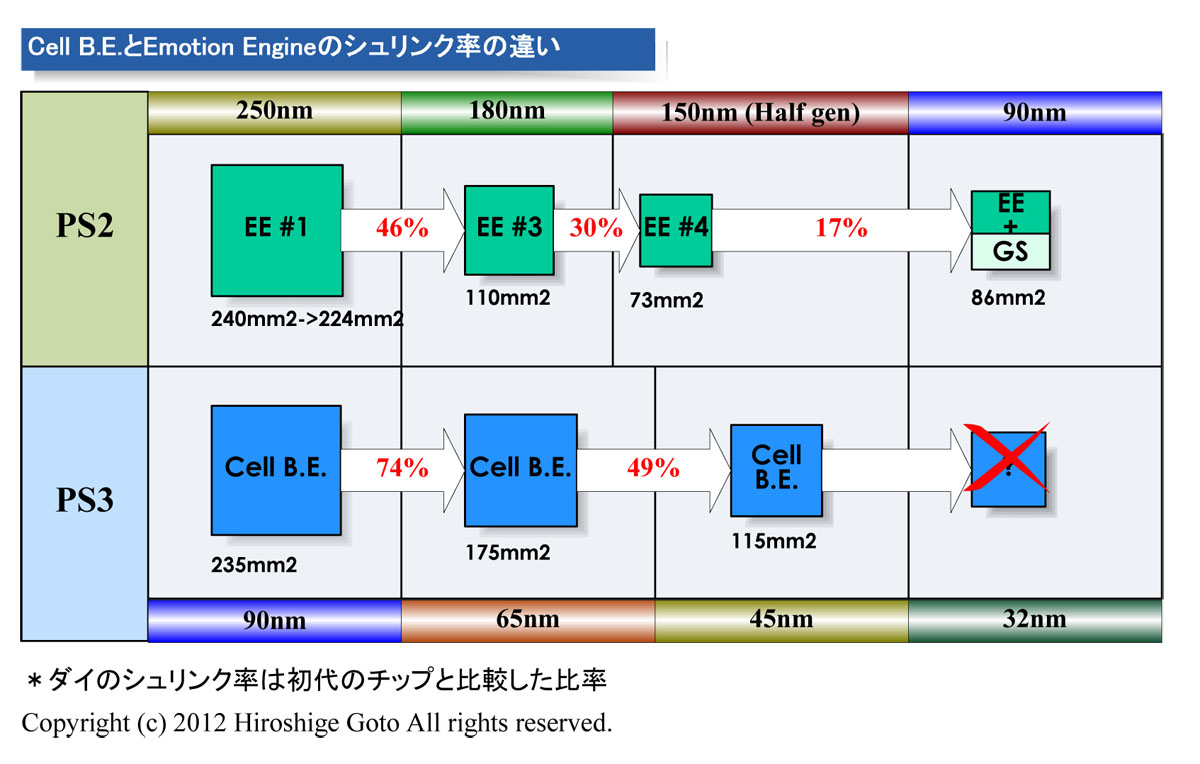
The 32nm shrink of Cell was planned and then CANCELLED, most likely due to high cost. This meant the expected 2012 PS3 price cut wasn't possible and didn't happen. This has interesting consequences for next-gen. You would expect the 22nm, 16nm and 11nm shrinks to follow during the lifetime of the PS4 and 720, rapidly bringing down that $400 cost into the $200-$250 cost needed to become attractive to the mass market. However, the price of process node development is rising very fast with new nodes:

Intel are the only company not to be challenged by this because of high volume of chips and high margins. Because the 720/PS4 use AMD CPU tech, fabrication at Intel is not an option. They must use a commercial foundry such as TSMC, Globalfoundries or Samsung. None of them have competitive 22nm or 16nm timetables, and their 40/45nm and 28/32nm introductions have been plagued with delays.

Sony sold their stake in the fabrication plants used to produce the Cell. They owned those plants so that they would be able to co-develop new process nodes and bring down the Cell cost fast. Without that ownership they are subject to the whims of the foundries they are producing at, and they won't have the influence or cash to pull in the node development timetable as neccessary. They will have to wait for these nodes to be ready. We are hitting a cost and feasibility wall in node shrinks that is slowing that timetable down considerably.

We will have TSMC 20/22nm production in 2014. However, as AMD doesn't plan to have 22nm CPUs out in this timeframe, we can conclude the cost is too high or the characteristics aren't good enough to have a console class CPU out in this time. I would instead expect that shrink in 2015. This is also therefore the earliest price cuts and the power/size reductions of a new model could come, if Sony and MS don't wish to lose more money in the meantime. The 16nm node would then be 2017, but we're so far out that I would expect that timetable to slip and underdeliver.

Instead of three lifetime shrinks, I would expect one, and for it to be much later in the lifecycle than it came for PS3 or 360. If the initial prices of PS4/720 are higher than $400 the resulting negative effect on sales will be compounded. Expect the initial price to remain for two years from launch, and it to not come down to $200 for five years. 



Around the Network

You're forgetting Moore's Law. All of the manufacturers listed are legally required to ensure that they meet it. If they don't meet their requirements, the UN security council is definitely going to enforce Moore's Law, and I don't think China or Russia will bother with a veto.

So either they'll have to force ahead with the die shrinks, or switch to Hell based processing, using the blood of virgins to allow for much cheaper processors.

tl;dr - There are lots of people working on this, many of them much smarter than you or I. I doubt very much that there will be years with no progress made in terms of hardware.


scottie said:
You're forgetting Moore's Law. All of the manufacturers listed are legally required to ensure that they meet it. If they don't meet their requirements, the UN security council is definitely going to enforce Moore's Law, and I don't think China or Russia will bother with a veto.

So either they'll have to force ahead with the die shrinks, or switch to Hell based processing, using the blood of virgins to allow for much cheaper processors.

tl;dr - There are lots of people working on this, many of them much smarter than you or I. I doubt very much that there will be years with no progress made in terms of hardware.


You're not funny, and you haven't addressed the obvious physical (silicon atoms are only ~0.5nm apart) and cost (see chart) reasons affecting Moore's law within the next ten years I mentioned. I'm not saying 22nm, 16nm and 11nm can't be done in that time, it's that the cost is so high so as to make shrinking the console CPU to them not actually get a good enough return to be worth doing. The cost and power benefits are NO LONGER "free" like during PS2 and early PS3.

Progress will exist but it will be slower and more expensive. My point is there should be no expectation of price cuts merely because time has passed.


Of course, if Pachter is right, the next gen consoles could have a much longer life-cycle than normal, as they wouldn't see same-brand replacements. Not that I expect that, however.

What about the PS3's future, though? Will they go back to their plans when projected costs are less? While I personally think they shouldn't cut current gen console prices until after next gen consoles launch, they can't leave the PS3 at that price forever. I have no idea what plans Microsoft has for the 360.

I suppose my normal strategy of "wait a year for the redesign and price" is out the window, then? That's a shame. Still, with both Sony and Microsoft as customers, won't this be a high level priority for AMD?


pokoko said:
Of course, if Pachter is right, the next gen consoles could have a much longer life-cycle than normal, as they wouldn't see same-brand replacements. Not that I expect that, however.

Slower hardware progress does imply longer lifecycle, because it will be longer before the possible enhancements of a new console would be worth the generation transition.

What about the PS3's future, though? Will they go back to their plans when projected costs are less? While I personally think they shouldn't cut current gen console prices until after next gen consoles launch, they can't leave the PS3 at that price forever. I have no idea what plans Microsoft has for the 360.

Strategically, Sony will not want a $99 PS3 undercutting a $400 PS4, even if it was economical to do so. The former's game library, established online, continued third party releases, and good-enough graphics would keep it too competitive to be worth it.

I don't know when a 22nm shrink would be viable, but it will remain a large investment ($100m+) for at least 2-3 years. Sony would have to positively decide to do it. I don't think it makes sense to do.

I suppose my normal strategy of "wait a year for the redesign and price" is out the window, then? That's a shame. Still, with both Sony and Microsoft as customers, won't this be a high level priority for AMD?

I believe Sony and MS will own their designs themselves and just pay AMD royalties. AMD is in a terrible financial position, shedding employees, and has no incentive to be doing any design work to help out Sony/MS unless paid additional hundreds of millions of dollars.

AMD don't do manufacturing any more, they sold that off a few years ago. After paying for the shrink design work, MS/Sony would need to pay billions of dollars to accelerate the node timetable at TSMC, GF or Samsung.


Around the Network

I think they're going to launch cheap and maintain that price point for a few years. I think the PS3 proved why you shouldn't launch expensive and wait for production costs to fall.


Ok, that is nice, but very wrong.
Technology that reduces the transistor size, which currently is being driven by the smartphone industry, will always result in old technology being cheaper. This causes higher efficiency and less waste per silicon wafer, thus the price of production goes down. Look at sticks of DDR3. Reduction in growth allows for larger sticks, but the high efficiency also creates dirt cheap sticks.



I think you'll find that I am hilarious, and that people have been predicting the end of Moore's law for quite some time. Moore's Law always seems to be doomed.



scottie said:
I think you'll find that I am hilarious, and that people have been predicting the end of Moore's law for quite some time. Moore's Law always seems to be doomed.

I said Intel will be fine. They have 22nm now, 14nm this year, and so on. But PS4/720 can't use Intel, and the foundries have already made commercial decisions to slow the intriduction of new nodes and push out the tech that gives those nodes their scaling and power reduction (Finfet, EUV, HKMG). Where is Finfet on TSMC's 20nm?

This is a commercial argument and not a technological one.


TheJimbo1234 said:
Ok, that is nice, but very wrong.
Technology that reduces the transistor size, which currently is being driven by the smartphone industry, will always result in old technology being cheaper. This causes higher efficiency and less waste per silicon wafer, thus the price of production goes down. Look at sticks of DDR3. Reduction in growth allows for larger sticks, but the high efficiency also creates dirt cheap sticks.

Did you read my words? "Transistor size reduction" technology is slowing down considerably at all foundries producing smartphone parts (TSMC, Samsung, GF) because of high implementation costs.