












This is the second part of my next-gen analysis series. For the first part concerning third party software see here.
During the sixth and seventh generations, the prices of consoles came down quite quickly. This was very necessary in the seventh gen, as the high launch prices of the PS3 and 360 hindered their early adoption considerably. It took a few years before the PS3 picked up into the successful console it is today and became profitable. This was made possibly by "die shrinks" of the initially large and expensive Cell BE chip, as well as the GPU, onto smaller process nodes (transistor sizes). Each shrink step (90nm -> 65nm) essentially halves the cost of the chip, halves the power of the chip, and increases chip yield so more chips on a wafer are viable. The reduced power and heat also contributed to fixing RROD.
The rumoured launch prices of the 720/PS4 are over $400. That price is a reasonable minimum assuming they don't want to lose much money per console, given the cost of the CPU/GPU/RAM to be used in each consoles. $400 is no mass market price, and launch sales will undoubtedly be sluggish. They will be made at a 32nm-class node, the smallest process node in mass production.
Here we have the progression of shrinking of Cell and the PS2's Emotion Engine CPU:
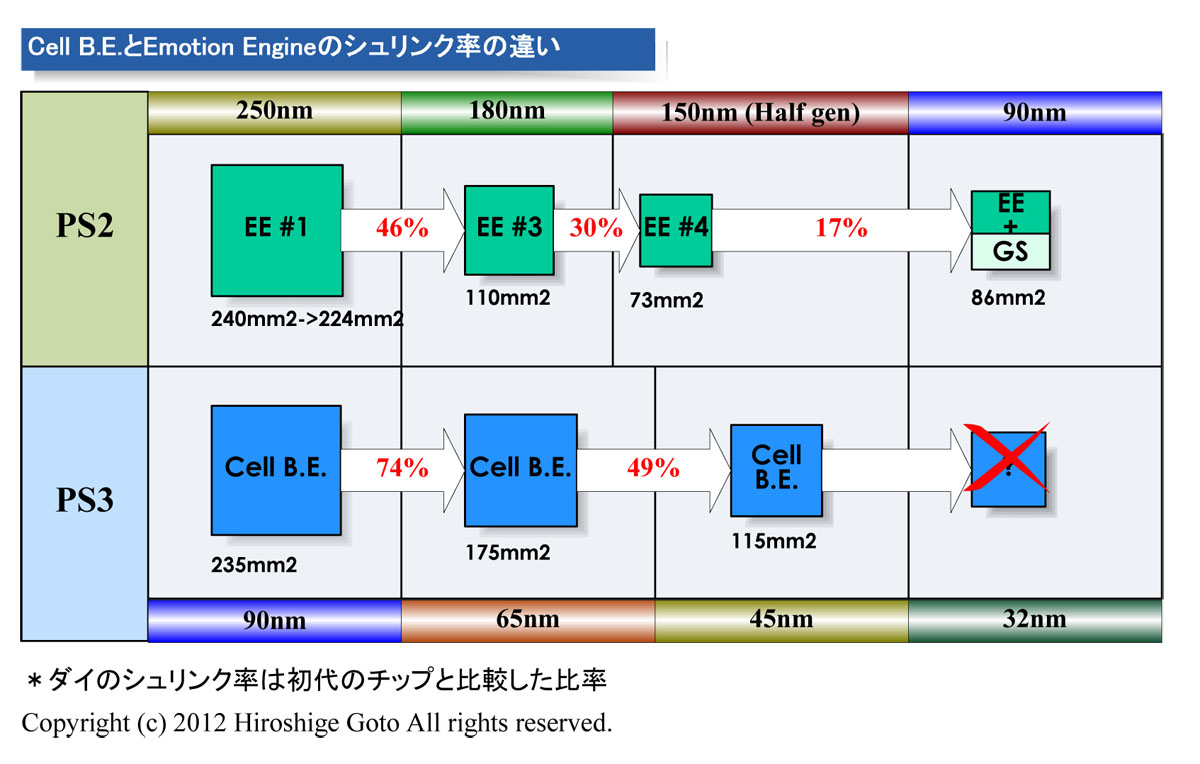
The 32nm shrink of Cell was planned and then CANCELLED, most likely due to high cost. This meant the expected 2012 PS3 price cut wasn't possible and didn't happen. This has interesting consequences for next-gen. You would expect the 22nm, 16nm and 11nm shrinks to follow during the lifetime of the PS4 and 720, rapidly bringing down that $400 cost into the $200-$250 cost needed to become attractive to the mass market. However, the price of process node development is rising very fast with new nodes:

Intel are the only company not to be challenged by this because of high volume of chips and high margins. Because the 720/PS4 use AMD CPU tech, fabrication at Intel is not an option. They must use a commercial foundry such as TSMC, Globalfoundries or Samsung. None of them have competitive 22nm or 16nm timetables, and their 40/45nm and 28/32nm introductions have been plagued with delays.
Sony sold their stake in the fabrication plants used to produce the Cell. They owned those plants so that they would be able to co-develop new process nodes and bring down the Cell cost fast. Without that ownership they are subject to the whims of the foundries they are producing at, and they won't have the influence or cash to pull in the node development timetable as neccessary. They will have to wait for these nodes to be ready. We are hitting a cost and feasibility wall in node shrinks that is slowing that timetable down considerably.
We will have TSMC 20/22nm production in 2014. However, as AMD doesn't plan to have 22nm CPUs out in this timeframe, we can conclude the cost is too high or the characteristics aren't good enough to have a console class CPU out in this time. I would instead expect that shrink in 2015. This is also therefore the earliest price cuts and the power/size reductions of a new model could come, if Sony and MS don't wish to lose more money in the meantime. The 16nm node would then be 2017, but we're so far out that I would expect that timetable to slip and underdeliver.
Instead of three lifetime shrinks, I would expect one, and for it to be much later in the lifecycle than it came for PS3 or 360. If the initial prices of PS4/720 are higher than $400 the resulting negative effect on sales will be compounded. Expect the initial price to remain for two years from launch, and it to not come down to $200 for five years.


