By using this site, you agree to our Privacy Policy and our Terms of Use. Close

Forums - PC - AMD Radeon HD 7970 announced


Today AMD announced the existence (and rapidly approaching release) of their latest flagship graphics card, the Radeon HD 7970, and it’s packed with a slew of new and improved technologies.

Here is what we know:

The Radeon HD 7970 uses the latest graphics architecture from AMD, dubbed Graphics Core Next (GCN), and is the first GPU built on 28nm production technology. The new and smaller technology allows for very high clock speeds and lower power usage at the same time. The core clock is set to 925MHz, although most (if not all) units should easily overclock to the 1GHz mark. During the conference call, the speaker reported his unit was currently running at 1.22GHz. 3GB of 1.375GHz GDDR5 is connected via 384-bit bus.

Four display connections will be available: two mini DisplayPorts, one HDMI 1.4 port, and one DVI port. All four are located along a single slot, leaving the second slot completely unobstructed for cooling. Despite the reduced number of output ports, AMD is making sure your multi-display setup won’t suffer: they’re including HDMI->DVI and active miniDP->DVI adapters with every card, so out of the box you’ll be able to run three non-DisplayPort monitors. Just like before, a total of six displays per GPU is supported.

The heatsink design has been tweaked slightly for improved cooling. The fan is now wider as are the blades, resulting in greater amounts of air circulation at lower RPM speeds. The max speed for the fan is now around 2000 RPM, lower than that of the 6900 series. To further improve cooling, the second DVI port was removed leaving the entire second slot unobstructed, reducing both temperature and noise levels.

The Radeon HD 7970 will be the first card to support the PCI Express 3.0 standard which provides 1Gb/s bandwidth per lane (16Gb/s for a 16x slot). It will retain backwards compatibility with both 1.0 and 2.0 standards, though a slight performance hit will occur during high data transfer rates.

Two PCI Express power cables will be required for the HD 7970: one six-pin and one eight-pin power connection will provide a maximum of 300W to the GPU. What’s interesting is the card, even under extreme loads, won’t use more than around 250W (I don’t recall the exact number…it was somewhere between 225-250W). So why not just put two six-pin power connectors on instead? That would be because…

NEW POWERTUNE

A refined version of PowerTune will debut with the new GPU, and this one is pretty interesting. Previous versions reduced performance as the power ceiling was reached, but did nothing if there was extra headroom. The version of PowerTune supported by the HD 7970 changes this. It will actually ramp up the clock speeds automatically when needed if its power draw will allow, similar to both AMD’s and Intel’s respective CPU ramping technologies.

On the opposite end of the spectrum is a new technology AMD calls ZeroCore Power. During long idle periods the Radeon HD 7970 can enter a very lower power state to conserve power. Should the display turn off due to power saving measures, the GPU will turn itself off, drawing less than 3W. When the GPU is needed, it can power back up within milliseconds. This technology also extends to other cards in a CrossFire configuration. Each card can power itself on or off independently as the situation demands.

Dual BIOS will make a return, allowing users to install a tweaked BIOS image while still having a backup plan that doesn’t involve buying another GPU.

Support for 16K displays is added. What are those? Well, basically it’s a freaking huge display. The Radeon HD 7970 supports displays up to 16,000 pixels wide by 16,000 pixels tall. With 4K displays right around the corner, an EyeFinity configuration that size display could easily be made in the near future.

DON’T FORGET THE AUDIO…

Perhaps one of the coolest new features doesn’t have as much to do with video as much as it does audio. Discrete Digital Multi-point Audio provides multiple independent audio streams for audio-capable displays using either HDMI or DisplayPort cables. Any audio stream coming from a video source on a particular display will play through that display’s speakers. Move the video? The audio follows.

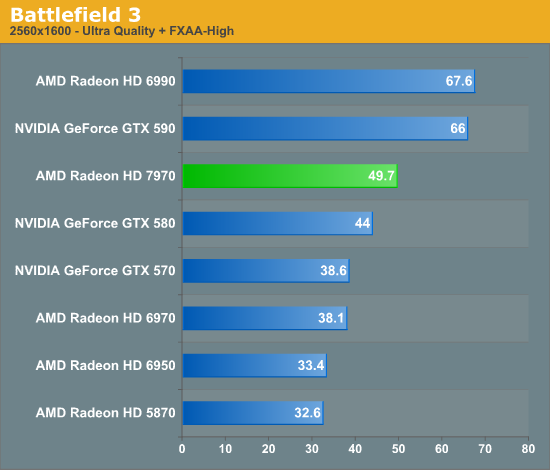
With a list of qualifications like this, performance expectations are going to be very high, and AMD says those expectations should be met. For example, take Battlefield 3 and run it at Ultra settings at a resolution of 5760×1200 (that’s three 1920×1200 displays) EyeFinity setup. According to AMD a single Radeon HD 7970 will be able to handle this. Excited yet?

The Radeon HD 7970 officially launches today and will be available from retailers January 9 with select models starting at $549.

Some of the reviews from the web:


GPU: 6970 X580 6990 7970
Idle: 97 W 118 W 112 W 89 W
GPU Load: 315 W 443 W 496 W 352 W
GPU & CPU Load 371 W 496 W 557 W 408 W


@TheVoxelman on twitter

Check out my hype threads: Cyberpunk, and The Witcher 3!

Around the Network

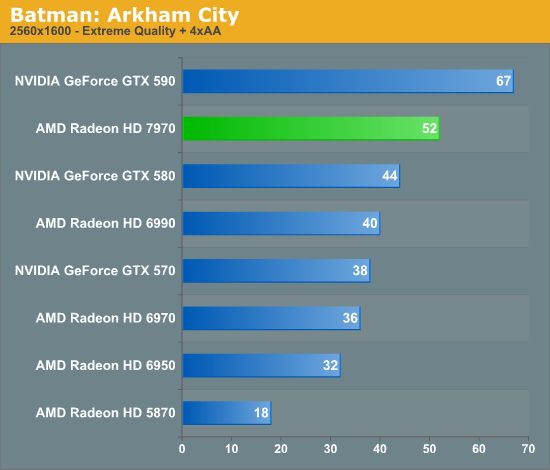
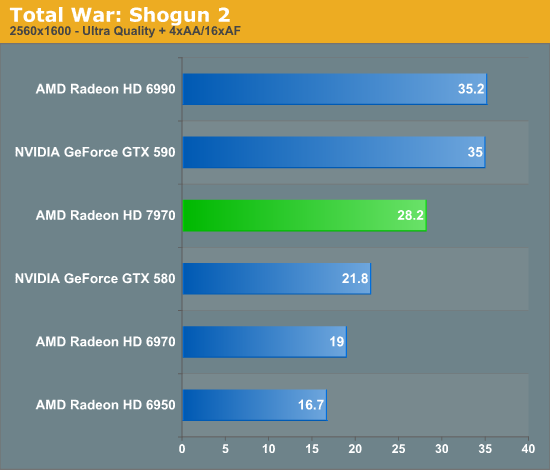
Why are the performance figures so "low"? Below both the HD6990 and GTX590 at most points.

I'll probably buy the generation after the 7970 and stick to my HD6950 for a while (it still kicks the ass of every game I own on max settings).


Woot! Compatible with my less then stellar motherboard...PCIe 2.1


Mummelmann said:
Why are the performance figures so "low"? Below both the HD6990 and GTX590 at most points.

I'll probably buy the generation after the 7970 and stick to my HD6950 for a while (it still kicks the ass of every game I own on max settings).


The 6990 and 590 are both dual GPU cards and 7970 is a single GPU card, that and AMD seem to have decided to go for lower power and increased compute power (something that Nvidia has been leading on) and effeciancy.


@TheVoxelman on twitter

Check out my hype threads: Cyberpunk, and The Witcher 3!

Advanced Image Quality


Much has been said about AMD’s claims of leading edge texture filtering quality on the HD 6000-series but for the most part, it was an improvement over previous generations. Whether it was up to expectations is still open for debate but the Southern Islands family is once again claiming to have virtually eliminated the flickering and artifacts that sometimes appear in games. 


In order to high the high note in terms of texture filtering, Southern Islands cards feature an improved anisotropic filtering algorithm that’s designed to virtually eliminate shimmering in high resolution textures. This may sound like a tall order to fulfill but after seeing it in action, we’re confident AMD can deliver this time around. 

One of the beauties of this new filtering algorithm is its ability to run without additional buffering so there is no drain on system resources. In addition, it is automatically enabled to gamers should see vastly improved image quality without having to dive into the Catalyst Control Panel. 


Introducing PRT (Partially Resident Textures)


One of the main challenges for today’s GPUs is how to handle large amounts of high resolution textures when moving through a scene. Presently, when a player moves through a game environment the texture information in upcoming frames is constantly loaded between the disk, CPU and the graphics card. Usually the effect of this preloading is seamless but as larger amounts of information are loaded, stuttering can occur. 


AMD’s solution to this somewhat complex problem is to leverage the local memory on the GPU and allow it to act as a true texture caching system. Essentially, upcoming textures are prefetched from the CPU and disk and stored locally on the GPU until they are ready to be used by the application. In a way this can almost be considered a form of texture “streaming” and should help eliminate the stutter normally associated with scene loading. 


In addition to preloading, PRT can also dynamically load selected textures based on when they will be needed instead of loading every bandwidth-hogging texture all the time. This should help eliminate the memory footprint the feature requires. 

Unfortunately for gamers Partially Resident Textures technology is application controlled so it has to be built into a game engine before it can be utilized. Supposedly, AMD’s development team is working with game developers to include this feature in upcoming releases but there aren’t any titles on the horizon that will put it to good use.


@TheVoxelman on twitter

Check out my hype threads: Cyberpunk, and The Witcher 3!

Around the Network

So it can run crysis?


Face the future.. Gamecenter ID: nikkom_nl (oh no he didn't!!) 

NiKKoM said:
So it can run crysis?


With the appropiate CPU, about 4 or 5 times.


Nice card, and a very good improvement over the HD6970, between 30-40% faster! Not bad at all.

Unfortunately the improvements are not as impressive if we compare it with the GTX 580, and then there is the price, $549!

I'll wait for the HD7950 with its dual BIOS


Please excuse my bad English.

Former gaming PC: i5-4670k@stock (for now), 16Gb RAM 1600 MHz and a GTX 1070

Current gaming PC: R5-7600, 32GB RAM 6000MT/s (CL30) and a RX 9060XT 16GB

Steam / Live / NNID : jonxiquet    Add me if you want, but I'm a single player gamer.

JEMC said:
Nice card, and a very good improvement over the HD6970, between 30-40% faster! Not bad at all.

Unfortunately the improvements are not as impressive if we compare it with the GTX 580, and then there is the price, $549!

I'll wait for the HD7950 with its dual BIOS

"Retailers will surely tack on an early-adopter premium, but if they somehow miraculously release at their MSRP, the GTX 580 is going to need a price drop before long. Of course, NVIDIA is supposed to release its new Kepler architecture in 2012. AMD has beat them to the punch, and upped the ante. In some areas, even an overclocked GTX 580 can’t match the new HD 7970 beast at stock. 2012 just got very interesting for GPUs.

AMD has taken back the hill. It’s your move NVIDIA."

From Overclockers.com

I think I'll wait for the 7750 or 7770


Pfft, nothing compared to the almighty CELL & RSX!!!