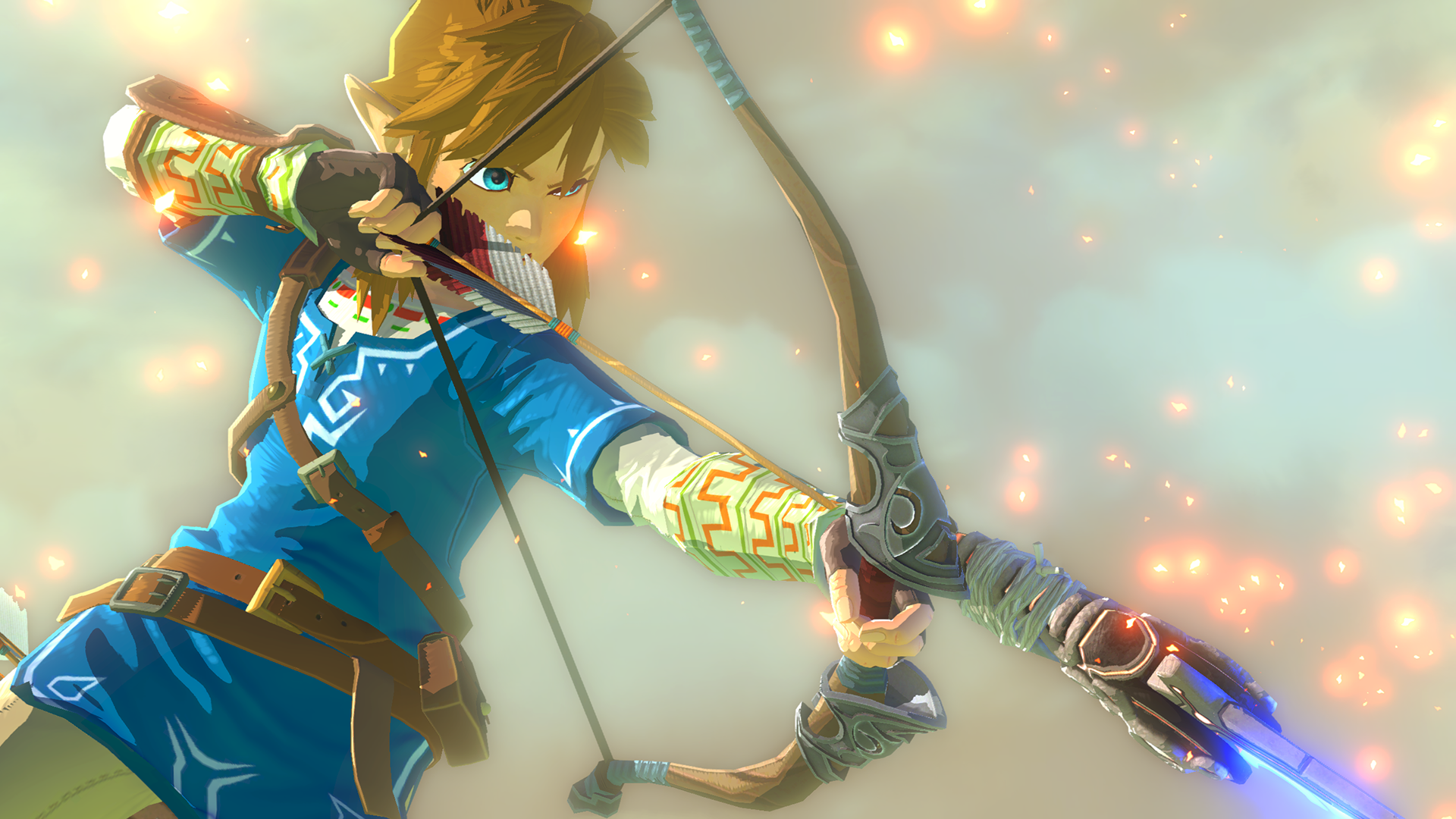


I will ask you a simple question: What did you think the Wind Waker was about? Take a moment and think this through, then write it down. Nothing too elaborate, of course, I do not expect an essay, treatise or tractate (working on that, myself). Just a paragraph of whatever comes to mind. Note that this is by no means a timeline/chronology discussion, so don't worry about that.
Done yet? Good, then we can proceed.
So, I'm guessing at least some of you thought about my question in terms of plot, and some thought of it in terms of mechanics. Nothing about that is wrong. The game certainly is about combat, and about a particular art style, and about adventure, and the pushing of a button. But that's not all there is to the Wind Waker. While there is as of yet no well developed academic school or standard for video game critique, it is reasonable to suppose that games communicate meaning though both interactive and non interactive elements, and that the non interactive elements are not by any means superficial or inconsequential to the game at large.
Using the plot as an example, could we say that the game is about a young man's quest to save a princess from an evil warlock? Yes, on one level, that's exactly what it is about. But to say this is all it is about is a grave and incongruous misinterpretation; one that is, unfortunately, quite common. I intend to dispel that notion to the best of my abilities, offering my own take on one of the defining video game experiences of the last decade. In doing so, I will discuss an oft neglected aspect of game design, namely theme.
Then, getting to the heart of the matter, what would I say the Wind Waker was about?
I think essence of the game is captured quite well in the intro; the wide blue seas with its somber waves, a lone island sparsely populated with a simple village, Link, standing at the edge of the world, stoically gazing out across the ocean, drafts of wind playing in the air, a Celtic motif yet unheard, all of it speaking with forbearance of new adventures. Of change, you might say. Yet the past is not left behind; the foreboding tale of a lost kingdom echoes in this world, and through it, the past is made to be the present.
For me, this speaks of the essence of Zelda, but not entirely on its own terms. The Wind Waker takes a new direction, but does not forget its roots. The conflict between the past and the present, and what this means for the future, is at the heart of the Wind Waker's tale. Even the shard hunt and parry move play into this.
The Wind Waker is not about good versus evil. Ganondorf is a tragic antagonist, selfish and cunning, but not evil. His struggle in this game is profound, and that's what makes him such a sympathetic character. Who is he fighting? Not Link. Link himself does not originally play any part in the events that transpire; like in Ocarina of Time he grows into a Hero, but unlike Ocarina, he was never destined to fight from the beginning. One of the themes of the game is man's struggle against fate.
Who guides the events of the game? Ultimately, Ganondorf and the King of Hyrule, both of whom are puppets of the gods. Tetra, Medli and Makar are all forced to give up their freedom, their lives, because of their designs. Link is the lone exception of all the main characters. This is mentioned early in the game when the King of Red Lions and the Guardians speak of the missing Hero of Time, but it is metaphorically represented in Link's ability to control the Wind.
Why is the Triforce important? Because it represents man's relation to the gods. Through it, a man can seize control of his own fate. Ganondorf wants power because of the injustices he has suffered in the past; so does the King. The difference between them is that the King has seen something in the new world that is worth living for, whereas Ganondorf lives only for himself.
The King's wish represents the end of the Zelda legend; the eternal struggle ordained by the gods is broken. Twilight Princess builds upon this. Did you ever think about what it meant when Zelda said 'I know now why the goddesses left the mirror in this world... They left it because it was their design that we should meet.' given what Midna had to do in the scene following that? That is why the Wind Waker is significant.
That's a short summary of my thesis. Certainly, it is not all-encompassing. With regards to the subjects I did cover, I did not explain my stance because that would make this far too long to handle. I am sure there are many of you that have questions or criticisms. I will be happy to oblige you. I ask only that you offer something in return.
...Well then, get to it.