By using this site, you agree to our Privacy Policy and our Terms of Use. Close

Forums - General - Is becoming a vegetarian/vegan worth it?

SvennoJ said:

I live in Canada. Most of the year fruit and veggies come from far far away. I try to buy what's local which severly limits options for variation in vegetables and fruit. And nuts are rediculously expensive here imo. I don't eat meat every day, but some other animal products like eggs and cheese sure.  

My diet is fine I think, I wouldn't know I don't pay much attention to it. I'm in the best shape of my life thanks to regular excercise. I'm  rarely sick even with my young kids bringing all kinds of crap home from school, and if I get sick it usually only lasts a day. Don't fix what aint broken.

Btw you cited a study comparing deficiences between omnivours and vegans, both list cacium as a deficieny. Can't win! :p

I also live in Canada.  I buy local produce when I can, and when I can't I buy a mix of fresh and frozen produce.  Frozen is often better than fresh when it comes to imported because it doesn't degrade in shipping like fresh does.  I eat whatever produce I want, any time of year (though favour what's in season to the degree I reasonably can, especially when buying local).  I don't buy much in the way of nuts, but I buy a lot of nut butters (I get organic nut butters that have no additives, they're just pureed nuts in a jar).

I'm a vegan and I'm not calcium deficient, but I eat a lot of calcium rich seeds, in addition to calcium rich leafy green vegetables.  The average person doesn't plan their meals, doesn't track what they're eating, and has no idea what they're deficient in until they're so deficient that a symptom shows up.  That's true for vegans and omnivores both.  It's just that the average vegan eats more food in total (thanks to lower caloric density of plant-based foods) and is eating foods that have more nutrients per calorie, so the average vegan is less likely to be deficient than the average omnivore.  :)

As for you being in great shape, that's a separate issue.  A person can be in the best shape of their life from a fitness point of view, and then keel over from a heart attack because their workouts were stressing a heart that's being fed by clogged arteries.  Strength and fitness on the one hand, and heart health on the other, are not nearly as intertwined as people would like us to believe.  One study looked at sedentary vegans vs. marathon-running omnivores and found the sedentary vegans on average had better heart health.  Cancer is another issue, sedentary vegetarians have lower cancer rates than healthy omnivores (source: https://nutritionfacts.org/video/vegetarians-versus-healthy-omnivores/).


Around the Network
scrapking said:
Aeolus451 said:
No, it wouldn't be worth it. It's unnatural for humans (omnivores) not to eat meat of any kind. Vegans and vegetarians could not live their lifestyle outside of the modern world where they have access to supplements/vitamins, medicine and to a wide variety of foods.

There's no debate that many humans practice omnivorous behaviour, but given the reams of diet-related diseases (heart disease, diabetes, stroke, many cancers, etc.) that isn't necessarily any kind of an endorsement.

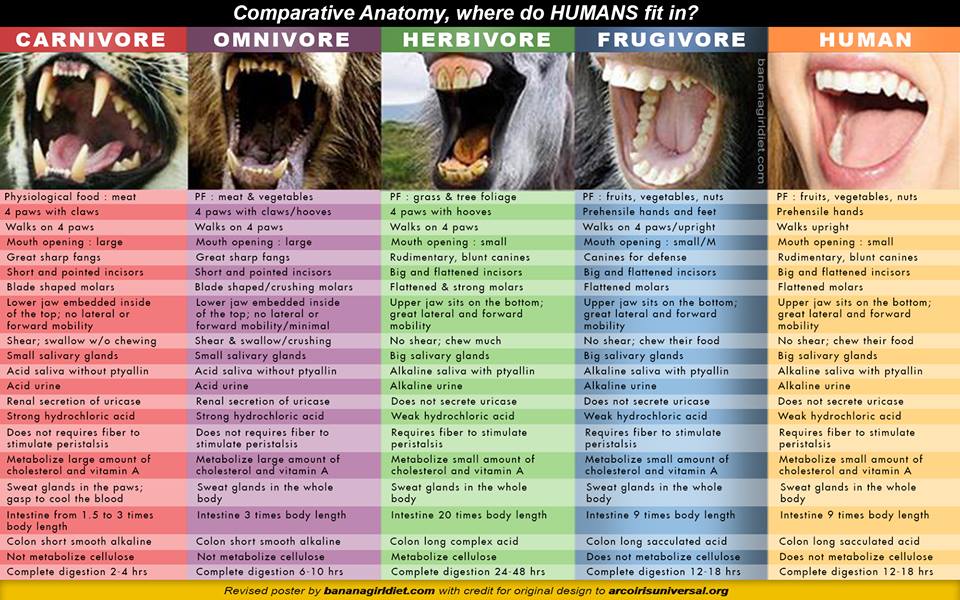
There is significant and growing debate about how omnivorous our bodies are.  We have short/blunt teeth, the ability to move our jaws side to side, no claws, and shorter intestines, all traits typical of herbivores.  If a human adopts a meat-only diet, they'll likely die of scurvy in a hurry.

Many ancient cultures were mostly, or even entirely, plant-based.  The plant-based cultures were often the longest-living ones.

You're perpetuating the big lie that meat is nutrient dense and plant-based foods nutrient-poor.  The truth is the opposite, plant-based foods have more nutrients per calorie and often a wider array of nutrients than animal-based foods.  Medicine?  Most medicines are synthesized from plants.  And 80% of our medical costs go to treat people with diet and lifestyle diseases that are caused by eating meat/dairy/eggs (and, to be fair, refined carbohydrates).  The truth is the opposite of what you've said on almost every point.

When I was an omnivore, and later when I was a pescetarian, I took a tonne of supplements to make up for the fact that I couldn't eat nearly as many nutrients as I can on a whole-food, plant-based diet.  Now I take no supplements at all, aside from vitamin D (and I only take that in the winter).

No, humans are entirely omnivore. A plant only diet is unnatural to humans and will slowly kill someone or permantly cause damage to their bodies unless they take supplements. Our bodies require enough nutruits from meats/animals based products that we need a daily intake of some of it. 

B1 - 
 

Signs of Deficency 

Muscle pain – typically in the calves due to rapid accumulation of lactic acid after slight physical activity

Congestive cardiac failure – shortness of breath, fluid retention and a rapid and sometimes bounding pulse

Peripheral neuropathy – loss of sensation and sometimes strength in the hands or lower limbs

Wernicke’s Encephalopathy – ataxia (unsteadiness), impaired consciousness and problems of eye movement

Korsakoff’s Psychosis – loss of memory for both new (anterograde) and past (retrograde) events together with confabulation, making up a version of events to cover for the loss of memory

Other features – hypothermia, hypotension (low blood pressure) and autonomic neuropathy


B12 - 

Signs of deficency are nervous system damage, memory loss, confusion, dementia and abnormal blood cell production

Here's more info on B12 deficency symptoms. https://en.wikipedia.org/wiki/Vitamin_B12_deficiency


Vitamin D -

Signs of deficency are bone/muscle pain, weakness, softening of bone.


A long lasting or severe deficency in any of these could easily cause permanant damage and they only come from animals. Did you know that a deficency in B12 and B1 can impair a person intellectuallly? 


Veganism and vegetarianism are unhealthy/unnatural lifestyles for human beings and because of that they require supplements to live like that. Vegans or vegetarians can prattle on all they want about how healthy their diet is but it's a complete utter lie. If someone wants to live either of those lifestyles, by all means have at it but don't try to spread misinformation about it to mislead people into thinking it's a healthy or a better lifestyle compared to living as a omnivore. 


Dark_Lord_2008 said:

Will we ever see a Mr Olympia winner on a Vegan/Vegetarian diet? Get as jacked as Phil Heath, Jay Cutler, Ronnie Coleman, Dorian Yates, Lee Haney or Arnold off eating a plant based diet! 

Yes.  The only American weightlifter to qualify for the most recent Summer Olympics was vegan.  His omnivore compatriots were unable to even qualify!  (source:  http://www.mensjournal.com/health-fitness/articles/why-americas-best-olympic-weightlifter-is-vegan-w434203)

A quick web search for vegan weightlifters shows some pretty jacked up people:  https://www.bing.com/images/search?q=vegan+weightlifters&FORM=HDRSC2

And Arnold Swartzenegger is transitioning towards veganism himself now.

It's actually easier to build muscle as a vegan.  Meat, dairy, and eggs create systemic inflammation in the body.  Inflammation reduces the body's recovery rate.  You get to work out more times per year as a vegan than you do as an omnivore, due to faster recover times.


Aeolus451 said:No, humans are entirely omnivore. A plant only diet is unnatural to humans and will slowly kill someone or permantly cause damage to their bodies unless they take supplements. Our bodies require enough nutruits from meats/animals based products that we need a daily intake of some of it. [...]

Veganism and vegetarianism are unhealthy/unnatural lifestyles for human beings and because of that they require supplements to live like that. Vegans or vegetarians can prattle on all they want about how healthy their diet is but it's a complete utter lie. If someone wants to live either of those lifestyles, by all means have at it but don't try to spread misinformation about it to mislead people into thinking it's a healthy or a better lifestyle compared to living as a omnivore. 

You make bold citations, offer only a single citation (to Wikipedia no less) to a nutrient that *animals cannot make* and that factory farmed animals are routinely supplemented in.  You additionally mention:

Vitamin B1, which is rich in the plant kingdom, and found in abundance in foods such as sunflower seeds, navy beans, black beans, barley, peas, lentils, oats, etc.

Vitamin D, which our bodies make from the sun (or is easily supplemented if you spend most of your time in your basement).

Your fundamental tenant that we need meat is a complete falsehood.  Why is there no RDA (recommended daily amount) of meat then?  Why does almost every government health body on the planet recognize that a plant-based diet can easily be nutritionally complete?  Because you're spreading fear and falsehoods, without a single scientific citation, that's why.  All the while saying it's the commonly scientifically accepted and well cited claims of others that are false.

Over the course of this thread I've provided dozens of citations.  You provided a link to wikipedia, for something that bacteria (not animals) make.  So I'll try to ask this politely...  are you OK?  Your message seems a bit manic, honestly.


scrapking said:
Azuren said:
[...]And before anyone chimes in with "he must not know how to be vegan": my sister-in-law is a souschef, and has managed to keep her body in a healthy state (she went vegan with him). He eats what she makes, and she makes healthy food that covers all bases. At the end of the day, mankind is omnivorous and we've evolved with as much in mind. Cutting out meat for some might work, but for many it can result in losing health, not gaining it.


Despite my hate for fish, I've always been a huge supporter of ovo-pescatarianism. Seafood and eggs for animal products, everything else follows vegan diet rules. The bonuses include:

Readily absorbed nutrients; many nutrients we need for our body can can obtained from plants, but the yield is much lower and requires vitamin supplements to make up for it. An example is vitamin A: yes, you can get it from kerotine, but the yield is low enough that a responsible dietician would recommend supplements instead. (Bonus Round: Do you have bad thyroids? Then kiss vitamin A goodbye if you're going to be a vegan, because you won't be able to convert it out of kerotine with bad thyroids)

Actual B12; you get B12 from a few things. Animals, animal biproducts, and... Dirt. So unless you're a fan of eating unwashed veggies, this is something you'll miss out on.

"Good" Protein; don't drink the Kool-Aid, kiddies, because the plant-based proteins you think are the same? They're not. They aren't as readily absorbed, and are just about as useless as trying to get Vitamin A out of kerotine. (Devil's Advocate Mode, Activate: While vegans don't get enough good protein, they do get enough protein. In fact, most people in America are getting too much protein)

Omegas; This is something that is almost exclusive to fish, so don't expect much of it elsewhere. You can get some from things like flaxseed, but as with most nutrients in plants, much of it is not readily absorbed.

And finally, not being full-on vegan means you can compensate with any multivitamins you want. That means no matter how unhealthy you are being, you can always override some of it with a supplement. Being vegan means you can't use most supplements, because guess where B12 supplements come from? Animals (for the overwhelming majority of options, anyway). Guess what you're probably going to be deficient on?

B12. Yay!

There are too many variables to make anything from the anecdotal evidence of this one person you know who ended up underweight.  However, when doing population studies, only vegans on average end up in the ideal BMI zone.  Vegetarians on average are heavier than ideal, pescetarians worse still, omnivores heaviest/worst of all.  We can all point to exceptions that prove the rule such as this person you knew, but the rule is that vegans average in the ideal BMI zone and all other groups do not.

A big problem with being a pescetarian is that for generations we've used the oceans as a dumping ground for pollution, and we continue to do so.  Seafood are full of heavy metals, PCBs, and other fun things.  And like with mammals, fish don't create nutrients.  By eating fish you're choosing to filter your nutrients through third-parties, rather than going to the source.  If you want that kind of nutrient profile, you can get it by eating sea vegetables (seaweed, algae, etc.), which is what I do.  That way you can get virtually contaminant-free sources of those same nutrients.  With how polluted much of the world is getting, it's never been better to eat low on the food chain than it is these days.

If you're eating the rainbow, plant nutrients are just as bio-available as filtering them through the bodies of animals.  For example, vitamin C makes plant-based iron extremely absorbable.  Another example, black pepper increases the bio-availability of turmeric by about 2000%.  Many plant foods have more absorbable nutrients when cooked than they do raw (eg. spinach, carrots, etc.).  If you eat the rainbow, and mix it up when it comes to cooked vs. raw, then you'll probably do well even without doing any research.  A food plan makes things even better.  And no one needs a food plan more than these omnivores who keep suffering and/or dying of heart disease, diabetes, strokes, etc., so this is not something unique to a plant-based diet.

B12 arguments are self-defeating.  Unless you're eating animals who ate food on the ground themselves, those animals will also be B12 deficient.  They give B12 supplements to factory farmed animals, which is the overwhelming majority of meat that people eat.  We've made our soil so sterile of the bacteria that causes B12 that unless you're gardening and/or eating unwashed vegetables, you'll need supplemented B12.  Whether you get your B12 from a pill, or whether you filter that B12 through an animal to tie it up with a bunch of cholesterol, saturated fat, and animal feces, most people are getting supplemented B12 either way.  BTW, I do eat unwashed leafy greens, and if I made you a salad you wouldn't know they were unwashed.  Unwashed doesn't mean covered in dirt, they get rained on after all, and you can brush them off without washing them.  The important thing is to leave the bacteria on them, not to leave the dirt on them.  :)

As you say, the average person in the western world gets twice as much protein as is optimal for human health.  However, studies have shown that vegans and omnivores have nearly identical blood levels of proteins (in fact, most studies that show a statistically significant difference actually show vegans having higher blood levels of protein).  Only plants can take nitrogen out of the atmosphere and synthesize amino acids, so only plants can create "protein" (which isn't really a thing, but a category of things).

Omega 3 fatty acids aren't exclusive to fish.  Flax seed and chia, pound for pound, have way more omega 3s than fish.  And where do the fish get it from?  From algae, of course.  So your comments on this are demonstrably incorrect.  And the omega 3s in flaxseed are extremely well absorbed by the body, the arguments some people level again plant-based omega 3s are about the conversion rate, not the absorption, as there are three kinds of omega 3 fatty acids.  ALA is the kind found in a variety of plant foods.  DHA is the kind you find in algae.  EPA is a kind that animals convert ALA and DHA into.  The less DHA (and EPA) you consume, the better your conversion rate.  The more you consume, the less the conversion rate matters.  I consume a lot of ALA, and a small amount of DHA, and my omega 3 levels as a vegan are excellent.

What B12 supplement comes from animals?  B12 is a bacterial waste product.  Don't they just culture the bacteria to create the B12?  I did a quick web search and couldn't find anything that backed up your claim.  In any case, since B12 supplements are commonly marketed to vegans, it's effortless to get B12 supplements that are free of animal products.

As for multivitamins, I've never taken one and can't imagine why I would.  How does some multinational know what nutrients I need more of?  Besides, supplemented vitamins are often worse than taking no supplement at all.  A good example of this is vitamin C:  in its natural state in whole plant foods, vitamin C is an anti-oxidant (which you want it to be); vitamin C supplements, however, may have a pro-oxidant effect on the body (which you definitely DO NOT want).  So, no, you can't just be an omnivore and take a multivitamin and have a guarantee of health.

When I was an omnivore, and later when I was a pescetarian, I took a lot of supplements.  All of that meat, fish, dairy, and eggs were very low in nutrients per calorie, and I was trying to make up for that.  Now that I'm on a strictly plant-based diet (plus mushrooms, which technically aren't a plant), I get more nutrients per calorie, and the foods I eat have lower caloric density, and I eat the rainbow, so I get more nutrients (and a wider variety of nutrients) as a vegan.

Anecdotal evidence is simply anecdotal. It's not there to prove anything, it's there because it shows that being vegan isn't as cut-and-dry as vegans want people to think. Vegans do tend to be thinner, but that's almost never because they're healthy be ause most vegans don't know how to properly be vegan in a healthy way. Many are like my brother: changing diet with only the okay from a rabidly vegan dietician (the worst kind of dietician).


As far as the "fish are tainted" argument is concerned, first of all a healthy diet includes one, maybe two meat-centric meals a week, so most of those fears are quashed fairly quickly by moderation. And as far as the polluted argument as a whole is concerned, you'd have to be grossly naive to think your fruits and veggies are noticeably better.


And you're still getting B12 in readily available sources, as opposed to your leafy greens that were "washed in rainwater" (Warning: WILL contain levels of feces that can dip into what the FCC would refer to as unacceptable). B12 is just something you're not going to get enough of as a vegan.


And more readily absorbed protein is that which has been processed by animals more fit for a vegan diet.


Never said it was only in fish, I said "almost exclusive". And surprise: the omegas you get from flax and algae are- you guessed it- not readily absorbed by the human body.


Most B12 supplements are derived from animal B12. The process to extract B12 from bacteria into pill form isn't a widely used practice for whatever reason, making truly vegan B12 hard to get.


As for this next paragraph, you pretty much dismiss every "Veganism can be healthy"  argument, since most rely heavily on supplements. Yes, you can do it without, but only the most hardcore will do so.


And what? My anecdotal evidence is null and void but yours isn't?


As a closing statement on this post, humans have had meat in their diet from long before they even invented tools. We're talking tens of thousands of years, across multiple species and continents. Not only that, but there's never been a functioning vegan society. Sure, some societies had less access to meat, but it was because of scarcity, not conscious decision. You can be vegan, and if it works for you, fine. But don't lie to people about the potential danger of such a drastic diet change, because then you get scenarios where quack doctors pissing an agenda end up actively causing harm to people like my brother.


Watch me stream games and hunt trophies on my Twitch channel!

Check out my Twitch Channel!:

www.twitch.tv/AzurenGames

Around the Network

Aeolus451 said:

No, humans are entirely omnivore.[...]

Are you so sure?  For your consideration:


scrapking said:

Aeolus451 said:

 No, humans are entirely omnivore.[...]

Are you so sure?  For your consideration:

The human part is missing how is doesn't readily absorb most plant nutrients. Frugivore is also a fancy way of saying "Not a carnivore". Most frugivores are omnivorous, though, so we could draw the conclusion that humans are most likely omnivorous.


EDIT: Oh, right, and the Frugivore option is also missing insects. Yum.


Watch me stream games and hunt trophies on my Twitch channel!

Check out my Twitch Channel!:

www.twitch.tv/AzurenGames

scrapking said:

Aeolus451 said:

No, humans are entirely omnivore.[...]

Are you so sure?  For your consideration:

They defined by their diets. I was expecting more of a counter at least on some of it or something. 


scrapking said:
HoloDust said:
What's with the necrobump?

Anyway, as vegetarian for some 23-24 years I couldn't care less if any of diets are healthy or not - live and let die, and all that jazz - just don't fucking touch my cheese.

I discoverd that back in May some people had replied to me in this thread, and I simply hadn't realized it until today.  I didn't want to be rude, so I replied.  Whether it's a new thread or a very old one, no need to jump in for those who're not interested, I figured.

Either way, enjoy your casomorphins.  ;)  (https://yumuniverse.com/addiction-to-cheese-is-real-thanks-to-casomorphins/)

Mmmmm...maybe I should start snorting cheese. :p


Azuren said:

Anecdotal evidence is simply anecdotal. It's not there to prove anything, it's there because it shows that being vegan isn't as cut-and-dry as vegans want people to think. Vegans do tend to be thinner, but that's almost never because they're healthy be ause most vegans don't know how to properly be vegan in a healthy way. Many are like my brother: changing diet with only the okay from a rabidly vegan dietician (the worst kind of dietician).


As far as the "fish are tainted" argument is concerned, first of all a healthy diet includes one, maybe two meat-centric meals a week, so most of those fears are quashed fairly quickly by moderation. And as far as the polluted argument as a whole is concerned, you'd have to be grossly naive to think your fruits and veggies are noticeably better.


And you're still getting B12 in readily available sources, as opposed to your leafy greens that were "washed in rainwater" (Warning: WILL contain levels of feces that can dip into what the FCC would refer to as unacceptable). B12 is just something you're not going to get enough of as a vegan.


And more readily absorbed protein is that which has been processed by animals more fit for a vegan diet.


Never said it was only in fish, I said "almost exclusive". And surprise: the omegas you get from flax and algae are- you guessed it- not readily absorbed by the human body.


Most B12 supplements are derived from animal B12. The process to extract B12 from bacteria into pill form isn't a widely used practice for whatever reason, making truly vegan B12 hard to get.


As for this next paragraph, you pretty much dismiss every "Veganism can be healthy"  argument, since most rely heavily on supplements. Yes, you can do it without, but only the most hardcore will do so.


And what? My anecdotal evidence is null and void but yours isn't?


As a closing statement on this post, humans have had meat in their diet from long before they even invented tools. We're talking tens of thousands of years, across multiple species and continents. Not only that, but there's never been a functioning vegan society. Sure, some societies had less access to meat, but it was because of scarcity, not conscious decision. You can be vegan, and if it works for you, fine. But don't lie to people about the potential danger of such a drastic diet change, because then you get scenarios where quack doctors pissing an agenda end up actively causing harm to people like my brother.

I didn’t say your anecdotal evidence is bad and mine is good.  Over the course of this thread, I’ve provided dozens of citations.  I occasionally add anecdotes to my comments as well (usually my personal experience), but those are simply to add texture to my citations.  You provided no citations, yet made claims, and provided nothing other than an anecdote to support your claim.

Nothing is cut and dried when it comes to an individual, but things can be cut and dried when it comes to population studies.  If only vegans average (note the word average) in the healthy BMI range, and every other group (including vegetarians) average above the healthy BMI range, then that’s important and valuable research that makes your anecdotes and mine equally irrelevant.  You then go on to say that vegans are thinner “but that's almost never because they're healthy,” and this is where your argument falls apart as you are making an important claim, with nothing other than an anecdote to back it up.  In fact, study after study shows that vegans typically *are* healthy.  They don’t average in the underweight zone, they average in the healthy BMI zone, and I’ve previously provided a citation for that.  Sedentary vegans have better heart health than marathon-running omnivores on average, and I’ve previously provided a citation for that.  Vegans are less likely to get a raft of cancers than omnivores, and I’ve previous provided a citation for that.  They’re less likely to get heart disease, to suffer a stroke, to have erectile dysfunction, etc.

A vegan dietitian is the worst kind of dietitian?  You come off sounding like you have an axe to grind.  I think the worst kind of dietitian is one who is behind on the best/most independent (not funded by vested interests) science and/or doesn’t communicate the best science to their clients for fear that they won’t stick to it.  I’d rather dietitians give it to people straight, and let people make their own compromises.

Fruits and veggies are as polluted in mercury and PCBs as fish?  Again with your bold, unsupported claims.  The foods highest in PCBs are all animal products:  http://www.dirksfish.com/pdf_files/PCBs_in_Food.pdf  Similarly, the foods highest in mercury are animal foods:  https://www.livestrong.com/article/318127-list-of-foods-that-are-high-in-mercury/  Importantly, fruits and vegetables have potent anti-oxidant abilities, so they’re typically less likely to be contaminated and they’re more likely to help the body cope with what contaminants it does get exposed to (such as all that Fukushima radiation that got dumped into the ocean, as one example).  http://www.hungryforchange.tv/article/19-foods-to-naturally-detox-radiation

Again with the B12.  Did you read my previous posts?  I’m genuinely curious.  B12 comes from bacteria.  Factory farmed animals are given B12 supplements.  If you eat meat from the grocery store or a restaurant, odds are high that you’re getting supplemented B12 yourself.  Getting a B12 supplement filtered through an animal’s body, rather than just taking one directly, isn’t a very compelling argument to me.  As for your claim that most B12 supplements aren’t vegan, I have done several web searches and have been unable to corroborate your claim.  So without a source from you, I’m not sure what to make of your claim.

Your protein argument is a non-scientific argument that has been roundly debunked.  Vegans have similar blood levels of protein to omnivores.  Most people, vegans included, absorb more protein than is ideal for optimal health.  So less readily absorbable protein is if anything *ideal* for optimal human health.  There’s growing evidence that an abundance of protein in the diet has an anti-nutrient effect on the body, tying up your your body trying (and largely failing) to absorb excess protein when it could and should be focused on absorbing other nutrients instead.

I would be surprised if your uncited and unsubstantiated claim that the omegas from flax seed weren’t readily absorbable by the body, since the science says otherwise.  The omega 3s in ground flaxseed are readily absorbable.  I *think* you may be confusion the arguments around absorption vs. the arguments around ALA conversion.

As for absorbing omega 3s from algae?  Dah fuk?  The nutrients in algae are some of the most readily absorbable on the planet.  You do know that algae is the source for omega 3s for the fish, right?

You then claim only the hardcore will be healthy on a vegan diet without supplements, but again the facts suggest otherwise.  I’ve previously provided a citation that the average vegan in the U.S. is deficient in 3 essential nutrients, but that the average omnivore in the U.S. is deficient in 7 essential nutrients, for example.  The majority of the supplement industry is marketed towards omnivores, it’s only a small sub-set of the industry that chooses to offer its products in what it designates as vegan (eg. egg-free, dairy-free, gelatin-free, etc.).  Most either aren’t vegan, or don’t choose to market themselves as vegan, as omnivores are their target audience.  Obviously that makes sense since omnivores are the majority of the population, but it does speak to the fact that millions of omnivores choose to supplement.  So the supplement argument is a non-starter, especially since vegans statistically are less deficient on average than omnivores.

I find it interesting that you even offer a “closing statement” as if you were trying to prove your case.  You haven’t many claims but no citations, so offering a closing statement is premature.  I disagree with much of what you’ve said, and have previously provided a large number of citations as to why I disagree.

Again with your claims that ancient societies all had a meat-based focus, or high levels of meat in their diet.  Again, rehydrated fossilized human stool, hair analysis, and more differs from that claim.  Citations previously provided if you scroll back.

Finally, you end by calling me a liar.  You haven’t provided a single citation, I’ve provided dozens, and I’m a liar?  That’s pretty damn crazy, you realize that right?  I’m not lying at all, this is what I personally believe, this is what I’m personally experiencing, and this is what the evidence is showing.  Vegans in general are healthier than omnivores in general.  Look at my previously posted citation to the Adventist studies.  They pit healthy omnivores vs. healthy vegetarians vs. healthy vegans (since adventists tend to take their overall health very seriously).  The vegans suffered less cancer, less heart disease, less diabetes, and less overall mortality.  You believe based on your relative’s experience that it’s hard to be healthy as a vegan, but the evidence doesn’t bear that out.  When I see all the omnivores dropping dead of heart disease, and stroke, and diabetes, it seems like being a healthy omnivore is what’s perilously hard.