Bofferbrauer said:
Soundwave said:
The GameCube kinda showed though that even at $99.99, Nintendo was easily being outsold by the PS2 and even the XBox.
So I'm not sure if simply having just a cheap system alone really is the be all, end all. The GameCube only got to 22 million, and it was $99.99 for like half of its life cycle.
My personal feeling -- don't make just one console.
That's supposedly the whole point of the NX concept per speculation no? Multiple hardware lines that play the same ecosystem of software? Why not have multiple options then?
NX Tablet - Portable of course. 500 GFLOPS.
NX Family Console - Classic Nintendo console, small form factor, 1 TFLOP processing power. New type of gimmicky controller (though not super expensive) Cheap $249.99 MSRP.
NX Pro Console - Made more for the needs of the Western market. 3 TFLOP processor (this will be noticably better than a PS4). Larger console size. $349.99 MSRP.
A game like Super Mario Galaxy 3 (hypothetical) could run at 960x540 with low effects and no anti-aliasing on the NX Tablet, but at 1920x1080 (full HD) resolution with higher end effects on the NX Pro Console. The NX Family Console (Famicom!) can run the game somewhere in between, 720p resolution with medium effects.
|
There are some problems there though. We already had some similar things in the and none of them worked out.
Sega came with the 32X, NEC with the TurbographX (base Model was the CoregraphX). Both failed for the same reason: The extended model could also run the games of the base model but not vice-versa. Thus the base model had a much bigger Install base and everyone produced games for them, as that one was more viable to bring profits. It's also why the Commodore Amiga failed (apart from piracy, every game was copied by the shitton and then some): While later models had vastly expanded capacities, everyone was still programming for a basic Amiga 500.
You can bring both side by side, but that confuses the consumers even more than Nintendo did by naming the Wii U so close to it's predecessor. Also goes for the games themselves: If they have different sections (and thus different boxes) in videogame stores, it will confuse the consumers even further; If they don't and use the same support, well, it will still confuse the users since those with the smaller model ain't sure it works on his model while those of the extended model are not sure to get anything more or different than the base model.
Oh, and you meant probably 3 TFLOPS processing power, not processor. Most of the processing power is delivered by the graphics chip, not the CPU.
The 3 Teraflops model also comes with an additional problem right now: It's actually too powerful. And thus produces too much heat for such a small case a console uses (RROD, anyone?). We will have to wait until 14/16nm processes are widespread enough with good yield rates to reduce the TDP to affordable levels for a console (which is ~170W max, Wii U is at 45W, but in an even smaller casing), but also for other technical advances in instructions both for CPU and GPU. Which all means such a model wouldn't come out before holyday 2017 at the earliest, with 2018 or even 2019 being much more realistic. Oh, and the price would be higher than 349$ for that one, that's for sure. Even more with Nintendo, who doesn't like to sell hardware at a loss.
|
The 32X is 20 years ago, Commodore is 30+ years ago. I think it's fair to say the electronics world is different today. Things like the Sega Channel (online network) failed in the 90s too, that doesn't mean online networking didn't eventually take off. Palm Pilots and PDAs kinda failed in the 90s too, but smartphones took off like a rocket in the 2000s. 30 years ago, there weren't like tons of choices in electronics.
Today you can buy a Macbook Air, Macbook, Macbook Pro depending on what your needs are, but they all basically run the same OS and same software applications. iPhone, iPad, iPod Touch, again similar concept. In today's world the consumer has choice, and we are used to that and choice is good. Why should I buy a Macbook Pro if all I need is a Macbook Air?
I'm suggesting ALL games play on ALL variants too, just at different settings (resolution, effects), much like PC games work on a wide range of PC hardware. So that you don't have the issue of "I don't have hardware version X, so now I can't play this game".
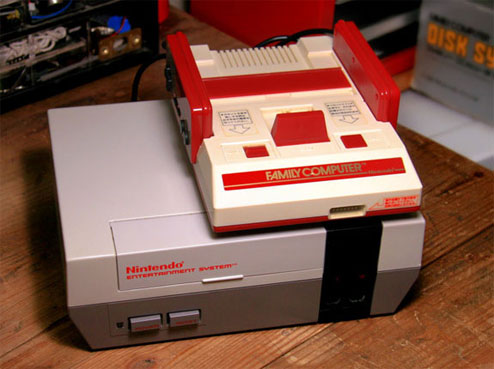
Also the consoles could be different sizes, "one size fits all" is becoming a tired line of reasoning IMO. The Pro version could be bigger. Even back in the day look at the size difference between a US NES and a Japanese Famicom:
I'm guessing the NX concept will use mobile parts too all the way up from the bottom to the top, so mobile processors akin to the Tegra X1. Just scale the chips up or down, but they should have fairly low power consumption and small size foot print.