




The Castlevania Series Review Part 1. Reviews of Castlevania, Castlevania 2 Simon's Quest, Castlevania 3, Super Castlevania 4, Castlevania Bloodlines, and Dracula X.
The original classic style of Castlevania is a stage based platform series where you attack oncoming enemies with your whip or subweapons. In the original title, you'll start off with a leather whip, but as you collect hearts, there are two more upgrades to the whip that turn it into a chain whip then morning star. Your subweapons, dagger, axe, cross, and holy water each take a single heart to use and getting the double shot and triple shot items allow for up to three subweapons to be on screen at once.
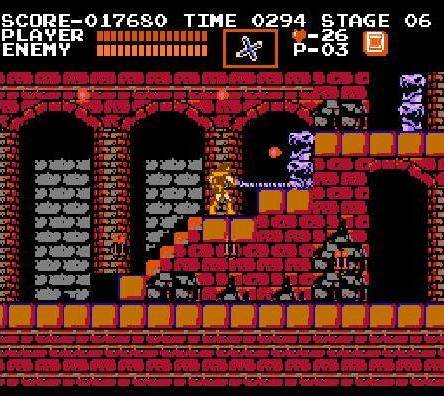
In the original Castlevania you play as Simon Belmont to defeat Dracula. Stages are designed well, and there are a few tricks that you can use to get knocked to different areas of the current screen and skip small sections of the stages. Difficulty is good, decent AI, and enemy placement is set up so you know what you're expecting and won't get hit with cheap deaths. Some subweapons are just too good though. The holy water freezes anything it touches and you can just keep throwing holy water and the enemy just sits taking damage. The dagger is pretty useless, the axe is one step above, so you're pretty much going to get the cross or holy water and hope you don't get either of the others. Stop watch is okay, stops most enemies, slows some, but doesn't deal damage. You'll find situations where some weapons are better than others, but the cross and holy water are almost always the best you can have at any time.
Gameplay - 9
Design - 9
Presentation - 9
Balance - 8
Overall - 8.75
During his battle with Dracula, Simon suffers a wound that is cursed and his flesh starts to rot. Simon must make his way back to Castlevania after acquiring all of Dracula's body parts to revive and defeat him once again in order to rid himself of the curse.
Simon's Quest is actually very different from the original title. It's Symphony of the Night before Symphony of the Night even existed. Simon starts off in a city and you can proceed however you wish. I originally beat this game without any help from a guide or anything, but since I've played through the games several times and already knew where to go without talking to anyone or without searching for any hint books within the game, I talked to all the townsfolk and acquired the hint books that were noticeable to see if there was enough information given to finish the game without requiring the player to go online. While there are a lot of false clues, most clues to complete the game are easy to find except for two. The clue that tells you to kneel while holding a crystal is in a location you'd never think of attempting to break and the clue telling you to show the ferryman Dracula's Heart you might pass up, and even if you don't, the English translation makes it unclear as there are two clues and the other one doesn't help even if you did find it.
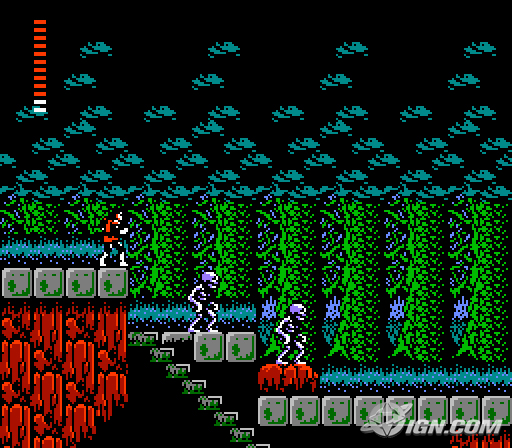
While you get subweapons this time around, you won't lose them when acquiring another one. Some subweapons don't even require hearts, though some do. Killing enemies and acquiring hearts is actually your source of money, rarely will you use it for subweapon usage, and as long as you progress through the game and don't die, you won't have to grind for it much. You'll use hearts to purchase more powerful whips or different subweapons. Other than subweapons, You have equippable items that lend you their effects. Dracula's body have effects that help the player, such as the rib which will work as a shield to reflect projectile attacks, Dracula's Eye will reflect the curse, the different colored crystal balls will allow you to see invisible platforms or progress past certain areas.
Since Simon's Quest is open world, not all failed jumps result in death. If there's no water then you'll drop down to a lower level and have to climb back up. Across the world there are a few towns and four mansions, so it's a fairly large game. Most enemies unfortunately walk back and forth, maybe walk the players direction, float towards the player, or hop towards the player, etc. The AI is rather lacking and the only reason the game can be difficult is if you're not equipped with a powerful enough weapon. A leather whip at the end of the game will be atleast eight hits on most enemies, if not more.

Some mansions and a couple parts in the world map have invisible walls and invisible floors. There really aren't many sections of either, but two areas you're required to pass are invisible walls in the mansions. On one part, if it's not an invisible wall you'd end up dying, but you could throw holy water and check, the other part just looks like a dead end. Some people might go to the internet when they don't immediately find where to go, while others may keep at it since the mansions aren't very large.
Gameplay - 6
Design - 8
Presentation - 6
Balance - 5
Overall - 6.25
Trevor Belmont appears in Wallachia as towns are being overrun by Dracula's monsters. While on his way to Castlevania, he gets the help of Grant DaNasty(Dynasty,) Alucard, and Sypha Belnades. Going back to the original level based style, as you progress through the game you can ally yourself with one of three characters, each having their own skills and weaknesses, and switch back and forth between them or Trevor. Grant can move faster and jump higher, but he can also stick and climb along any wall or ceiling, while he has less defense and his weapon is a dagger that attacks straight ahead of him very quickly with short range. In the Japanese version, his regular attack is the dagger subweapon and the only subweapon he can acquire is the axe, while the western version he can get the Axe or Dagger. Sypha can acquire three spell books as her subweapons, as well as the stop watch. The ice book freezes surrounding enemies which a single attack will shatter, the fire book fires shoots out a wave of fire about the distance of Trevor's whip and much more powerful, while the thunder book shoots out three orbs which home in on their enemies and are about as powerful as the fire books single flame wave. Sypha's defense is worse and she has the same movement as Trevor, but she attacks as quickly as grant with a short range weapon that hits in an arc, so a little above her to slightly below her midsection. Alucard also has less defense than Trevor, he can turn into a bat and fly which slowly uses hearts, can use the stop watch, and is the only other character which his attack upgrades. His level one attack shoots a ball of energy straight forward, second level shoots one forward and one upward at an angle, third shoots one forward, one upward at an angle, and one downward at an angle.
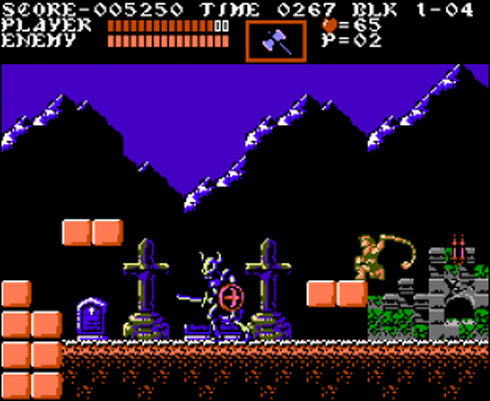
While in the original game you travel along a predetermined path of stages, Castlevania 3 allows you to choose which stages you go to. If you go through one path, you will go through stages you wouldn't go through going through the other path, but also get a different character. Going through the B path is harder than the A path with level designs that are really there to make use of Alucard's bat transformation. While going through a good portion of the game, the difficulty isn't too hard, going through route B and a lot of the later levels in route A are very difficult. If you die at some of the more difficult spots, it makes it that much harder to progress because most of the checkpoints are right before the hardest parts when you're equipped with nothing. The difficulty is also rather cheap at times with enemy placement and the level design. If you're not good at the series, this is one of the last games you'll probably want to play if you're attempting to actually finish the game. To those people who commplain about having to restart at the beginning of the stage when dying all your lives, Castlevania 3 has you start at the last point you received an orb, meaning there are several points in the game you might go back a stage rather than start at the beginning of the one you're on.
Gameplay - 9
Design - 7
Presentation 9
Balance - 6
Overall - 7.75
100 years after his last battle with Dracula, Simon Belmont ventures to Castlevania to do battle once again. Super Castlevania 4 is actually a remake of the original game while the localization tries to imply this is the third time Simon has fought Dracula, but not until they say how every 100 years Dracula awakens to be defeated by the Belmont family. Clearly the localization team didn't pay attention to what they were translating in the first section of the opening.
While a remake, the game is completely new. Simon can now whip in eight directions, hold his whip out and damage enemies, and has a somewhat controllable jump instead of the definitive location that he'll land on previous titles. In the earlier titles, and really because of weaker hardware, holding up and attacking to use one of your subweapons while on a ladder didn't always respond properly, so the subweapon has been changed to its own button allowing better use of the subweapon. It allows you to duck and use a subweapon which would have been beneficial in the older releases at times. There are also hooks within the game that Simon can latch his whip onto and swing across, or just swing back and forth if you want to.

The cross is now the only overpowered weapon in the game. The holy water is certainly powerful, but not game breaking powerful as it was in previous games. The axe is about as useful as it was in Castlevania 3, at times it's really useful because of the stage, but other times you're better off using your whip. The dagger might not be too useful, but it's more useful of a weapon than it was before now that throwing a lot faster so several daggers thrown could technically be better than the cross at certain points, but you'd also be using a lot more hearts in the process.

This game is several times longer than the original. Once entering the main gatets, Simon will go through forests, caves, resorvoires, and some dungeons before he even reaches the castle. Then he'll go through sections of the castle, many as representations from the original game in some way. Throughout the game you'll fight all the bosses from the first game, all the monsters, and then some. The game is very well balanced getting ever so slightly more difficult the further you get. There's never a part within the game that is too hard to progress if you die, but the game isn't easy. It's still got a bit of difficulty, but is the most accessible game in the series to those who haven't played it.
Other than the overpowered cross, the only issue Super Castlevania 4 has is the slowdown during points in the game when a lot is going on. It's fairly infrequent, so it's not much of an issue, but it does happen. I could mark off one for the localization issue and this graphics issue, but I'm letting it go.
Gameplay - 10
Design - 10
Presentation - 10
Balance - 10
Overall - 10
Castlevania Bloodlines is the first game in the series they attempt to tie the series into Bram Stoker's Dracula as well as real world events. John Morris who's the son of Quincy Morris from Bram Stoker's Dracula and Eric Lecarde venture forth to kill Elizabeth Bartley, a vampire who's trying to resurrect Dracula.

You can play as both John Morris and Eric Lecarde, each plays a little bit different. John Morris can jump and attack in seven directions, every direction except up, though can only attack left and right when on the ground. John can also latch his whip onto any platform above him with a diagonal whip to pull himself in that direction. Eric can attack in all five directions surrounding him so long as he remains on the ground, and while jumping can only attack two directions ahead of him. Eric can also duck onto the ground and do a pole vault, jumping straight up and damaging anything in his path several times higher than his normal jump. Because John can swing across and Eric can pole vault, certain stages have two different ways to progress and each characters abilities will let him progress through one of the paths.
Power ups are still there, where each character powers his weapon up twice, though subweapons have changed a bit. The holy water and axe remain, cross has been changed to the boomerang, and there are some high damaging special subweapons only if you get a third magic power up. Damage for the subweapons have been tweaked a bit and I find holy water in this game to be mostly useless only because there's not many enemies you can hit with it, with the axe being more powerful than the boomerang but boomerang has more range.

Stage design is good. While playing through the game at the end of the game there are also a few really unique ways to progress. There's one mirror room where the image is showing the player and portions of the stage that are shifted to the left, so by looking at the portions that aren't shifted and shifted, you're supposed to gauge whether a platform is where you're going to jump or not, while another section has entire screen upside down and the player walking along the ceiling, and while right and left work the same, up is down and down is up. Bloodlines has a continue limit though and you only get two or three continues before it's game over.
Gameplay - 10
Design - 10
Presentation - 10
Balance 9
Overall - 9.75
Dracula X. The SNES version of Rondo of Blood. Graphically it's better, but that's about it really. Aside from when going from some areas to the next the backgrounds don't fit together at all and it's just a poor transition, it's actually got a really good level design with stages completely different from the original Rondo of Blood. enemy placement is good mostly, but then there are issues with it. The Belmont's don't need to run, they walk everywhere, but in this game, Richter couldn't possibly walk any slower, or he could, but then I couldn't use that cliche. Anyone who plays the game, whether it's regularly or otherwise probably starts jumping because it speeds you up, but once you jump you can only attack or use a subweapon until you land, so you may receive unexpected damage. Whenever getting damaged, Richter has almost no recovery time, so at times it's never just getting hit once, it might be two or three times before you get out of some enemies range.

As you progress, there are some parts in the game you can get knocked off an edge and you don't die, you go to a different stage instead, similar to Rondo of Blood having different stage exits. On Dracula X though, by not getting past these points you'll actually miss out on the good ending.
Daggers are once again more useful than before, Richter now throwing three at once so a wider area and they cross the screen near instant. Everything else is balanced well and the cross is still really good, but no longer the super overpowered weapon it was in the previous games. Every subweapon is worth using now.
Gameplay - 6
Design - 6
Presentation - 5
Balance - 5
Overall - 5.5






















 .
.