By using this site, you agree to our Privacy Policy and our Terms of Use. Close

Forums - PC - AMD first to reach 5GHz with FX-9590 processor

Just wanna point out that my 8350 that I got on sale with 990fx quad sli gigabyte mobo for 299, 6 months ago runs at 4.7 ghz. AMD have to be absolutely insane to ask that much money for this.

Stock 8350 could easily reach 5ghz with proper watercooling (not all in one watercooling units)...


Around the Network
Scoobes said:
AMD, still chasing the clock speed dream. I somehow doubt this will come close to the single threaded performance of a similarly priced Intel chip. There is literally no point in AMD competing in the high end of CPUs, Intel just have way too many advantages.

APUs however...


Only advantage AMD have is price(not present here with this cpu), multithreaded performance and Steamroller which should yield 15-20% performance improvements while still using am3+ socket. People who invested in an am3+ mobo 3 years ago will certanly get their moneys worth.


disolitude said:
Scoobes said:
AMD, still chasing the clock speed dream. I somehow doubt this will come close to the single threaded performance of a similarly priced Intel chip. There is literally no point in AMD competing in the high end of CPUs, Intel just have way too many advantages.

APUs however...


Only advantage AMD have is price(not present here with this cpu), multithreaded performance and Steamroller which should yield 15-20% performance improvements while still using am3+ socket. People who invested in an am3+ mobo 3 years ago will certanly get their moneys worth.

Not sure how much of an improvement that'll be with the new Haswell chips out. Even the old Sandy Bridge CPUs outperform the majority of AMDs AM3+ chips.

Personally I think AMD should just forget about the performance end of the X86 market. Concentrate on APUs where they can leverage their GPU tech for more balanced hardware.


fordy said:
ethomaz said:
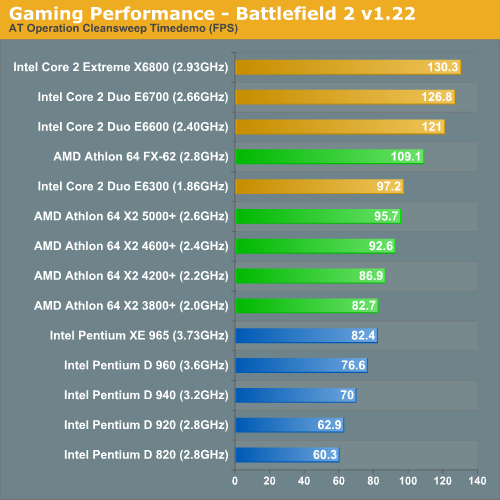
It is a share how today a AMD CPU running at 5Ghz can't hold a Intel CPU at 3Ghz in single clock performance... but when I remember around 2004 lol how the things changed.


Why? What happened around 2004, and how is it relevant to now?


Athlon 64 happened. And, before it, Athlon XP happened. It's relevant because of context: Those CPUs outperformed the much-higher clocked Pentium 4/Pentium D, while now what happens is the exactly opposite. And those AMD CPUs actually outperformed Intel's at a lower price...


disolitude said:
Scoobes said:
AMD, still chasing the clock speed dream. I somehow doubt this will come close to the single threaded performance of a similarly priced Intel chip. There is literally no point in AMD competing in the high end of CPUs, Intel just have way too many advantages.

APUs however...


Only advantage AMD have is price(not present here with this cpu), multithreaded performance and Steamroller which should yield 15-20% performance improvements while still using am3+ socket. People who invested in an am3+ mobo 3 years ago will certanly get their moneys worth.

I'll bet you that an AM3 Steamroller will never be released.

The reason I know this is that server roadmaps have to extend further and be more reliable than desktop ones, and they don't show a Steamroller CPU without an APU. And the economics of a new die and socket validation for a $150+ desktop part that doesn't come out on server are unworkable.


Around the Network

That thing consumes 220W.

Speedy but I wish AMD wouldn't push GHz war anymore.


e=mc^2

Gaming on: PS4 Pro, Switch, SNES Mini, Wii U, PC (i5-7400, GTX 1060)

RazorDragon said:
fordy said:
ethomaz said:
It is a share how today a AMD CPU running at 5Ghz can't hold a Intel CPU at 3Ghz in single clock performance... but when I remember around 2004 lol how the things changed.


Why? What happened around 2004, and how is it relevant to now?


Athlon 64 happened. And, before it, Athlon XP happened. It's relevant because of context: Those CPUs outperformed the much-higher clocked Pentium 4/Pentium D, while now what happens is the exactly opposite. And those AMD CPUs actually outperformed Intel's at a lower price...

As mentioned before, the fact that AMD outperformed Intel for that time wasn't because the Athlon architecture was entirely spectacular, rather it was Intel's stubbornness to embrace NetBurst as part of it's marketing ploy to "make clockspeed count". This became more evident when Intel eventually scrapped NetBurst and moved to Core architecture, and overnight we saw Intel CPUs once again outperforming Athlons, despite the fact that Athlon had an on-die MMC. Once Intel followed suit with an on-die MMC in Nehalem, it only pushed their performance even more strides ahead of AMD.


Soleron said:
yum123 said:
so If clock speed is becoming more irrelevant. what are the best measurements to look for when choosing a cpu. number of cores and?

No easy number any more. Look up benchmarks for the kind of application you're interested in.

So its essentially firmware and certain software features for each cpu now 


yum123 said:
Soleron said:
yum123 said:
so If clock speed is becoming more irrelevant. what are the best measurements to look for when choosing a cpu. number of cores and?

No easy number any more. Look up benchmarks for the kind of application you're interested in.

So its essentially firmware and certain software features for each cpu now 

I think what he's trying to say is that some CPUs excel at some things compared to others. There's no clear-cut defined number to show which CPU is superior to all others, given all the factors such as cycles per instruction, instruction pipelines, complexity of branch predictors, etc. 

So the best way to measure CPU capability is to test it using tests designed for what you'd expect to use it for (video benchmarks usually stress test streaming, gaming benchmarks measuring FP computing etc.)



fordy said:

As mentioned before, the fact that AMD outperformed Intel for that time wasn't because the Athlon architecture was entirely spectacular, rather it was Intel's stubbornness to embrace NetBurst as part of it's marketing ploy to "make clockspeed count". This became more evident when Intel eventually scrapped NetBurst and moved to Core architecture, and overnight we saw Intel CPUs once again outperforming Athlons, despite the fact that Athlon had an on-die MMC. Once Intel followed suit with an on-die MMC in Nehalem, it only pushed their performance even more strides ahead of AMD.

The K8 architecture was really spectacular... it did miracle in performance until Intel moved to Core 2 (the first Intel Core was still below what AMD had at that time).

Core 2 changed everything...