




By using this site, you agree to our Privacy Policy and our Terms of Use. Close

Forums - PC - Leaked AMD Roadmap - Steamroller Delayed, Trinity on Rise

New developments in AMD's plans for 2013 have become apparent, thanks to a roadmap leaked by the Turkish site Donanim Haber. If this slide is accurate, the first thing you'll notice is the eerie lack of Steamroller, intended to be Piledriver's successor, which points to another delay; Piledriver cores will remain the foundation for the 2013 generation of AMD x86 desktop processors, though new chips will also be released in the Trinity line (with upgraded integrated graphics chips) and Brazos platform, the low-power option for netbooks.


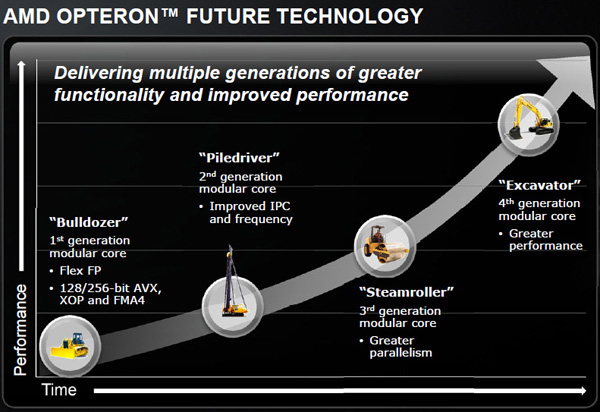
It should be noted that none of these chips will use Steamroller, AMD's next planned architecture, which will supposedly deliver large improvements over the Piledriver series. This means -- assuming this graphic is legitimate -- we likely won't see Steamroller until 2014, when we suspect AMD will next release its new architecture.
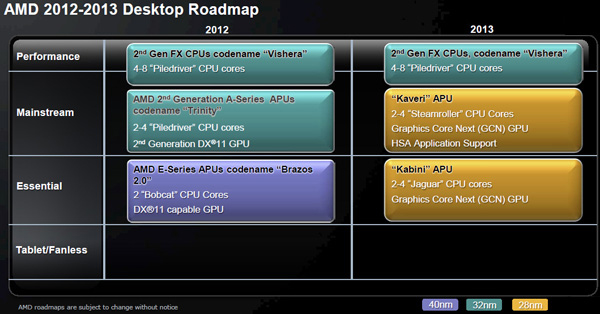
The original roadmap: Steamroller was originally slated for a 2013 release.

With AMD's Bulldozer and Piledriver platforms outperformed by Intel's Sandy Bridge and Ivy Bridge series (though not in the $100 market, but the $120 i3-3220 gives AMD a run for its money), AMD seems to have directed its attention away from performance CPUs for 2013, and is instead developing their APU branch. This could be a wise move considering AMD's recent difficulties. Because PC enthusiasts and performance users make up a microscopic percentage of AMD's customer-base, it's not all that surprising that AMD is stepping back for a moment to re-evaluate its plans for future performance CPUs and niche markets.
APUs fit in cleanly with AMD's general approach to offering solid performance at a low price; by eliminating the need for a dedicated video card, they make it possible to own a cheap build that can handle casual gaming in addition to everyday tasks. We first featured AMD's earlier APUs in our HTPC build guides, which were targeted toward home-theater and gaming-lite system builders.

The two new chips on the chart are codenamed Richland and Kabini. Richland includes an improved integrated Radeon chip, where Kabini is slated to replace Brazos 2.0 in netbooks and other mobile devices, using the new low-power Jaguar cores (replacing Bobcat). Vishera will remain AMD's high-end CPU for 2013—whether it can still attempt to compete with Intel remains to be seen.

Link


Around the Network

is it me or is the background of the text black?


Face the future.. Gamecenter ID: nikkom_nl (oh no he didn't!!) 

There is no way for AMD to get back competing above $150 in desktop CPUs, or in mobile or server at all. These delays only underline that point.

The current gen Piledriver on 32nm can't compete with Ivy Bridge on 22nm
So a Steamroller on 28nm in 2014 certainly won't compete with Haswell on 14nm. That's ~4x the transistor density AND a greater per-core performance disadvantage to now.


AMD need to aggressively push their APUs. The only way they can compete with Intel now is offering greater value for money by having decent CPU performance whilst giving much greater GPU performance then Intel HD4000 graphics.


This isn't good for CPU prices. AMD becoming less and less relevant will give Intel little to no incentive to keep costs down.



Around the Network
Darc Requiem said:
This isn't good for CPU prices. AMD becoming less and less relevant will give Intel little to no incentive to keep costs down.

This has already happened.

Cheapest quad-core processor:

2007: Intel Q8400, $183
2012: Intel i5 2320, $177

Incidentally the Q8400 existed as a response to the Phenom II X4 940 being competitive. After that point, no AMD flagship ever was, and thus a whole $6 price drop for quad-cores beyond that.


Soleron said:
Darc Requiem said:
This isn't good for CPU prices. AMD becoming less and less relevant will give Intel little to no incentive to keep costs down.

This has already happened.

Cheapest quad-core processor:

2007: Intel Q8400, $183
2012: Intel i5 2320, $177

Incidentally the Q8400 existed as a response to the Phenom II X4 940 being competitive. After that point, no AMD flagship ever was, and thus a whole $6 price drop for quad-cores beyond that.


Ironically it's probably as much Intel trying to keep AMD arround so as to avoid strict anti monopoly regulations as anything. If Intel wanted to get rid of AMD they could lower prices across the board and AMD would be dead real quick. I mean Intel makes twice as much profit as AMD makes revenue these days. 


@TheVoxelman on twitter

Check out my hype threads: Cyberpunk, and The Witcher 3!

zarx said:
...


Ironically it's probably as much Intel trying to keep AMD arround so as to avoid strict anti monopoly regulations as anything. If Intel wanted to get rid of AMD they could lower prices across the board and AMD would be dead real quick. I mean Intel makes twice as much profit as AMD makes revenue these days.

That's one theory. Intel are also forced to have a 60% gross margin by their shareholders, because they include big pension funds and other risk-averse groups. This seriously limits their control over pricing. AMD is able to survive by taking 40% or less.

Also Intel is competing with themselves somewhat: they need to persuade people that buying a new PC is indeed better. Their recent focus has been more on battery life than high-end performance for this reason.

Hopefully Apple/Qualcomm/Samsung using ARM will emerge as a viable alternative for desktop chips.


Soleron said:

That's one theory. Intel are also forced to have a 60% gross margin by their shareholders, because they include big pension funds and other risk-averse groups. This seriously limits their control over pricing. AMD is able to survive by taking 40% or less.

Also Intel is competing with themselves somewhat: they need to persuade people that buying a new PC is indeed better. Their recent focus has been more on battery life than high-end performance for this reason.

Hopefully Apple/Qualcomm/Samsung using ARM will emerge as a viable alternative for desktop chips.


I don't think that ARM is going to enter the X86 market any time soon, and I don't see x86 in the desktop going anywhere any time soon ether, too much legacy code. Intel are already starting (the first 2 generations of Atom were a joke but things are starting to look better) bringing the fight to ARM, and they have a hell of a lot of R&D money to throw around and Win8's tablet focus as a catalyst. 


@TheVoxelman on twitter

Check out my hype threads: Cyberpunk, and The Witcher 3!

zarx said:
Soleron said:

That's one theory. Intel are also forced to have a 60% gross margin by their shareholders, because they include big pension funds and other risk-averse groups. This seriously limits their control over pricing. AMD is able to survive by taking 40% or less.

Also Intel is competing with themselves somewhat: they need to persuade people that buying a new PC is indeed better. Their recent focus has been more on battery life than high-end performance for this reason.

Hopefully Apple/Qualcomm/Samsung using ARM will emerge as a viable alternative for desktop chips.


I don't think that ARM is going to enter the X86 market any time soon, and I don't see x86 in the desktop going anywhere any time soon ether, too much legacy code. Intel are already starting (the first 2 generations of Atom were a joke but things are starting to look better) bringing the fight to ARM, and they have a hell of a lot of R&D money to throw around and Win8's tablet focus as a catalyst. 

I'd say 95% of what people and businesses do with computers is Internet, Email, Office, Pictures, Video, Messaging. For them, you can present a tablet-like interface on top of arbitrary hardware and it still does what they want. I expect WinRT desktops within a year of 64-bit ARM, if Metro is at all viable.

Legacy code can be divided into games (which can be emulated) and professional applications (probably no fix).

I agree Intel's not going down without a fight and that ARM is not magic, but well with AMD dead, ARM is the only alternative. Dell/HP etc will be desperate to find a supplier to pressure Intel with.