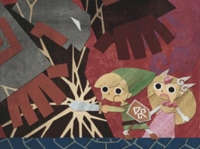
To Sheik's quote: That's right, I had forgotten that line. Still, Zelda's relation of the legend is somewhat suspect for reasons I'll get into later, but also because there was one set of circumstances (the backstory of Wind Waker) where it simply failed to come true.
To the untranslated quote: well, the last two lines were basically in the game ("The history of light and shadow will be written in blood!"), but as to the rest of it? You'll have to keep reading. I do find it interesting, though, that he refers to "the gods you believe in", which implies that he may not share the views that the Triforce goddesses are what people assume them to be.
I fear I am on the edge of that most hated phenomenon, the argument concerning series canon, which is first cousin to the Babylonian whore itself, the dreaded Timeline Argument (tm). To that end, I will talk about one of the themes that I find more interesting in the series as a whole, and Wind Waker/Twilight Princess in particular: that is, the problem of the unreliable narrator.
In most fantasy stories, things are accepted as being generally true just because they are related to you. No one is able to lie about the past, either by intentional falsehood, unintentional misleading, or omission. The Legend of Zelda is interesting to me as a narrative whole because it never seems to expect us to accept people relating the past as telling the truth.
Probably the best examples of unreliable narrators are the King of Hyrule and Ganondorf in Wind Waker. Both present a more or less true version of events, but both lie about different things either because they don't know (the King says that Link is in no way related to the Hero of Time, though Valoo proclaims him to be the Hero of Time reborn) or because they are just lying (Ganondorf talking about the goddesses intending to destroy Hyrule and its people) or because their preconceptions have colored how they see events (this applies to both of them in many places).
This is just as true in Twilight Princess, though to a different degree. Zant says that dwellers of the light were responsible for oppressing the Twili; Midna claims that the goddesses themselves chased her people out of Hyrule; the Light Spirit Lanayru claims (and even shows, in allegory) that the light spirits of Hyrule were the ones to seal away the fused shadows and the Twili. Even Lanayru fails to tell the entire story, though: the story it relates implies that they were sealed away from the Sacred Realm itself, while the actual point where they were banished from is atop the Arbiter's Grounds deep in the Gerudo Desert, implying that there was a long chase and probably some kidn of battle. None of these accounts is entirely true, and it's impossible to get a full idea of what happened just by listening to the stories they relate. Each of them is colored by particular biases, even Lanayru, and each of them is suspect in different ways. I find this immensely interesting.
This extends to the holders of the Triforce as well. Each of them, up to and including Ganondorf, refer to the pieces of the Triforce as the blessing of the gods, with Ganondorf in particular claiming that he was chosen to wield power, giving him a divine mandate to rule over all worlds (which makes his desecration of the statues of the goddesses considerably more complex than it seemed at first glance). Zelda believes she was similarly chosen by the gods. We know, though, that neither of those things is true: the Triforce was split when Ganondorf touched it, and went to those whose qualities were best suited to wield it. Ganondorf rebels against the idea of destiny as instigated by the gods, when the actual engine of his fate is his own ambitions in another time and place. Zelda's power is similarly there as a result of his actions. So is Link's. Whenever Ganondorf or Zelda ruminate on the fate given to them by the gods, their ruminations are suspect by sheer virtue of the fact that they can't possibly know how the Triforce pieces came into their possession. Their entire outlooks become suspect, predicated on a single idea ("I am chosen by the gods") that is in no way demonstrably true and may be demonstrably false. Zelda's attribution of the events of Twilight Princess to the plan of the goddesses becomes the rationalization of someone who doesn't have the perspective to be able to see that all of these events - good and bad - came about as the consequences of actions that were immensely evil.
That there is some degree of fatalism in the themes of Twilight Princess is obvious, but it is important to consider the point that there is little textual basis for viewing fate as the engine of the gods; rather, it seems to be the engine of consequence, where the primary instigator of conflict (the Twili, Zant, Ganondorf) is the one responsible for the events that play out. I think you are right in that it is about fate, but on a very personal level: Ganondorf continues to destroy himself over and over and over. Sometimes he doesn't even realize that he's doing it, and sometimes he's not even doing it directly. His perspective is warped, and his fate is sealed by his lack of perspective.
Just about the only person whose perspective we can trust, interestingly, is Link himself.




Existing User Log In
New User Registration

Register for a free account to gain full access to the VGChartz Network and join our thriving community.