









| Hardstuck-Platinum said: I'm pretty sure that Sony has realised that skyrocketing prices has made the high end PS6 model (codename Orion), no longer viable as a mass market product. |
And I'm pretty sure they don't care. There's no way PS6 & Helix aren't at least $1000 without being loss leaders. Outside of maybe Nintendo, consoles are shifting to a high-end luxury product. As prices of current-gen consoles have increased, so has the average income of console buyers. Here's how much things shifted in the U.S. in just under a four-year span according to Circana:

And this shift to continue to become even more lopsided in the near future. The biggest barrier of entry into a console's ecosystem is the hardware itself. 35 years ago a SNES cost only $489 at launch in current dollars. Five years later an N64's adjusted launch price was $423. The following generation, the PS2's adjusted launch price was $563. But that was also a time when we had price cuts, two years into their lives, the SNES cost $100 ($230 adj.), the N64 cost $130 ($265 adj.), and the PS2 cost $200 ($368 adj.). Five years into its life, the PS2 was down to $150 ($251 adj.). Right now, a PS5 disc edition costs $650, and the Series X disc edition costs $800. There's not chance in hell that at this rate the next gen consoles don't cost $1000 at launch. External inflationary pressures (tariffs, the Iran War, and "A.I.") are definite factors, but so is the end of the idea that consoles should be "loss leaders" where they make up for the loss through software and accessory sales. The focus is now on maintaining and increasing profitability, which does not necessarily require retaining a large customer base.
With Sony's impending shift to all-digital, they'll be making substantially more profit per game, they're probably hedging their bets that whatever they lose in volume they'll make up for in per-customer profitability. Even if they lose half their customer base to a combination of people unable to buy a PS6 because of the price, unwilling to buy a PS6 because of the price, or unwilling to buy a PS6 because it doesn't support physical games, if they're making twice as much profit per customer, it all comes out even. And we're seeing this in a lot of other places.
Live events like concerts and wrestling shows have seen ticket prices explode much faster than the rate of inflation. In terms of sticker price, a single ticket to a regular Monday Night Raw now costs almost a much as what it cost me and three friends to see the Royal Rumble in 2010, for the same seats (about three rows up from the floor). Admission to Disney World/Land has outpaced the rate of inflation by a significant amount. More and more people are being priced out of more and more things. About the only things that haven't outpaced the rate of inflation are movie tickets, TV sets, CDs, and video game software. More and more corporations would rather make more money off of fewer customers these days, preferring to appeal to people with at least six-figure incomes. If they lose half their customers but make twice as much per customer off the remaining half, they're still making the same amount of money. And those people who are better off will still likely be in a better position to spend on lower- to mid-level luxuries in tough economic times, as opposed to lower-income people who will just forgo those things entirely if things get worse because they simply can't afford it. I live off of $23k/year. Definitely low-income. Fortunately I have just myself to take care of. If I saved up and used tax return money, I could afford to buy a PlayStation one year and an Xbox the next like I did this generation and last (got a PS4 & PS5 both at launch, got an XBO & XBS the following year), but now I'd only be able to afford one even if I wanted (and if the Helix doesn't support physical, I'm done with Xbox as well).
I mean, when corporations see graphs like these:

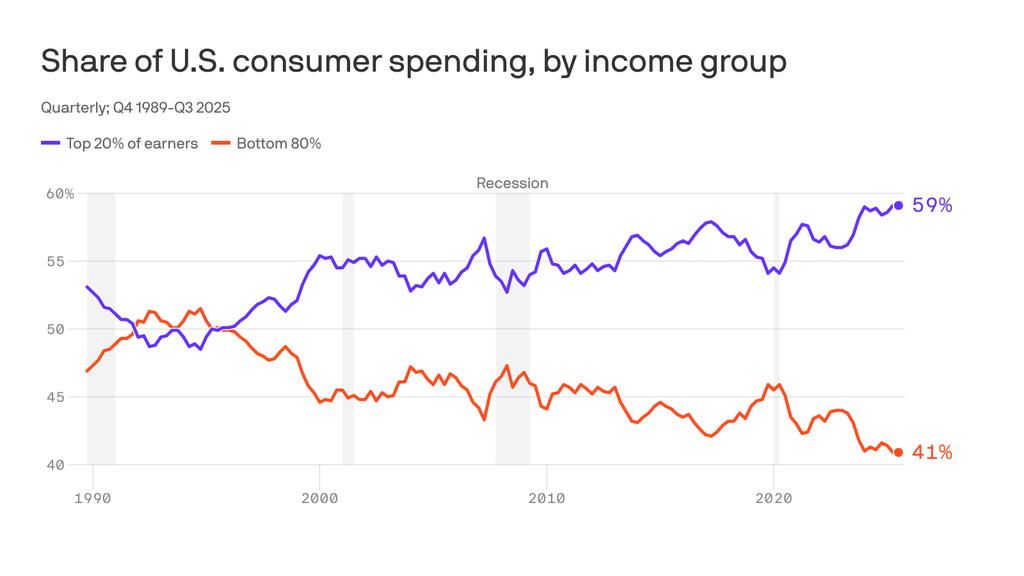
It's no wonder why more and more of them are increasingly disinterested in making the fun things in life affordable for lower-income households. Hell, even necessities are still getting more expensive as inflation is steadily increasing again. And now we have "A.I." and automation coming for most of our jobs. It's almost like the capitalist class and wealthy people in general just don't care what happens to all of us poors. Like I said, I've lived off of $23k a year for a while, and now I'm at the point where about the only fun thing I get to do anymore is occasionally go to the theater on half-price ticket Tuesdays. Buying games and Blu-rays has slowed down a lot over the past year. Hard to enjoy fun things when you're broke half the time. My house payment went up last year because of rising insurance rates, I have medical bills mounting after an incident back in December, and I had to make multiple repairs to my vehicle, including a new clutch. When you're living paycheck to paycheck, your ability to enjoy luxuries like video games could vanish quickly because of other priorities. If you're making $100k+ a year, you're far more insulated against these things. That's why people making that kind of money are now over half of console buyers, and it could easily grow to 60%, 70%, or more next generation. It's going to be a rich person's hobby.
Visit http://shadowofthevoid.wordpress.com
 Art by Hunter B
In accordance to the VGC forum rules, §8.5, I hereby exercise my right to demand to be left alone regarding the subject of the effects of the pandemic on video game sales (i.e., "COVID bump").


