Nintendo says that it sold 3 million Wii systems in December and 4 million copies of Super Mario Brothers 5. 1up then incorrectly says that NPD does not include Wal-Mart sales in their numbers. NPD may not track Wal-Mart sales directly, but they are estimated and put in. So Wal-Mart’s numbers are definitely included in NPD.
Now, nothing about Mario 5’s sales are surprising to me. In fact, it feels like old news. To those young people wondering how things were like when classic Mario was out, this is how it was. Mario games just kept selling and selling and selling. When people got angry or confused when I said that 3d Mario was not selling as Mario should, I am referring to this sales phenomenon you are seeing before your very eyes today. In Japan, the situation is even more pronounced.
The hardcore melting down… yet again… is because they, once again, wrote a narrative in their mind that the Wii was doomed. Well, the Wii is not doomed yet. It will, naturally, be doomed tomorrow.
Now, I stated the reason why the Wii sales declined. The hardcore did not listen and just yelled “fanboy!” at me. I said the Wii sales declined because Nintendo put out bad software. In fact, this software was unusually bad because they were not just bad games, they were anti-content games. The entire User Generated Content direction was the cause of such bad software. And there was quite a consumer backlash. Anyone calling Wii Music’s few million sold as “good” needs to remember that it came out on the fastest selling console ever that was still sold out, during the holidays, with massive amounts of marketing, with Wii in its title, as a flagship Wii game, being made by Nintendo, and championed by Shigeru Miyamoto and the game only sold a few million. That is disastrous. And then the Wii momentum almost immediately reversed itself. The Wii, completely sold out, had Nintendo desperately cutting the price on it a year later. That was how bad momentum had dropped. (And the price drops didn’t do anything. It was the arrival of correct software that rocketed the Wii up again.)
Reports of the Wii’s death have been exaggerated. While hardcore gamers were squealing with joy about Wii’s year over year ‘drop’, the Wii may very well ‘grow’ this year compared to 2009’s flat performance. If they accepted what I said that User Generated Content and the bad software it was making was the source of Wii’s problems instead of screaming “fanboy!”, they wouldn’t be so shocked today.
Again, Mario 5’s success is old news to me. At E3 2009 when everyone was buzzing and yucking it up about Wand and, especially, Natal, I said no one is going to remember either one and that E3 2009 is going to be remembered for the year when Mario returned to home consoles. Of course, I was called ‘fanboy!’ for that.
If you want to know about the past of gaming, go to a game journalist website. If you want to know the present of gaming, go to a message forum where they are constantly up to date. But if you want to know about the future of gaming, you come to this webpage. While people digest and talk about Mario 5’s sales, I am thinking more about Zelda Wii, and Nintendo’s new console they are cooking up in their labs right now. Now is the time when Nintendo will begin hardening the direction they will be taking with their new console. As comparison, the philosophy of the Wii and its general direction was hardened back in 2004. Console business is very tough and it takes years for these companies to go from their established ideas to hardware of amount to be shipped over the world.
Since Zelda’s peak was not classic Zelda but Ocarina of Time, it shows that the antidote to Zelda’s problems is not going to be identical to Mario’s problems. A New Legend of Zelda isn’t going to work. As I have said before, I believe the solution to Zelda is to return the series to its tight action based gameplay that was prominent in the classic Zelda games and in Ocarina of Tme as well. Zelda games have been snooze fests lately.
In the short term crystal ball, I see Mario Galaxy 2 doing nothing. I believe there are as many people who disliked Mario Galaxy 1 than people who liked the game. If Mario Galaxy 1 didn’t sell a person to the Wii, Mario Galaxy 2 won’t do it either.
Metroid: Other M isn’t going to do anything either (though we don’t know much about this title). I’m pretty much burnt out on 3d Metroid games for a while. I’m sure you are as well. There are tons of Metroid released games in the last few years. More Metroid is not the solution.
I would, however, be greatly excited over a 2d Metroid that resembles Super Metroid. This is a spot that Metroid Prime couldn’t scratch due to its 3d nature. A 2d Metroid game on the home console would be fantastic.
One of the reasons that Mario 5 is selling so well, that no one says, is because it is treating Mario 5 consumers like first class customers. If you like 2d platforms or even Mario platformers, how were you treated? You had to buy a port such as the GBA classics. You were stuck with download only games. But these gamers never got the royal treatment of a full retail release of a quality 2d platforming game.
All these people who say these type of games belong on handhelds or on download absolutely infuriate me. What you are saying is that I must be treated as a second class customer. For well over a decade, I’d had the “Industry” and other people tell me my interests in games should be stuck or confined to some side room. I am not allowed in the main room with my interests. So you people can go to hell, I’m going to the Mushroom Kingdom.
I don’t see anything at this moment )pre-E3 2010 and pre-Vitality Sensor) going on for the Wii outside of riding Mario 5’s sales (which should stop sometime around 2029). The one exception would be Monster Hunter Tri. I have never touched a Monster Hunter game and this game has my attention big time. I didn’t care about it on PSP because people in the West do not play big games on handhelds. Japanese do because they are all weird or something over there. But in America, at least, we like our big games on big TVs.
Unlike the PSP games, Monster Hunter Tri has potential to expand in the West. Hopefully, Reggie and all do not screw it up. I don’t see Dragon Quest IX being able to be sold well due to the RPG being stuck on a handheld (and if Nintendo couldn’t do it with Dragon Quest 1 while practically giving it away with Nintendo Power during the NES golden days, I doubt NOA could do it today). Yet, the more I find out about Monster Hunter Tri, the more I like it. And Wii owners are starving for game content (which Monster Hunter Tri is reportedly said to have much of).
Check out the Monster Hunter Tri website (which is currently in teaser mode). Try knocking on the door. There is surprisingly much detail put in. The guy keeps saying new things on and on and on seemingly forever. The game looks very promising. And I think it will appeal to those who are former gamers.
Another thing is that World of Warcraft is ripe to be plucked. The heavy stigma that is on WoW and its players reminds me of prior to when the Wii launched on game consoles in general. People are ready for something to take WoW’s place. Ironically, it won’t be another MMORPG. What will replace WoW will be a smaller game, very playable in groups and especially with couples, and could even be entirely offline. Remember, people don’t play WoW to play online with auction housese and all. They play WoW to romp around a massive fantasy world with their friends and spouses. WoW will be co-opted from a place no one is going to suspect. But perhaps that is better discussed in another post.
Meanwhile, we have Mario 5 ripping through the markets. Behold the impact below:

Normally, I ignore message forum posts. But when they talk about Blue Ocean Strategy or disruption, I feel it is somewhat my duty to step in to protect the integrity of the works. What is odd is that this post on disruption comes out of nowhere in a Mario 5 thread where no one was talking disruption.
On GAF, I read this:
Innovator’s Dilemma is frequently mentioned in these forums, but I’m not sure how many people truly understand it. I say this, simply because so few people have pointed out the glaring distinctions between Christensen’s prototypical “disruption” and the actual one we’re seeing in the games industry.
One of the primary reasons why disruption occurs, according to Christensen, is that companies are constantly chasing the enthusiastic, highly devoted consumer. In most industries, this absolutely makes sense, because in most cases, highly devoted consumers provide larger profit margins. Not only is that empirically true, but it simply makes sense: of course it’s possible to profit more on incredibly enthusiastic customers. People who don’t care very much are going to be very picky about price, while people who care a great deal can be exploited for more cash than might seem otherwise necessary.
The problem is, this isn’t how the gaming industry works, and it’s part of the reason the game industry’s disruption has been so dramatic and controversial. It is the new markets that provide higher margins, while the established markets are providing either no profits at all or losses. On a per capita basis, Sony and Microsoft should be capable of reaping more profits out of us (i.e. the “hardcore” gamers) than Nintendo is out of these new — and presumably less dedicated — consumers. Sony and Microsoft have failed so spectacularly at this that they are clearly banking very hard on this “convergence device” future.
I bring all this up for a reason: many have pointed out in the past that according to The Innovator’s Dilemma, the disruptive company will eventually begin to move upmarket and invade established segments. However, the whole reason disruptive companies do this is because the higher end markets typically provide higher gross margins. Therefore, the theoretical impetus for Nintendo driving upmarket is essentially nonexistant.
All of this could have been explained very simply, with one rhetorical question: why would Nintendo spend the money and resources driving upmarket when that upmarket isn’t profitable? (Of course, the answer is that they would not). I just felt it was odd that no one have ever pointed this out, because the standard “disruption” model has some pretty significant distinctions from what we’re seeing in the games industry, yet no one ever points these out.
The reason why no one points this out is because that is Blue Ocean Strategy, not disruption. Blue Ocean Strategy is all about removing oneself from competition and going after a new market. Disruption is far more complex than Blue Ocean Strategy (And BSO is pretty complex itself if anyone has gone through the book. There is much more to it than just ‘blue ocean’ and ‘red ocean’ metaphors). The articles I’ve written on the subject of disruption do not even really get to the heart of it. I just hope the articles are a bridge to a gamer wondering what is going on and the actual work itself.
In such matters, I will let Christensen speak for Christensen:
“The disruptive innovation theory points to situations in which new organizations can use relatively simple, convenient, low-cost innovations to create growth and triumph over powerful incumbents. The theory holds that existing companies have a high probability of beating entrant attackers when the contest is about sustaining innovations. But established companies almost always lose to attackers armed with disruptive innovations.” (From the Introduction in “Seeing What’s Next”)
In other words, if Nintendo had followed the sustaining innovation of graphics and processor speeds that Microsoft and Sony were going on, Nintendo would have surely lost. However, Christensen says that a disruptive company almost always wins when the other companies go the path of sustaining innovation. I think that is quite a statement for any business analyst to make.
If Microsoft and Sony keep going the sustaining path (such as making better Wii-motes), they will always lose to Nintendo provided that Nintendo goes a disruptive path.
The Console War has always been which console is faster, which console is prettier, and the Console War has been measured in symmetrical lines. But the battle this generation and future generations are going to be asymmetric. Think of the computer companies or software companies where each is trying to disrupt another. That is the future of video game console generations. (Natal is a classic ‘co-opting’ attempt of the Wii’s disruption. Unfortunately for Microsoft, the execution is all wrong.)
One thing that people must remember is that there is more than one type of disruption:
“Disruptive innovations introduce a new value proposition. They either create new markets or reshape existing markets. There are two types of disruptive innovations: low-end and new-market. Low-end disruptive innovations can occur when existing products and services are “too good” and hence overpriced relative to the value existing customers can use. Nucor’s steel minimill, Wal-Mart’s discount retail store, Vanguard’s index mutual funds, and Dell’s direct-to-customer business model were all low-end disruptive innovations. They all began by offering existing customers a low-priced, relatively straightforward product.
“The second type, new-market disruptive innovations, can occur when characteristics of existing products limit the number of potential customers or force consumption to take place in inconvenient, centralized settings. The Kodak camera, Bell telephone, Sony transistor radio, Xerox photocopier, Apple personal computer, and eBay online marketplace were all new-market disruptive innovations. They all created new growth by making it easier for people to do something that historically required deep expertise or great wealth.”
Nintendo is following both Blue Ocean Strategy and disruption. So the Wii is very much a new-market disruption, not a low-market disruption. Since video games revolve around the software and not the hardware, we are going to have to focus on the software.
Disruptive games are hot. Sustaining games are not. While games like Wii Sports Resort sell tons, they aren’t driving the same exact craze about the Wii as Wii Sports did. But Wii Sports Resort is a sustaining improvement over Wii Sports.
Super Mario Brothers 3 launched to great craze and excitement. However great that excitement was, none of it matched the original Super Mario Brothers. Mario 3 was a sustaining innovation on Mario 1. Mario 1 truly was a disruptive type of game. It changed video games forever. It placed gaming in a new context of use (such as popularizing background music). This is why Mario 3 sold less than Mario 1 despite Mario 3 being the better game (“But Mario 1 was bundled so how do you know?” Not in Japan it wasn’t. At least, not that I think.)
Mario 4 (Super Mario World) was a sustaining innovation over Mario 3. This is why that game had less excitement than both Mario 1 and Mario 3.
Mario 64 is an interesting case. The entire 3d revolution in gaming is what Christensen would refer to as a radical sustaining innovation. He makes this distinction to explain the explosion of interest when televisions went from black and white to color. Gaming going to 3d was still a sustaining innovation… just a radical one. Mario 64 did receive much excitement over this radical sustaining innovation. The sequels of Sunshine and Galaxy did not receive equal excitement.
NOA would define Super Mario Brothers 5 as a ‘new market disruption’ in that it is bringing in people to buy the Wii purely for Mario 5. However, due to the 3d revolution being a ‘radical’ sustaining one, I think we can only conclude that Mario 5 is a low-market disruption. 3d Mario games with their orchestra music and all are “too good”. Mario 5 gamers do not want all that. They are quite happy with the 2d.
But the point is that the New Market Disruption coincides with the Blue Ocean Strategy quite nicely:

Here is another illustration:
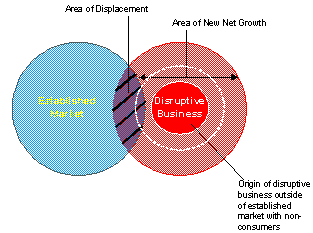
New market disruptions often migrate to low market disruptions. I believe we are going to be seeing this more and more with the Wii.
New market disruptions do their disruption by getting traditional customers to defy the incumbent and join the new context of use. While Microsoft made Natal to attempt to co-opt the entire Nintendo disruption, Sony appears to either be cramming with the Wand (just throwing out technology) or is trying to defend its position. In other words, before Sony gamers defect to the Nintendo motion control games, the Sony motion control games will keep them on the Sony platform.
Nintendo is disrupting the entire “Industry”. And the “Industry” does not like it at all. This is why you hear nothing but seething hatred for the Wii and any customers in the ‘new market’ (dah CAZ-SAULS durr durr durr).
There are reasons why the defection is not occurring. But keep in mind that Nintendo’s disruption will stretch beyond this current console cycle. One of the big obstacles for consumers to defecting is the lack of HD graphics on the Wii (which Miyamoto admitted to investors at the Q/A).
Nintendo has been showing third party companies some plans at a new Nintendo HD console to get their input. Nintendo wants ALL game companies on their platform (it helps sell hardware and adds more royalties to Nintendo). Apparently, someone or a few people went around telling people Nintendo was doing this. One of these people who were told Nintendo was doing this was Michael Pachter. Michael Pachter then rushes to the microphone and declares a new Wii HD will be out very soon and stubbornly insists that it will be so due entirely on what he heard from his buddies at these third party companies. Unfortunately for Pachter, Nintendo had no intentions of releasing such a console any time soon. Reggie even said this (prior to Pachter making these Wii HD statements) when every press on the web began shouting about Wii HD (due to the third party sources).
Part of the recent reluctance of third party companies to put games on the Wii is that they know Nintendo has demoed some HD plans to them. They don’t know when Nintendo would ever put out a HD console, so they might as well focus on the HD Twins. If they started putting money in the Wii, Nintendo could, at any time, put out a HD system and their Wii game would instantly ’suck’ because it wasn’t in HD. It is too risky.
The problem with Nintendo is that they have dug a hole with the Wii and before they fill it in with content (meaning using the Wii’s motion controls with some games) they are planning to dig another hole with whatever console they have planned next. Since the Wii sold mostly due to potential, many will not buy a Wii 2 since the Wii has not fulfilled the duty they expected it to. This might be one reason why Zelda Wii is motion plus. But Zelda Wii is going to be crammed with different motion plus gameplay systems Instead of making new motion controlled games, Nintendo is likely going to cram all motion control ideas into that one Zelda game. Instead of a gameplay system as an axis with content revolving around it, Zelda Wii will likely be a sandwhich of gameplay systems placed on upon another with thin slices of content bologna between them. Think more Phantom Hourglass and Spirit Tracks and less Ocarina and Link to the Past.
Disruption literature says that a business is at highest risk when it is successful. Nintendo is currently in a very high state of risk at the peak of their success. This is a very dangerous time for the company.
Now, Opiate asks why Nintendo would go for the higher ends of the market if they are not profitable. Let me present this scenario as an answer.
Pretend you are the CEO of Barnes and Nobles. When you look at expanding your cashflow, you think of getting people to buy more books, getting them to buy more expensive books, to putting coffee shops in your stores so people will stay and buy more books. What you are not doing is looking at people who do not buy books or only buy a few books. You are not looking at people who have difficulty getting to your book store. You are looking at people who are already in the book store.
Then came along a disruptor called Amazon. Amazon made a bookstore online. It was laughed at and declared an instant failure. You can’t really thumb through a book on Amazon as you could in a book store. You cannot ask for help or assistance of someone there in a book store as you could in a book store. And you know what Amazon didn’t have? Coffee shops. Who the hell would shop for books on Amazon? The people who did were called casual book buyers. In other words, they were declared not real customers. Barnes and Nobles ignored Amazon and laughed at it.
All the things Amazon was laughed at did not matter to the Amazon customers. Amazon appealed to customers because Amazon placed book buying in a completely new context of use. But Amazon did not stay with their books. They began putting all other sorts of books up there. Then they expanded to other markets.
Very rapidly, people began to laugh at Barnes and Nobles and their ‘brick and mortar’ stores as being the backward ones.
The next time you go into Wal-Mart, look at their televisions and electronic equipment (Wal-Mart is a disruptor). There is some decent stuff in there and some high quality brands. This stuff wasn’t there years ago. In fact, Wal-Mart was mocked for just having their Chinese made stuff. The televisions and electronic equipment Wal-Mart had were truly dreadful and very low market. But Wal-Mart did not wish to be pinned into that definition that was forming. So they went upmarket. Granted, it is nothing compared to Best Buy but it is way better than where Wal-Mart was. Did you know that Wal-Mart wants to sell Macs? Apple fans, of course, had a cow when ‘low tier’ Wal-Mart announced their desire. But Wal-Mart already sells iPods and does so successfully. Now, Wal-Mart sells the iPhone which was not originally done.
Businesses are motivated more than just money. They desire prestige. In fact, the desire for prestige is another big reason why businesses ignore disruptors and disruption opportunities to their peril. Not only are the crappy customers not seen as profitable, selling to them will give no prestige to the company in relation to their industry.
Another reason why games keep being ‘high definition’ is because that is what is perceived as prestige. Incredibly as this generation began, game companies were racing to make ‘high definition’ games even though they weren’t making any money, if any, from it. The ‘game industry’ in particular is obsessed with prestige. This is why so many games mimic movies is because movies have prestige, and if the game resembles a movie, then the game and its game developers will have ‘prestige’, right? (No. The Movie Industry just laughs its ass off at this, and gamers get annoyed at games being more movie than game.) Nintendo wants all games, especially the high profile ones, on its system. It wants the Grand Theft Autos, the Call of Duties, and other such games. (Reggie is selfish. He wants it all.)
In my analogy of the Barnes and Noble CEO, the thing is that he does not see the market Amazon is going to tap. No one does. The reason why is because it does not yet exist.
Opiate asks why Nintendo would disrupt if the lower ends are more profitable than the higher ends. The answer is that it was not this way before Nintendo disrupted. No one saw the Wii market. Not even Nintendo could guess its size. Analysts cannot analyze a market that does not yet exist.
Sony and Microsoft’s decision to do sustaining innovations to their consoles was a rational decision. From their perspective, the Wii looked insane. It is because from their perspective, the New Market was a very niche market if at all years ago.
I don’t understand how Opiate can ask this question in a GAF thread where the hardcore are melting down over Mario 5’s sales. Mario 5 was not greeted with applause when the game was announced. It was laughed at. It was said that no one is going to buy that game. The ‘bet’ with Reggie about Mario 5 outselling Modern Warfare 2 was seen as “Reggie is stupid, LOL”.
These people are not *wrong*. They simply could not see the New/Low Market that is buying Mario 5. In the same way, they could not see the New Market that bought Wii Fit or Wii Sports.
You cannot use hindsight for a business decision. The most famous disruption in gaming history would be the NES. Nintendo made tons of money on the NES. Yet, why didn’t other game companies do what Nintendo did on the NES? It took a Japanese company to do it as American companies didn’t want to. But why?
There was no prestige in it, for one. All the prestige was on the new personal computers and their gaming. Electronic Arts held out for years for putting out games on the NES.
But the most simplest reason was because no one imagined the NES market existed. No one imagined the 2d Mario market existed or the Wii Fit market or the Wii Sports market. You cannot analyze a market that does not yet exist.
It may be unprofitable for Nintendo to put out a HD console and software today. But it will not be tomorrow. It will eventually come. Nintendo is gunning for those high profile games on the other systems. And Nintendo won’t rest until they get them.
As bad as it may seem for the hardcore gamer, it is only going to get worse for them from here on. Imagine a game like Modern Warfare 2 becoming exclusive to a Nintendo platform. Hey, it happened to high profile Japanese games such as Dragon Quest IX and Monster Hunter Tri, why not Western games? And Grand Theft Auto on the DS shows that Nintendo is pushing to get these games onto their systems.
The road to disruption is never clear when you are riding in it. But when we look back in history a decade or two from now, we will clearly see the Big Picture in how Nintendo rewrote gaming.