



Capturing the Casuals: How Microsoft Can Beat Nintendo
--by Stuart Lindsay
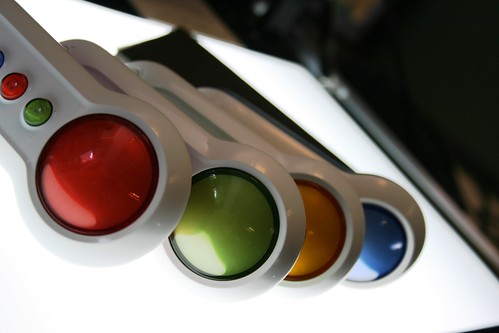
While there may be some crossovers between the needs of Casual and Hardcore audiences as to the social aspects of gaming, titles like Scene It? are locked down in their genres by design. They are bundled with specific control peripherals: buzzers, cameras and karaoke microphones which are unlikely to be used outside their respective games, and they also require crowds of at least four people in order to get the most fun out of them. Here, Microsoft is promoting this type of gaming as a walk-in, pick up and play group activity which naturally replicates the comings and goings of ‘real-life’ social events like karaoke nights and TV quiz shows, separate from the alternative fantasy or sci-fi worlds that traditional games represent. Also, it's use of Avatars, in competition with Nintendo’s Miis, replace the traditional ‘gamer geek’ stereotype with a more visually attractive, socially networked stand-in.
Nevertheless, unlike Nintendo, Microsoft and its Third Party developers haven’t allowed this mindset to influence these traditional games that would otherwise segregate their Hardcore audiences. The games, which these audiences enjoy, work on perhaps entirely opposite sets of design principles to Scene it? Characterised by a long-term investment of time on behalf of the player, Hardcore games require skill, dedication, and as online functionality in multiplayer becomes increasingly widespread, isolation. The switch from the previous generation to the current one by both Microsoft and Nintendo marks their separate takes on how they’ve chosen Casual and Hardcore games should share their respective platforms. A case in point: Unreal Tournament 3 and Metroid Prime 3: Corruption.

Previous efforts in evolving the First Person deathmatch sub-genre, as Unreal Tournament 2003 and its Xbox equivalent, Unreal Championship proved, were misjudged, over-simplifying rather than streamlining the gaming experience. These games unfavourably redefined the formula to suit a more casual audience: health pickups became symbolic icons that were much easier to see, and adrenaline-fuelled special moves which were activated by sequenced button presses removed most of the nuanced tactics the series was previously famous for. A later titles on the Xbox, Unreal Championship 2, somewhat addressed this issue, but its selectable pre-match weapon load out and close combat ‘Finishing Moves’ somewhat broke down the flow of spontaneous play.
While all these games, including Unreal Tournament 2004, had their strengths, in comparison and hindsight to Unreal Tournament 3’s commitment to both hardcore traditions and advancing the series, it’s easy to see where they went wrong. Unreal Tournament precisely conforms to the remit of the hardcore game, demanding a commitment of time and skill in a concentrated burst, and Unreal Tournament 3 delivers this precisely. Gone are the giant health pickups and special moves, replaced by a series of weapons and tactics that once again require real skill to use. For example, just as in the original Unreal Tournament, the Link Gun doesn’t lock on to its target anymore. Instead, its user must directly aim the particle beam at the enemy, unassisted. With games like Unreal Tournament 3 providing real Hardcore thrills, it shows that the Xbox 360 can accommodate both Hardcore and Casual audiences, without diluting the principles of each through merging them.
In comparison, Nintendo seem to have gone the other way in the switch from the last generation to the current one. The Metroid Prime series, long considered as one of Nintendo’s elite Hardcore series on the GameCube, was considerably downgraded in its third entry on the Wii. Its difficulty was lowered to suit the skill levels of the Wii’s Casual players who were familiar with other motion-controlled games on the console. While these motion controls in Metroid Prime 3 were certainly one of the high points of the game, Nintendo used this intuitive set up as a hook for players weaned on Wii Sports and minigame compilations. The game held onto some classic Metroid conventions such as objective-led exploration, clever puzzling and massive organic worlds, but enemies and bosses did much less damage to the player than in the previous games.
Even the normal and hard difficulty levels present less of a challenge. Perhaps Nintendo were worried that Casual gamers would find the control scheme difficult to use in a fully explorable 3D world, and adjusted the difficulty level of its inhabitants accordingly. Another change that upset Hardcore fans of the series was the inability to go back to a completed game, to explore the environment more thoroughly in order to collect all those elusive energy tanks and missile expansion sets. Instead, upon completing the game, players are taken back to its beginning for another playthrough. This curtails the game’s longevity, a feature that would otherwise give it a long-term appeal.

The result of this merging of Hardcore and Casual tastes is a game that, while it contains features that appeal to both sets of audiences, fully satisfies neither. In the end, perhaps the key to solving the disparity between Casual and Hardcore on current generation consoles is to keep them separate. By creating games with specific audience tastes in mind, and marking them through separate advertising campaigns, games can clearly be signposted as to which category they belong. Capturing the casuals, then, is as much about containing them as it is collecting them.
--- http://www.planetxbox360.com/article_6168/Capturing_the_Casuals_How_Microsoft_Can_Beat_Nintendo
MP3 is easier for casuals? I dk. I wish MS luck in their self delusions when people complain about how easy Fable 2 and then they deny their game designers capacity to "be casual" when it comes to core gaming experiences.
“When we make some new announcement and if there is no positive initial reaction from the market, I try to think of it as a good sign because that can be interpreted as people reacting to something groundbreaking. ...if the employees were always minding themselves to do whatever the market is requiring at any moment, and if they were always focusing on something we can sell right now for the short term, it would be very limiting. We are trying to think outside the box.” - Satoru Iwata - This is why corporate multinationals will never truly understand, or risk doing, what Nintendo does.






 (mostly)