The Ghost of RubangB on 23 May 2008
|
The Ghost of RubangB said:
|
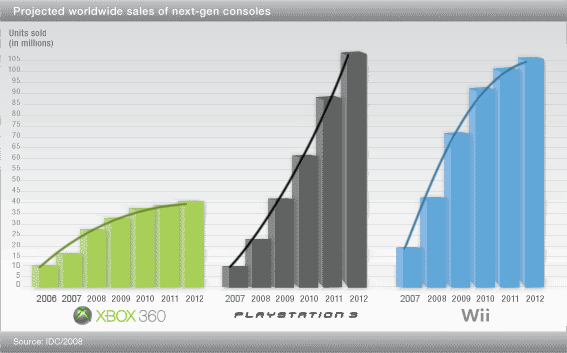
I zoomed way in on the graph and rounded to the nearest million. That's sales per year in millions.











|
The Ghost of RubangB said:
|
I zoomed way in on the graph and rounded to the nearest million. That's sales per year in millions.



The Ghost of RubangB said:
I zoomed way in on the graph and rounded to the nearest million. That's sales per year in millions.
|
I was going to do the same thing, but you beat me to it.



2008 so far:
VGChartz Hardware data for the period 05th Jan 2008 to 17th May 2008:
Wii: 6,938,438
Ps3: 3,838,066
X360: 2,880,832



Holy hell @ 27 million in 2011 for the PS3!



Since a lot of you were interested in seeing this I threw something together:
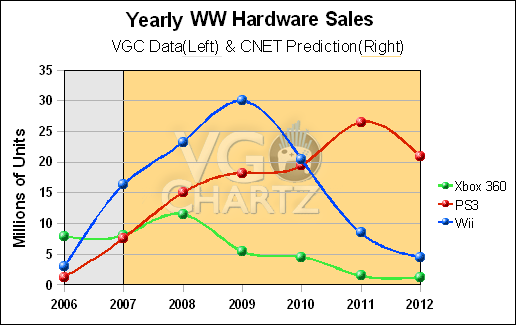
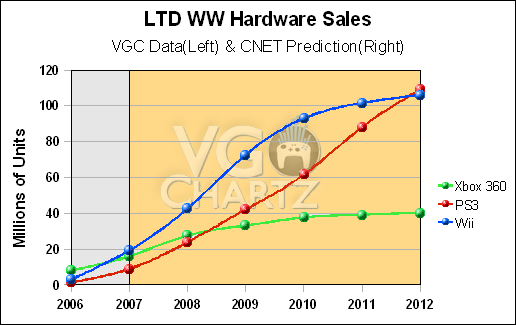
I find it somewhat odd that their prediction should stop at 2012 given their predicted PS3 sales for that year. They're already 4 years into the future with the prediction any claim to variables as a deterrence for continuing the prediction is gone and it seems that truly the only reason they stopped there was because the PS3 surpassed the Wii.
Or to put it another way I believe they reached the conclusion they were aiming for. We can debate "if" and "why" they played with the numbers all day and still not have a definitive answer so I think I'll throw my weight behind the safe bet and say they did play with the numbers to get the conclusion they want and they did it to produce an article that would garner page views.
 |
| To Each Man, Responsibility |


Good work on the graphs, Sqrl. But wouldn't it be possible to use the most current VGC data and move the VGC part further to the right?


I feel bad for people who trust CNET and use that graph for investment analysis.


| stranne said: Good work on the graphs, Sqrl. But wouldn't it be possible to use the most current VGC data and move the VGC part further to the right? |
The problem at that point is in extrapolating what their predictions are. Since the information they give us is only precise to the calendar year end I can only be true to their prediction from those points. Any representation that used the latest VGC data would have to use some method for filling in what we don't/can't know with the information we have.
Or in short, nope 
Since you brought it up though, the fact that they make this prediction so far into the future is really only an invitation to be proven wrong. I don't think you can truly use analysis to make meaningful predictions beyond at most 2 years in this market, particularly when that prediction prescribes massive change as suddenly as this one does. Thats not to say analysis is innaccurate, but if you want reasonable certainty to within a reasonable range of accuracy then you have to accept that analysis has its restrictions, not the least of which is how far into the future you can predict. CNET is either unaware of this restriction or they don't care for reasonability in their analyses.
|
|
| To Each Man, Responsibility |

About Us |
Terms of Use |
Privacy Policy |
Advertise |
Staff |
Contact
Display As Desktop
Display As Mobile
© 2006-2025 VGChartz Ltd. All rights reserved.