By using this site, you agree to our Privacy Policy and our Terms of Use. Close

Forums - Politics - Israel-Hamas war, Gaza genocide

Main events on February 27th

  • Gaza’s Health Ministry said that at least two Palestinians have been killed and 25 injured in Israeli attacks on the Gaza Strip in the past 24 hours.
  • Israel’s military destroyed a residential building outside the areas of its control in Gaza City’s Zeitoun neighbourhood.
  • Hamas said the “ceasefire” in Gaza is “meaningless” as long as Israel continues attacking and killing Palestinians.
  • Iranian Foreign Minister Abbas Araghchi has addressed the 17th Al Jazeera Forum in Qatar’s capital, Doha, today, calling the issue of Palestine the region’s “moral compass”.
  • The Israeli prime minister’s office says Netanyahu is expected to meet Trump next Wednesday in Washington, DC, where the pair will discuss Iran.
  • Israeli settler attacks continued across the occupied West Bank, with settlers beating and injuring two Palestinians near Ramallah in today’s most violent attack.

Trump’s ‘Board of Peace’ to convene in Washington, discuss Gaza: Report

United States President Donald Trump’s so-called “Board of Peace”, tasked with overseeing governance in the Gaza Strip as part of a US-led peace plan, will convene in Washington, DC, later this month for its first meeting, according to online news outlet Axios.

The outlet, quoting a US official and diplomats from four countries who are part of the board, reported on Friday that plans for the meeting on February 19 – which will also serve as a fundraising event for the reconstruction of Gaza amid Israel’s genocide in the enclave – are still tentative and could change.

Axios reports that the meeting is scheduled for the day after Israeli Prime Minister Benjamin Netanyahu is scheduled to meet with President Trump at the White House. The news outlet notes that if Netanyahu attends the Board of Peace meeting, it will be his first meeting with Arab and Muslim leaders since the start of Israel’s war on Gaza on October 7, 2023.

The White House and the State Department did not comment on the report.


Around the Network


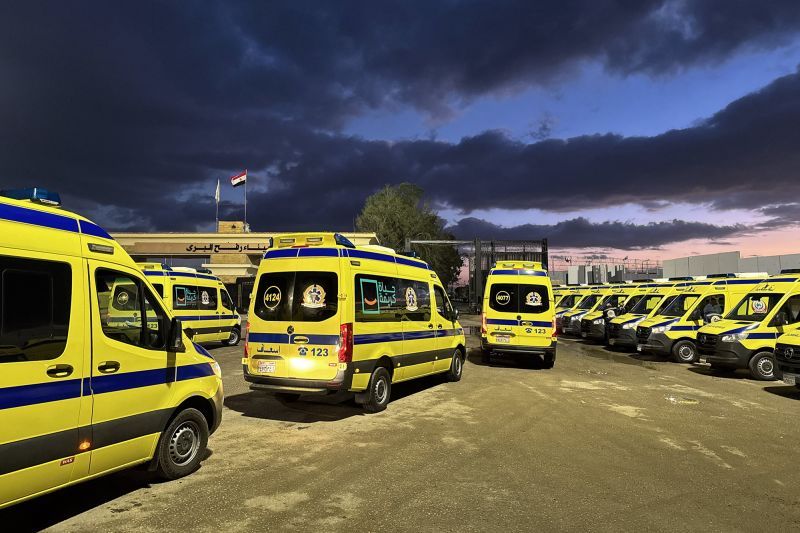
Confusion at reopening of Rafah crossing leaves Palestinians stranded


Ambulances wait on the Egyptian side of the Rafah border crossing with Gaza on Wednesday.

The first week of the partial reopening of the Rafah crossing between Gaza and Egypt was marked by confusion, and logistical hurdles, according to Palestinians attempting to cross and multiple sources who spoke to CNN on condition of anonymity.

The disorder resulted in far fewer Palestinians traversing the border between Egypt and Gaza than was expected, nearly two years after Israel seized and shut the crossing.

When the partial reopening was announced last week, an Israeli security official told CNN that 150 Palestinians per day would be allowed to leave Gaza, while only 50 would be permitted to enter. But even that detail was unclear, as Egyptian state media reported that only 50 would be allowed to leave and the same number to enter.

In the end, the number of people who crossed during the first week amounted to only a fraction of those figures. On Monday, when the crossing officially reopened, only 12 Palestinians crossed the Rafah border in each direction. On Tuesday, the highest day for which CNN has obtained numbers, 40 crossed each way.


In those first two days, most of the Palestinians who were medically evacuated to Egypt during the war and were due to return to Gaza were barred from re-entering the territory, despite receiving prior approval from Israeli and Egyptian authorities.

According to the Palestinian Ministry of Health, 20,000 people in Gaza have completed medical referrals and are awaiting permission to travel abroad for treatment. Since the war began, about 1,000 Palestinians have died while waiting to be approved for medical evacuation, according to the ministry and the World Health Organization (WHO).


It was not immediately clear why the numbers allowed through the crossing have changed each day. The few who did manage to pass through from Egypt described an arduous and exhausting journey.

To return to Gaza via the Rafah crossing, Palestinians must undergo three security checks – first with Egyptian forces, then with the European Union Border Assistance Mission to Rafah (EUBAM) alongside Palestinian forces, and finally the Israeli military once inside Gaza.

Those who returned on Monday told CNN they reached the Egyptian side of the Rafah crossing at 3 a.m. but did not make it into Gaza until 11:30 p.m. Some described difficulties, mistreatment, and increased scrutiny at both EUBAM and particularly Israeli checkpoints.

Um Omar, frustrated and in tears, said Israeli forces had handcuffed those crossing and questioned them at length.


“The Israelis made everything difficult today. They searched us and they interrogated us about everything – about migration (from Gaza), about Hamas, about the 7th of October, and every topic you can imagine,” she said.

The Egyptians treated them well and tended to their needs, she said, while the Israelis prevented them from having anything on them, including food and drink.

“They made us get rid of all our belongings. They only allowed one bag of clothes per person. Even a little girl was not allowed to take her toy with her. They told her the toy is forbidden and took it from her,” Um Omar said, shouting angrily.


In a statement, the United Nations Human Rights Office of the High Commissioner (OHCHR) reported similar accounts from Palestinians returning to Gaza, alleging “patterns of ill treatment and coercion.”

“After two years of utter devastation, being able to return to their families and what remains of their homes in safety and dignity is the bare minimum,” the statement said, quoting the head of OHCHR’s Office in the Occupied Palestinian Territory, Ajith Sunghay.


Families ‘inconsolable’ in Gaza as Israel returns more unidentified bodies


Employees of Gaza's Nasser Medical Complex unload bodies of Palestinian prisoners in Khan Younis, southern Gaza

Israel has returned dozens of Palestinian bodies and human remains to Gaza without providing any information about their identities or how they were killed, according to Palestinian medical officials.

The remains arrived at al-Shifa Hospital in Gaza City on Wednesday in plain white bags and are now being examined by forensic teams in an effort to identify them and provide answers to grieving families.

“The bags carry the weight of lives lost. Now they’re undergoing examination, prolonging the grief of families desperate for closure,” Al Jazeera’s Ibrahim al-Khalili reported from al-Shifa Hospital on Saturday.

Palestinian medics say several bodies were mutilated.

“The International Committee of the Red Cross handed over 120 body bags containing 54 bodies as well as skull samples placed in 66 separate bags,” forensic official Omar Suleiman told Al Jazeera.

Previous exchanges of Palestinian prisoners’ bodies have revealed extensive signs of abuse, with many showing indications of torture, mutilation and execution.

In November, the rights group Physicians for Human Rights-Israel released a report saying at least 94 Palestinian detainees have died in Israeli custody, citing causes including torture, medical neglect, malnutrition and physical assault.

The group said the actual toll could be significantly higher.


Hamas leader rejects disarmament while Israeli occupation of Gaza continues

Hamas’s political leader abroad, Khaled Meshaal, has rejected calls to disarm Palestinian factions in Gaza, arguing that stripping weapons from an occupied people would turn them into “an easy victim to be eliminated”.

Speaking on the second day of the Al Jazeera Forum in Doha on Sunday, Meshaal described the discussion around Hamas handing over its weapons as a continuation of a century-long effort to neutralise Palestinian armed resistance.

“In the context that our people are still under occupation, talking about disarmament is an attempt to make our people an easy victim to be eliminated and easily exterminated by Israel, which is armed with all international weaponry,” he said.

“If we want to talk about it … it is necessary to provide an environment that allows reconstruction and relief and ensures that the war does not reignite between Gaza and the Zionist entity. This is a logical approach, and Hamas — through mediators Qatar, Turkiye and Egypt, and through indirect dialogues with the Americans via the mediators — has reached, or there has been, an understanding of Hamas’s vision on that. Yes, this is something that requires great effort, not an approach of disarmament.”

“The problem is not that Hamas and the resistance forces in Gaza provide guarantees; the problem is Israel, which wants to take the Palestinian weapons … and put them in the hands of militias to create chaos,” he said.


Meshaal pointed to Hamas’s proposals for an extended calm as an alternative to dismantling its military wing.


“Hamas proposed a truce of five to seven to 10 years. This is a guarantee that these weapons are not used,” he said, adding that the mediating nations, who have a “deep relationship with Hamas, can form a guarantee”.

Meshaal pointed out that if people were to go back to the origin of the conflict, the issue is one of “occupation and a people resisting occupation, with the right to self-determination and independence”. “Resistance is a right for people under occupation; it is part of international law and the heavenly religions. Resistance is part of the memory of nations,” he added.


How reconstruction became Israel’s new weapon of ‘silent transfer’ in Gaza

Analysts and urban planners warn that Gaza’s reconstruction is being designed not to restore Palestinian life but to “re-engineer” it – turning the basic human right of shelter into a tool of political extortion and alleged demographic change.

“Reconstruction is not the ‘day after’ the war; it is the continuation of war by bureaucratic and economic means,” Ihab Jabareen, a researcher specialising in Israeli affairs, told Al Jazeera.

Jabareen argued that for the Israeli security establishment, reconstruction is the ultimate bargaining chip, allowing Israel to move from a strategy of direct military occupation to one of “sovereignty by flow”.

“Whoever owns the oxygen of Gaza – the cement faucet – owns its political and security shape,” he said, adding that Israel aims to create a unique system of “control without responsibility” in which it holds veto power over how daily life in Gaza is conducted without the legal obligations of an occupier.

This system relies on turning the potential entry of construction materials and aid into a political decision through what Jabareen called three layers of extortion:

  • Security extortion: linking the flow of materials to “long-term surveillance”, creating a permanent dependency under which Gaza is rebuilt to a size that can be easily “switched off” at any moment.
  • Political extortion: using reconstruction to determine who governs. “Whoever distributes the cement, distributes the legitimacy,” Jabareen said, suggesting that Israel will allow reconstruction only under a “technocratic” proxy administration that fits its security needs.
  • Pacification extortion: turning the hope of basic survival – a roof over one’s head – into a “reward” for silence, rather than a right.

Before these political battles can even be fought, Gaza literally remains buried under the rubble of two years of Israeli bombardments. A United Nations Development Programme report released in November painted a grim picture: The debris generated by the war creates an “unprecedented obstacle” that could take seven years to clear – and that is only under “ideal conditions”.

“Gaza stands as one of the most devastated places on earth,” the report said.

Faced with this reality, Palestinian experts rejected the top-down models for reconstruction proposed in Davos. Abdel Rahman Kitana, professor of architecture at Birzeit University in the occupied West Bank, pointed to the “Phoenix Plan”, a framework developed by the Union of Gaza Strip Municipalities, as a viable local alternative.

“Reconstruction is not just about restoring what was destroyed. It is about reshaping life,” Kitana told Al Jazeera Arabic as he warned against disconnected solutions for Gaza. He instead advocated for an “integrated approach” rooted in the Phoenix Plan, under which rubble is not treated as waste but as a resource that could be recycled for land reclamation.

Kitana insisted that any successful plan for Gaza’s reconstruction must be bottom-up. “We cannot succeed without the people themselves. … They know their needs and their dreams,” he said, warning that ignoring local agencies will lead to a “fragile, alienating environment”.

Israel’s ‘dual use’ rule

However, both the UN’s seven-year reconstruction timeline and the “Phoenix Plan” face a critical hurdle: Israel’s “dual use” list.

Historically, Israel has banned items such as fertilisers and steel pipes under the pretext that they could be used for military purposes. Today, that list has expanded to include more essential items, including oxygen cylinders, cancer medicines and water filters.

Jabareen says the blockade is no longer a pretext for security but a “philosophy of governance”. “Israel has turned the ‘dual use’ excuse into a mechanism of indefinite delay,” he said.

By requiring project-by-project approval for every sack of cement, Israel ensures that reconstruction remains a perpetual “project” that keeps donor countries and agencies exhausted and the Palestinian administration in “a state of constant begging”, Jabareen said.


‘Silent demographic engineering’

While Israel blocks key materials on the ground, the Trump administration is creating a “political fantasy” abroad, experts said. Gaza’s Board of Peace, pushed by Trump, promises a $10bn gross domestic product boost to Gaza and a “New Rafah” with 100,000 housing units.

Jabareen viewed the plans, which include “waterfront properties” and “industrial zones”, as a form of “silent demographic engineering”.

“They are trying to shift the Palestinian cause from a national rights issue to a real estate problem,” he said. The goal, he argues, is to design a Gaza that is “economically useful” to the region but “nationally hollowed out”.

By focusing on “investments” and “tourism” while ignoring the rubble and the mass graves, the plan seeks to “legitimise a political fantasy”, Jabareen said. “If you can’t displace the Palestinian by force, you displace his idea of home by re-engineering his space.”

So who will eventually build this “New Gaza”? Jabareen warned of a “privatisation of occupation” even if Israeli companies do not enter Gaza directly.

“Reconstruction is a chain of indirect profits,” he noted, adding that the logistics of inspection, the security firms managing the crossings and the insurance companies covering the risks will all generate revenue for Israeli or allied firms.

The contracts for reconstruction themselves become a political filter. “This creates an international ‘market of obedience’,” Jabareen said. “The donor who objects is excluded, and the contractor who asks questions on sovereignty is replaced.”


‘Silent transfer’

Jabareen said the most dangerous aspect of such a policy is the “weaponisation of time itself”.

With UN assessments indicating that removing debris alone could last until 2032 and a full reconstruction of Gaza stretching to 2040, the “wait” becomes a policy of displacement.

“Time decomposes societies,” Jabareen said.

He said Israel is betting on “rational emigration” – after living for years in tents, Palestinians will leave, not because they were forced by tanks, but because they were exhausted by fears over their future.

“The long wait is not condemned by the international community. Israel realises that bombing brings condemnation, but bureaucratic delay brings only silence,” Jabareen said. “If the fighter jets failed to displace them, the waiting might succeed.”



Around the Network

Pro-Palestine groups to protest Israeli president’s visit to Australia

Pro-Palestinian groups are planning several rallies across Australia to oppose a visit by Israeli President Isaac Herzog despite the government’s restrictions on rallies.

Herzog is scheduled to visit Sydney on Monday to honour the victims of December’s Bondi Beach attack, which killed 15 people at a Hanukkah celebration in Australia’s worst mass shooting in decades.

In response to the attack, the state of New South Wales, where Sydney is located, passed legislation allowing police to restrict public protests for up to three months. Authorities have invoked these powers in parts of central Sydney during Herzog’s visit.

But the Palestine Action Group plans to hold a protest at Sydney’s Town Hall on Monday, according to the ABC News broadcaster.

Organisers of the protest said they plan to walk from Town Hall to Macquarie Street despite the route falling within the restriction zone as the state government urged them to choose a different location.

Similar protests are planned Monday in other Australian cities, including Perth, Melbourne and the capital, Canberra.

The Australia Palestine Advocacy Network (APAN), a national coalition for Palestinian human rights, said the Israeli president should not be welcomed and he must be held “accountable”.

“Isaac Herzog is not a ceremonial guest. He is the head of state of a government carrying out genocide in Gaza, enforcing occupation, and maintaining apartheid over Palestinians. His rhetoric was cited by the International Court of Justice in assessing the risk of genocide,” APAN posted on X.

Rights group Amnesty International’s Australia chapter also urged people to take to the streets on Monday when Herzog arrives, citing his role in Israel’s genocidal war in Gaza.


“President Herzog has unleashed immense suffering on Palestinians in Gaza for over two years – brazenly and with total impunity,” it said. “Welcoming President Herzog as an official guest undermines Australia’s commitment to accountability and justice. We cannot remain silent.”

The progressive Jewish Council of Australia also opposed Herzog’s visit, saying, “We refuse to let our grief for the Bondi massacre be used to legitimise” the Israeli leader.

Last week, a coalition of civil society groups lodged a legal complaint that urged authorities to deny Herzog a visa and open a criminal investigation under Australian law.

Australian human rights lawyer Chris Sidoti, a member of a United Nations inquiry into rights abuses in Israel and Palestinian territory, called for Herzog’s arrest. But the Australian Federal Police ruled it out with officials citing the Israeli president’s “full immunity” on civil and criminal matters, including genocide.


Meanwhile in Israel


Thousands protest against President Herzog’s Australia visit

Thousands have gathered across Australia to protest against the arrival of Israeli President Isaac Herzog, who is on a multicity trip aimed at expressing solidarity with the Jewish community in the country following a deadly mass shooting last year.

The visit has attracted the ire of some people in Australia, who accuse Herzog of being complicit in civilian deaths in Gaza.

Pro-Palestine groups are organising protests across the country on Monday evening. In Sydney, thousands gathered in a square in the city’s central business district, listening to speeches and shouting pro-Palestine slogans.

The Bondi massacre was terrible, but from our Australian leadership there’s been no ⁠acknowledgement of the Palestinian people and the Gazans,” said Jackson Elliott, a 30-year-old protester from Sydney. “Herzog has dodged all the questions about the occupation and says this visit is about Australia and Israeli relations, but he is complicit.”

There was a heavy police presence with a helicopter circling overhead and officers patrolling on horseback. About 3,000 police personnel will be deployed across Sydney during Herzog’s visit.


People hold placards during a protest against Herzog’s Sydney visit, February 9


Sydney police use pepper spray, scuffles break out at pro-Palestinian rally

Police in the Australian city of Sydney have deployed pepper spray and scuffled with protesters as a march against Israeli President Isaac Herzog’s visit turned violent, according to the AFP news agency.

Police used pepper spray on protesters and members of the media, including AFP, as a pro-Palestinian rally attempted to leave a designated area.


Three people killed in Israeli strike on southern Lebanon: Report

An Israeli attack on a car in the town of Yanouh has killed three people, including a child, according to Lebanon’s National News Agency. In a statement, the Israeli army said it had targeted a member of Hezbollah in the attack.

Lebanon in late January filed a complaint with the United Nations about repeated Israeli violations of a November 2024 “ceasefire”.


Israel says it kills senior Hezbollah member in southern Lebanon

Israel’s army says its forces have bombed southern Lebanon’s Yanouh area, killing a person it identifies as Ahmad Ali Salami. The military statement published on Telegram claimed he was Hezbollah’s head of artillery in Yanouh.

The army said it was “aware of the claim that uninvolved civilians were killed”, claiming, “Prior to the strike, steps were taken to mitigate harm to civilians, including the use of precise munitions and aerial surveillance.”

Saying the incident was under review, the military said it “regrets any harm to uninvolved civilians and operates to minimize harm as much as possible”.

Assassinations are illegal, it's a war crime no matter who is targeted. 


New law allows Israeli settlers to move into Palestinian cities

This is seen by Palestinians as the most dangerous push towards annexation and the most critical decision since Israel occupied the West Bank in 1967. It allows individual Israeli settlers to own lands in areas that were historically under Palestinian control.

Palestinians can only build in Area A and Area B. What happens is every time they try to build in Area C, Israel demolishes that. Now, this new development puts that at risk. Why? Because one clause, one part of this decision allows the Israeli authorities to demolish houses in Area A and Area B, which have historically been under full Palestinian control.

When we talk about the Israeli settler presence, we talk about Area C. This is where we see many settler attacks take place, and this decision kind of puts all the occupied West Bank in limbo. It puts it in a place that further consolidates Israel’s occupation and control over lands, but also, and in the words of many Israeli officials, buries the dream of an independent Palestinian state.

We will start to see Israeli settlers coming to Palestinian city centres. There’s nothing preventing them, according to this law, from owning land and coming to the centre of Ramallah, for example.

Again, all of this is illegal under the signed agreements with the Palestine Liberation Organization, but also under international law that prohibits an occupying power from moving its citizens to the occupied territory.

There’s also barely a day without Israeli settler attacks against Palestinians, wherever they are. The main goal is basically to kick Palestinians off their lands one way or another. These attacks are getting more brazen.

This all was supposed to be temporary until 1999. The Oslo accords were never implemented beyond the first step
https://imeu.org/resources/important-events/oslo-accords-timeline-20-years-of-failed-us-led-peace-talks/239
The Oslo Accords (1993–1995) established a five-year interim phase for Palestinian self-rule, intended to lead to a final, full-control agreement by May 4, 1999.

Now Gaza is next with the so called 'peace' board.


Jordan slams Israel’s new occupied West Bank measures as ‘illegal’

Jordan’s Foreign Ministry has called the new rules a “blatant violation of international law” and an assault on Palestinians’ right to an independent state.

In a statement, the ministry responded to the measures, which, according to the Israeli media, included scrapping decades-old regulations that prevent Jewish private citizens from buying land in the territory.

The ministry said Jordan “strongly condemns the illegal Israeli decisions and measures adopted to impose unlawful Israeli sovereignty, entrench settlement activity, and impose a new legal and administrative reality in the occupied West Bank”.

The steps constitute “a flagrant breach of international law, an undermining of the two-state solution, and an attack on the inalienable right of the Palestinian people to establish their independent, sovereign state on the June 4, 1967 lines with occupied Jerusalem as its capital”, the statement said, adding that Israel has “no sovereignty over occupied Palestinian land”.

Jordan reiterated its “absolute rejection and condemnation” of unilateral, illegal and null measures in the West Bank and warned that the policies of Israel’s far-right government fuel cycles of violence and instability in the region.