







 Currently Online






Confusion at reopening of Rafah crossing leaves Palestinians stranded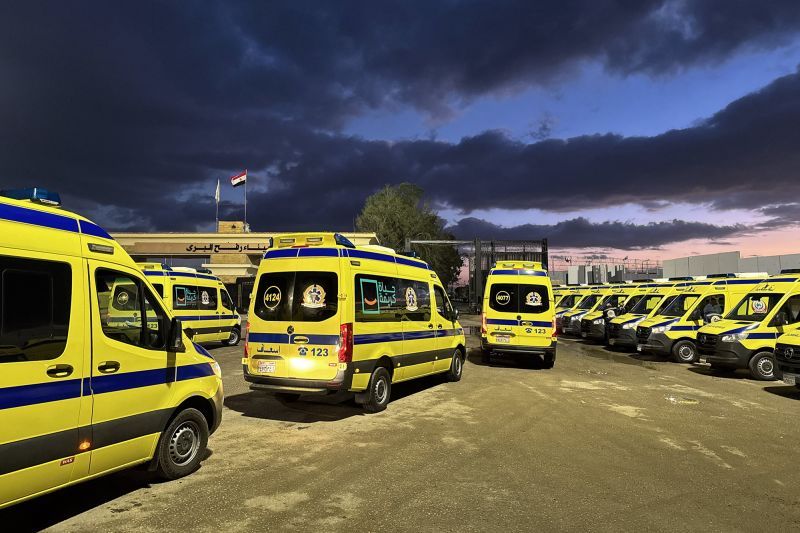
Ambulances wait on the Egyptian side of the Rafah border crossing with Gaza on Wednesday.
The first week of the partial reopening of the Rafah crossing between Gaza and Egypt was marked by confusion, and logistical hurdles, according to Palestinians attempting to cross and multiple sources who spoke to CNN on condition of anonymity.
The disorder resulted in far fewer Palestinians traversing the border between Egypt and Gaza than was expected, nearly two years after Israel seized and shut the crossing.
When the partial reopening was announced last week, an Israeli security official told CNN that 150 Palestinians per day would be allowed to leave Gaza, while only 50 would be permitted to enter. But even that detail was unclear, as Egyptian state media reported that only 50 would be allowed to leave and the same number to enter.
In the end, the number of people who crossed during the first week amounted to only a fraction of those figures. On Monday, when the crossing officially reopened, only 12 Palestinians crossed the Rafah border in each direction. On Tuesday, the highest day for which CNN has obtained numbers, 40 crossed each way.
In those first two days, most of the Palestinians who were medically evacuated to Egypt during the war and were due to return to Gaza were barred from re-entering the territory, despite receiving prior approval from Israeli and Egyptian authorities.
According to the Palestinian Ministry of Health, 20,000 people in Gaza have completed medical referrals and are awaiting permission to travel abroad for treatment. Since the war began, about 1,000 Palestinians have died while waiting to be approved for medical evacuation, according to the ministry and the World Health Organization (WHO).
It was not immediately clear why the numbers allowed through the crossing have changed each day. The few who did manage to pass through from Egypt described an arduous and exhausting journey.
To return to Gaza via the Rafah crossing, Palestinians must undergo three security checks – first with Egyptian forces, then with the European Union Border Assistance Mission to Rafah (EUBAM) alongside Palestinian forces, and finally the Israeli military once inside Gaza.
Those who returned on Monday told CNN they reached the Egyptian side of the Rafah crossing at 3 a.m. but did not make it into Gaza until 11:30 p.m. Some described difficulties, mistreatment, and increased scrutiny at both EUBAM and particularly Israeli checkpoints.
Um Omar, frustrated and in tears, said Israeli forces had handcuffed those crossing and questioned them at length.
“The Israelis made everything difficult today. They searched us and they interrogated us about everything – about migration (from Gaza), about Hamas, about the 7th of October, and every topic you can imagine,” she said.
The Egyptians treated them well and tended to their needs, she said, while the Israelis prevented them from having anything on them, including food and drink.
“They made us get rid of all our belongings. They only allowed one bag of clothes per person. Even a little girl was not allowed to take her toy with her. They told her the toy is forbidden and took it from her,” Um Omar said, shouting angrily.
In a statement, the United Nations Human Rights Office of the High Commissioner (OHCHR) reported similar accounts from Palestinians returning to Gaza, alleging “patterns of ill treatment and coercion.”
“After two years of utter devastation, being able to return to their families and what remains of their homes in safety and dignity is the bare minimum,” the statement said, quoting the head of OHCHR’s Office in the Occupied Palestinian Territory, Ajith Sunghay.


