By using this site, you agree to our Privacy Policy and our Terms of Use. Close

Forums - Gaming - 32/64-bit Generation Wars!! Tech Specs and Graphics: Saturn Vs Playstation Vs Nintendo 64 Vs Gameboy Advance


Which one had the most impressive graphics (2D, 3D or both) for the 32/64-bit generation era?

Sega Saturn 2 6.67%
 
Sony Playstation 5 16.67%
 
Nintendo 64 22 73.33%
 
Nintendo Gameboy Advance 1 3.33%
 
Total:30

The CPU core is a two-way superscalar in-order RISC processor. Based on the MIPS R5900, it implements the MIPS-III instruction set architecture (ISA) and much of MIPS-IV, in addition to a custom instruction set developed by Sony which operated on 128-bit wide groups of either 32-bit, 16-bit, or 8-bit integers in single instruction multiple data (SIMD) fashion (i.e. four 32-bit integers could be added to four others using a single instruction). Instructions defined include: add, subtract, multiply, divide, min/max, shift, logical, leading-zero count, 128-bit load/store and 256-bit to 128-bit funnel shift in addition to some not described by Sony for competitive reasons. Contrary to some misconceptions, these SIMD capabilities did not amount to the processor being "128-bit", as neither the memory addresses nor the integers themselves were 128-bit, only the shared SIMD/integer registers. For comparison, 128-bit wide registers and SIMD instructions had been present in the 32-bit x86 architecture since 1999, with the introduction of SSE. However the internal data paths were 128bit wide, and its processors were capable of operating on 4x32bit quantities in parallel in single registers.

https://en.wikipedia.org/wiki/Emotion_Engine
https://en.wikipedia.org/wiki/32-bit_computing

So bottom line is the Emotion Engine is a 32-bit CPU where multiple integers can be grouped into one operation.



Around the Network
Doctor_MG said:

I feel like the Atari Jaguar and 3DO should have been included here. Yes, they came out pretty early on (1993), they are still both 32-bit machines on a technical level. This is especially true given the fact that you've included the GBA in this comparison where DS would probably have fit better.

Yes, they should be here being 32-bit console of this generation. If I have time, maybe next week, I will add them to this list.

For this comparison, I will not include any other console older than the GBA because tech-wise, things changed a lot with time. For the moment the thread will be limited to this first wave of 32/64-bit console. I will evaluate, eventually, the NDS.


Remember the elusive 32 bit PC-FX console by NEC as the successor of the PC-Engine. Nearly no 3D capabilities but best FMV MJPEG video in that generation.


Doctor_MG said:
Pemalite said:

We also need to keep in mind that.... The Gamecube, Wii, WiiU, Switch, Xbox, Xbox 360, Xbox One, Xbox Series X, Playstation 2, Playstation 3, Playstation 4 and Playstation 5 are also 32bit or 64bit devices as well.

The OG Xbox being -the- most capable 32bit console ever with it's 32bit Intel Pentium 3 based processor and the Nintendo 64 being the weakest 64bit console.

If we are going by the CPU (as we seem to be in this thread), then the PS2 is 128-bit. I'd also argue that the Wii U had the most capable 32-bit processor. 

The PS2 processor is NOT 128-bit. You fell for false marketing/propaganda.

The PS2 had 128-bit SIMD... Which is a processing element, not the processor itself.
https://en.wikipedia.org/wiki/Single_instruction,_multiple_data

It would be similar to Intels SSE technology on it's 32bit CPU's... Aka. Also 128-bit SIMD.

And we go by the CPU as that is what has always determined the "bits" of a system.

You are right, I actually forgot that the WiiU had a 32bit CPU.


www.youtube.com/@Pemalite

Assorted Thoughts

  • The Saturn's Dual CPU is a good example of how being ahead of the curve can leave you behind. I've heard that a lot of games had to be creative on how they used the two CPU's (Virtua Fighter used one per fighter, some games used one for 3D and one for 2D, etc).
  • As far as similar tech goes, the Saturn's Hitachi CPU was similar to that found in the 32X and the Capcom CPS3. This surprised me, since NONE of Capcom's (admittedly few) CPS3 games landed on the Saturn. You'd think they'd at least like to brag about the first home version of Street Fighter 3.
  • The PS1 only stands out by being the most ordinary console here. No dual CPU like the Saturn, CD-ROMs instead of cartridges, fairly typical specifications in most regards (though a bit below the average), etc.
  • The PlayStation's R3000 CPU was apparently more frequently used in workstations than enertainment products. Silicon Graphics, the makers of the N64 CPU, used it for their IRIS series of work computers.
  • I'm having trouble finding any solid examples of hardware that used the VR 4300 CPU besides that "Neo Geo Hyper 64" hardware that only ended up getting seven arcade games (and those games were only ever ported to the PS1 if anywehere at all). Even Ultra 64 branded arcade hardware like the Midway V unit seem to use largely different hardware.
  • The GBA is the odd man out, but I thought that the ARM7 CPU was familiar. Sure enough, it's the same CPU that appears as the second CPU in the DS, and also serves as the Dreamcast's Sound Processor. Neat.


Around the Network
Salnax said:

Assorted Thoughts

  • The GBA is the odd man out, but I thought that the ARM7 CPU was familiar. Sure enough, it's the same CPU that appears as the second CPU in the DS, and also serves as the Dreamcast's Sound Processor. Neat.

That was a common thing for Nintendo hand helds. The second cpu in the gameboy advance was the main processor of the Gameboy/color. The second cpu on the ds was the main cpu on the GBA. The second cpu on the 3ds is the main one of the DS. It is done mainly for backwards compatibility.  


The N64 was the most advanced and capable; it introduced new technologies to the console space that PS1 and Saturn weren't capable of, like perspective correct textures, anti-aliasing, and texture filtering.

Games like Conker's Bad Fur Day, Banjo Kazooie/Tooie, DK64, Perfect Dark, really showed what the hardware could do when pushed.

That said, PS1 and Saturn were no slouch.

On the former, the likes of Legacy of Kain and Ridge Racer Type 4 set a high bar, while the latter, despite its complex and difficult to harness internals, still proved itself capable of holding its own with games such as Panzer Dragoon Zwei and Burning Rangers.

It was an exicting generation that thrust gaming headlong into the future, and while all three major consoles had their strengths and weakenesses, each also earned a place at the table in its own way.


I discovered this only recently, but Shenmue was a game originally planned for the Saturn, then ported and developed for the Dreamcast.

This old demo of the game is quite impressive, probably pushing the system to the limits:


Factor 5's N64 games were also very impressive for the generation and hardware

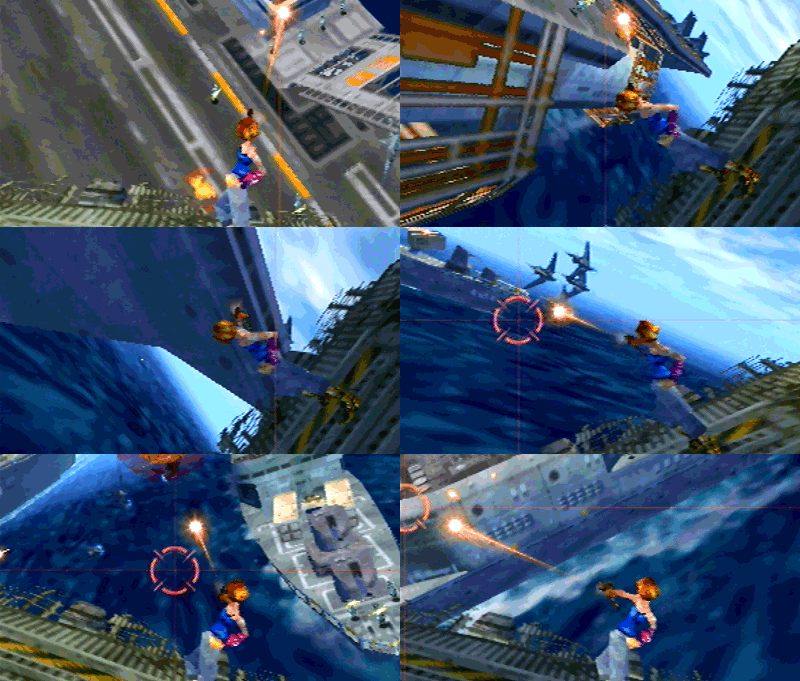
Sin and Punishment is also a showpiece, it's a crime it didn't get a global release at the time, excellent game.

JimmyFantasy said:

I discovered this only recently, but Shenmue was a game originally planned for the Saturn, then ported and developed for the Dreamcast.

This old demo of the game is quite impressive, probably pushing the system to the limits:

Yeah, if they'd made an actual game on par with this demonstration, it would've been not only the most impressive looking Saturn game by far, but frankly more impressive than anything on PS1 too.


curl-6 said:

Sin and Punishment is also a showpiece, it's a crime it didn't get a global release at the time, excellent game.

I agree, it's one of the most impressive game of this generation! Hope for a Switch remake bundle soon :)