

Long story short: The NES is one of the few consoles to not natively support RGB out of the box and, as a result, the picture quality that can be gleened from it - even on CRTs but, most especially, on LCDs and LEDs - is quite terrible. I've been seriously considering a "Hi-Def NES" HDMI modification for some time now, as the resulting picture possible is a joy to behold.
Click here to watch a rundown of what can be achieved with such a mod vs. Composite output, or even an RGB modification.
Second story short: the Hi-Def NES is an expensive endeavor. The board itself, which must be soldered onto the original NES hardware after some trickey de-soldering, costs $125 or more if you can find one. If you're not experienced with console mods, having the job done for you runs in the range of $250-$300, and you have to send your baby out into the wild blue to have the work done.
Pre-modded systems can be bought, but often knock on the door of $400 and are difficult to come by. Premium systems, like the Analogue NT (which is a Hi-Def NES in a newly fabricated shell), were sold closer to $500, and are now running at extortionate prices on eBay. So where does this leave those of us leary of paying someone $300 to carve up our beloved original NES?
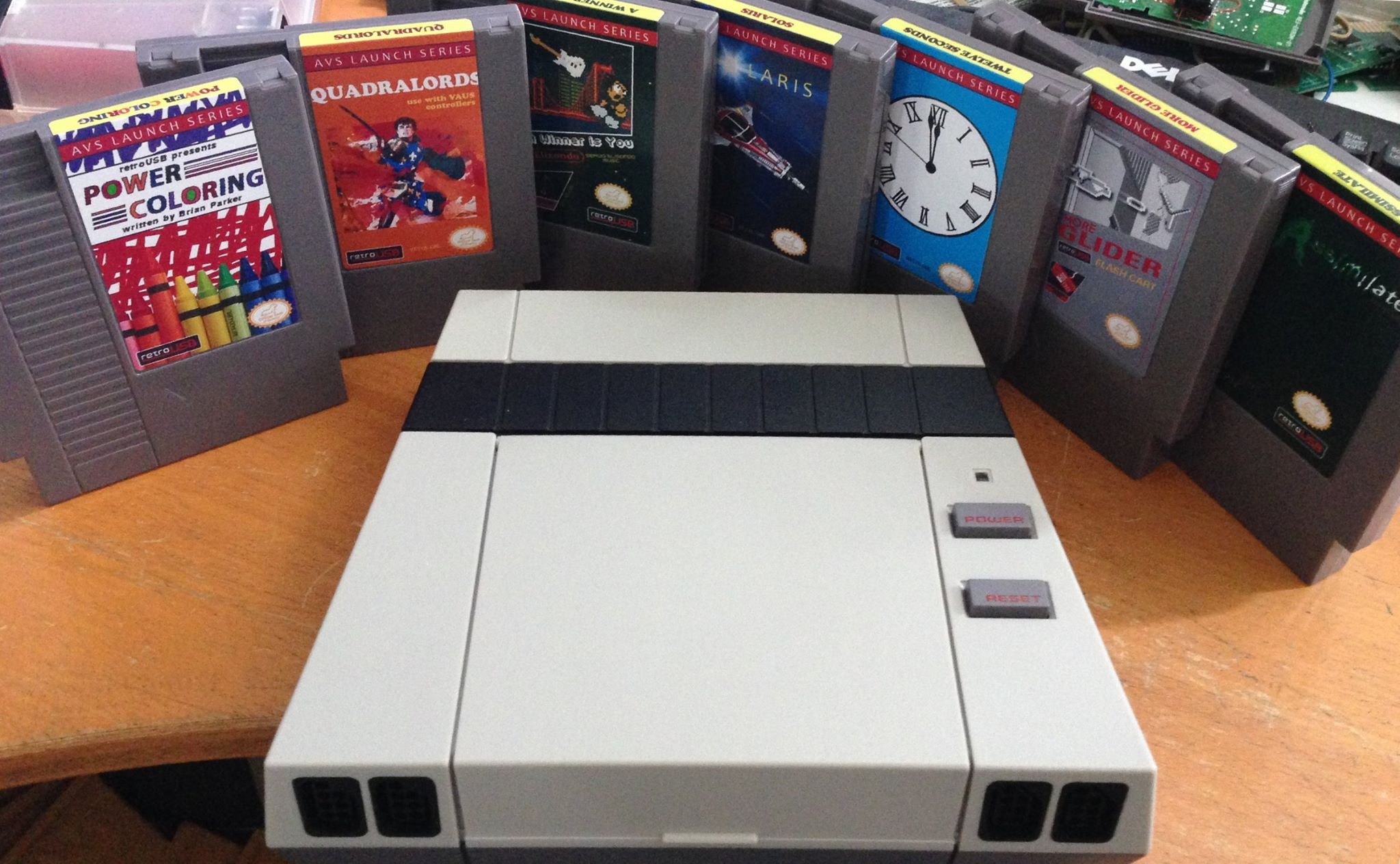
Enter the AVS by RetroUSB. Below are two articles running down the system's specs, release date and price:
http://www.nintendolife.com/news/2016/05/retrousbs_hdmi_nes_the_avs_is_heading_for_a_summer_release
http://www.retrocollect.com/News/retrousb-announce-avs-nintendo-nes-hdmi-ready-clone-console-due-for-summer-release.html
These articles do an okay job of pointing out some of the benefits of the AVS, but fail to answer the question that many would later ask in the comments sections: "but what about the other "clone consoles?" What the AVS does is impressive, but what it does differently in infinitely more important. So what sets it apart?
The idea of an NES/Famicon clone console is nothing new. In fact, many of these cheap "Famiclones" also include support for several other retro systems. The early units of the 1990s and early 00s were mostly plagued by incompatibility issues that arose from using hardware that was very different from that of the NES in a half-hearted attempt to approximate it. They lacked compatibility and had video solutions that were no more impressive than the output of the original NES.
A second wave of Famiclones hit recently, and they are the one's likely to cause the most confusion, as some support newer A/V output options. The major difference between the AVS and the Retron 5, say, is that systems like the Retron are actually just inexpensive kit running software emulation. The best of them rip a ROM from your catridge and then play it off of an emulator, the worst just recognize the ROM itself and play a pre-ripped version from an online database.
In essence, these "clones" do little more than emulate the classics and give you support for retro controllers (something that's already done better on a decent PC). To make matters worse, they often use hardware similar to that found in smartphones - and not of the cutting-edge variety either. Not only are gamers on these toys subject to the same incompatibility issues that plague the PC emulation scene, but they're using underpowered hardware to fuel this emulation, resulting in performance that stacks up poorly when compared to playing games on their original hardware.
Here's a review of the Hyperkin Retron 5 for the hardware junkies out there: http://retrorgb.com/retron5review.html
What's different about RetroUSBs AVS is that it's not emulating software. Like the aforementioned Analog NT - which uses original NES parts, along with new materials - the Retro AVS is a painstaking recreation of the NES hardware. Crafted by the madman that brought us the PowerPak, and a whole host of other NES compatible accessories, the AVS runs NES and Famicon games natively, and is built using all new materials.
The result is a machine with the sole purpose of playing NES titles, both old and new (homebrews, etc.), and outputting them over HDMI with a handful of options available for tweaking the visuals. The output resolution is a crisp 720p, a perfect multiple of the NESs native output of 240p. The AVS features onboard scaling options for 3:3, 4:3, and 5:3, as well as scanlines of variable strength. The machine is powered via USB, which also serves to install firmare updates and upload high scores to the web.
Release is planned for the end of June and the box will set you back only a cool $185.
If you're interested in learning more, there is an exhaustive thread by the system's creator over on Nintendo Age, which dates back all the way to the system's conception. It's very informative, and will give you an idea of the passion that's being poured into this project. Subscribe to that thread for updates, and watch the RetroUSB homepage for the official launch details.
I, for one, am very excited about this new HDMI solution for the NES. I had a chance to spot the thing at the Portland Retro Gaming Expo, and assumed it was just another emulation box - the visuals were that sharp! At $185, this thing is a bargain for someone thinking about putting their NES under the knife for much more. The new plan is grabbing a small broadcast monitor to hook my old girl up to, and throwing this beast up on the wall on my DLP projector.
Anyone else thinking of picking one up?
Retro Tech Select - My Youtube channel. Covers throwback consumer electronics with a focus on "vid'ya games."
Latest Video: Top 12: Best Games on the N64 - Special Features, Episode 7