


Welcome to the Official VGChartz Retro Gaming Thread!
Created by both moi and Tachikoma where we'll discuss retro gaming! Each month will have a new theme (occasionally we'll recycle game themes topics, however we'll try to minimalize that when possible). Basically this thread is for you to put your nostalgia goggles on and talk about the systems you grew up with!
This OP will be updated monthly so check back here whenever the theme changes. We may even add things throughout the month. When that's added we will add "Edit 1", "Edit 2" and so forth in the title so people know to check back during the month.
This months theme

Basic background:
Nintendo introduced the Super Nintendo to Japan on the 21st of November, 1990 (Almost 25 years ago, and will hit it's 25th birthday in this very thread!), It launched a year later on August 23rd, 1991 in the US and across the EU and Australia in mid 1992.
While in the US, EU and Australian regions a number of accessories for the system such as the Super Gameboy, Superscope, Mouse and tablet and XBand were released, along with a few different brands of cheat cartridge, the Japanese version of the console featured a whole host of additional hardware and a number of different SKU options due to partnerships within Japan with Sharp.

Sharp SF1
One such release was the Sharp SF1 (Super Famicom Naizou TV SF1) a combination of the Super Famicom hardware built in to Sharps own TV hardware, advertised in 1990 as the successor to the Sharp C1 unit released several years earlier, which we will cover in the future.
A 14" and 21" version were made available in Japan in 1990, due to the way the consoles PCB was wired directly in to the televisions own hardware, the SF1 featured much clearer visuals to a standard Super Famicom connected to a standard TV set.
An extra bonus to this hardware setup was access to the ability to record gameplay direct from the device to a compatible Sharp VCR.
Satellaview
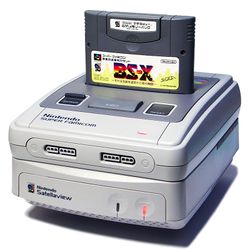
Another Japan-only addon made use of the rarely used EXT port found on the bottom of Super Nintendo consoles, designed to accomodate the Japanese and EU console design, a US version was never made and the service that once supported the hardware was never offered outside of Japan.
Initially released in 1995, the hardware used a provided BS-X game cartridge and 8Mb Memory pack, which would use a specific television station that would air "Super Famicom Hour" at a fixed time of the day, broadcasting a scrambled datastream over terrestrial radiowaves, which would be unscrambled by BS digital GIGA decoders and handed off to the Satellaview hardware, storing the received data on the 8Mb memory pack.
The hardware came with a pseudo minigame called "The Story of the town whose name was stolen", an interactive menu system presented as a game, using the user-provided details to display an avatar of the user, who would interact with the world while providing access to functions such as downloaded data execution, a news system provided by Kabe Shinbunsha, programming schedules and of course, an inventory system and currency which could be used to buy in game items. The service offered a selection of BS-X only games such as Dezaemon (BS-Version), BS-X Shooting, SatellaWalker 1 and SatellaWalker 2.
Broadcasting over the St GIGA radio frequency began in early April 1995 just before the release of the hardware and ran until late March, 2000 when the service ended, however broadcast of game data ended in early 1999, followed a few months later by the ending of the soundlink broadcasts, leaving only the guide broadcast until the services closure.
A small group of Japanese developers are currently working on making narrow band transmission hardware to emulate the broadcast environment to allow collectors the ability to use the hardware as originally intended.

Snes-CD
The ill-fated addon which was initially going to be a departure from Nintendo's usual partner, Sharp, was planned to be a CD addon for the SNES, allowing for much greater amounts of data to be used in games, and provide full motion video functionality to the SNES hardware, as well as a CD drive and interfacing PCB to communicate with the SNES via it's EXT connection, the device was intended to have it's own processor to aid the console in processing VCD data to be used with games.
As part of this partnership, just as Sharp did in the past with the likes of the Sharp Twinfami, for providing the CD addon for Nintendo, Sony would have been able to release a Sony branded Super Famicom console with built in CD unit.
Development of the Snes-CD started in 1988, two years prior to the consoles eventual release, and as history eventually showed, the partnership fell through and they instead partnered with Phillips, who would never go on to manufacture an addon for the Snes but also go on to reuse their development knowledge from the partnership to create the Phillips CD-i, Sony themselves would go on to release the very popular PlayStation 1, 5 years after the SNES's release, and the rest, as they say, is history.
Super Famicom Hotel System "Box"
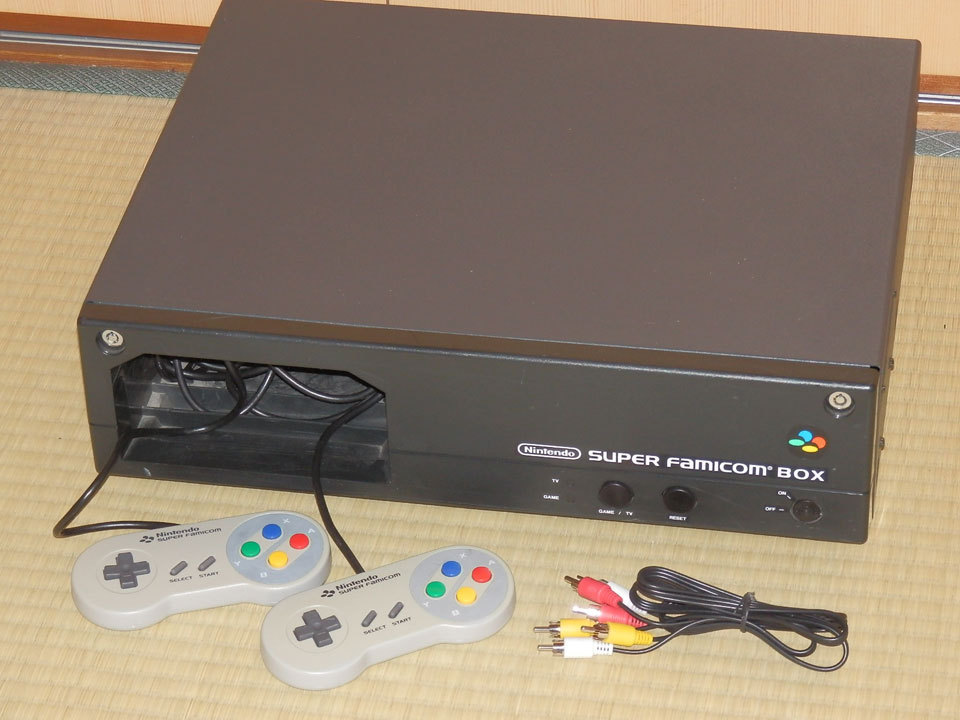
Another Japan-only oddity, is the Super Famicom Box, which was essentially a SNES with a range of games built in to a menu, the box contained a compartment for the controllers and was intended to be used in hotels, along with a pay per use mechanism which would interact with the unit and be staff setable for price and playtime, a guest could insert coins and the system would switch on to a menu, allowing the guest to use the system to play games on the hotel TV set until the paid time duration expired.
When the unit became active the guest could switch between the game and standard TV programing using buttons on the unit itself, as well as reset the system to return to the game selection screen. Similar units were available to hotels that supported NES games and later, Panasonic 3DO games.

Super-Gameboy
One of the peripherals that did see a worldwide release was the Super Gameboy, a cartridge that would allow for GameBoy and GameBoy Color games to be played through the Super Nintendo's hardware, however the Super Gameboy cartidge itself contained the same hardware as the original Gameboy with some modifications, and would use the Super Nintendo only to push video through it's video encoder, access the controller inputs and to pull power from the main system, beyond those functions the actual CPU of the Snes remained idle during use.
The first revision of the hardware which saw worldwide release actually suffers from a timing issue which was never fixed outside of Japan, where Japan saw the release of the Super Gameboy 2, visually nearly identical except featured transparent blue case plastic and a status LED, the timing issue was resolved in this version of the hardware.
Additionally, a Super Gameboy specific controller was released for the peripheral but low sales make it a relatively rare addon for the system today.

The differences between the Super GameBoy and Japan only second release include a different selection of borders, though the original set were still accessible via special codes. The borders and palletes could be set by the user for most game, some Gameboy Color games could interact with the hardware to display custom borders and palletes specific to the game, too.
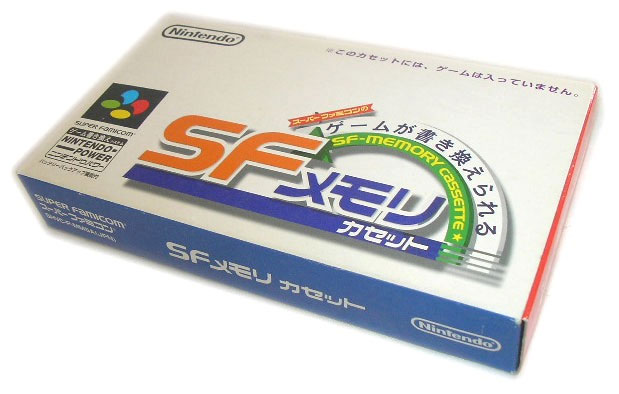
SF Famicom Memory Cassette
Little known by even the most ardent of Nintendo fans is that one of the first ever flashcarts released for Nintendo consoles was actually the SF Memory Cassette, by Nintendo themselves.
Originally intended to suppliment the "Nintendo Power" service, which allowed Nintendo gamers to buy blank Super Nintendo cartidges and, at participating stores, insert their cartidge and buy a selected game which would be copied to an available slot on the cartidge, or overwrite a selected existing slot if the cartidge was full, the price of the game would be lower than retail games as no additional hardware was needed, the cartidge could hold up to 7 different 4mbit games depending on the games chosen, the remaining 4mbit of the 32mbit flash memory cannot be used to store games as it's used by the boot menu.
In 2001 the service in stores was discontinued, new blank cartidges could no longer be bought, but those who still owned the cartidge could mail the cart to Nintendo's customers service to have games put on to the memory cassette.
Nintendo ended the mail-in service for memory cassettes in 2007, a full 16 years after the consoles original release.
There is currently no available way to add or remove games to these cartidges now the service has ended.

SuFami Turbo
The SuFami Turbo (SUper FAMIcom Turbo), was a peripheral released only in Japan and developed as a licensed product by Bandai, the idea behind this addon was to lower the cost of producing games and bypassing the approval and production process of Nintendo, the two slots would allow for two individual carts to communicate with each other, the first slot running game code and the second providing additional data or savedata, 9 of the 13 known games for this peripheral supported this sort of communication, the majority of the released games were Bandai's own SD Gundam releases, and sales for the peripheral were very low.
Design differences
As most peope will know, the original release of the Super NES / Famicom were drastically different in design between the US release and that of the model released in Japan, UK and neighbouring EU countries, the design of the US console primarilly features greys and purples, which can be traced all the way back to the original design prototypes for the US model of the console, as shown below.

The eventual design retained the angular edges and purple accents, even reflecting the two tone purple in the controller AYXB buttons, on standard SFC controllers outside of the US the more widely recognized green blue yellow red configuration was used.
This is the US model:

Compare this to the Japan/EU version of the console:

While the design of the controller (Designed by Nintendo's Japanese branch) retained the reflective design queues of the Japanese/EU Super Famicom console hardware, it looks somewhat out of place along side the angular US version, even with the button colors swapped, Nintendo at the time did not want the Us version's controller design changing beyond colors and logo screen printing.
The final design for the US console is a slight adjustment over what was originally intended, the cartidge slot and front controller port beams initially were flat like the surrounding plastic, but were changed at the last minute to reduce the impact in the difference of design between the console and controller.

Prototype SNES
One of the rarely publicised prototypes for the Super Famicom shows us the design asthetic for the console was more in keeping with the later years of the NES, specifically the NES Junior and NES AV, it featured connector ports similar to the US NES and later re-released Famicom hardware in Japan, and the controllers design is more in keeping with the NES Dogbone controller design, it also had an EXT connector on the front of the console but as the image above shows, all of the ports are actually mock up and plastic only.

Backwards compatibility that never happened
While even if it had happened it would not have been the first home console to support backwards compatibility with games (Early Atari's would do this, too), the SNES was rumored to have once intended to have a seperate deck option to allow for NES games to be played, but this rumor is untrue, the original intention was to redesign the NES console to match the new design of the SNES, and allow for the controllers to work across both systems, as shown above, the intention was to unify the design and ease the upgrade process of people opting initially for the cheaper redesigned NES, who would be able to switch to the new SNES and have the peripherals they purchased still work, the power and AV connections would also be the same allowing for Nintendo to release an "Upgrade" pack which was intended for existing new-model nes owners to get the latest SNES at a lower price, as the pack would contain only the console itself.
However the poor sales of the NES AV and later NES Junior changed Nintendo's direction and they redesigned the SNES to be more unique, but kept the basic design elements of light grey with a darker grey "plate" around the cartidge socket.

Star Ocean's Top 5:
5. Chrono Trigger (avaliable on SNES, PS1, PSN, VC, DS, Smart Phones): A game I never played until I got it for $5 on PSN. When I finally did, I was in love. The game is really fun and interesting. While the plot didn't grip me as much as it may have if I had played it back on it's initial release, the game itself is very well done with beautiful sprite work by Akira Toriyama and gameplay from the golden era of gaming. Though this RPG is on the shorter side in it's genre (roughtly beaten in 15-25hrs), it's worth playing, especially for it's multiple endings and fun gameplay + unique story.
4. Legend of Zelda: A Link to the Past (avaliable on SNES, GBA, VC): This is potentially my favorite home console Zelda game ever. Everything from the music and atmosphere to it's gorgeous and vibrant graphics make it an experience worth playing for yourself. While the story itself may be typical for a Zelda veteran, it's a great place to start for people jumping into the series. It has plenty of secrets and great dungeon design and is the first in the series to introduce the concept of the Dark World. This game is also great for sequence breaking dungeons if players desire. It's a game not worth missing out on, try it if you can.
3. Umihara Kawase (avaliable on Super Famicom, PSX (JP), PSP (JP), PS Vita): An interesting indie game from the Super Nintendo era. This game is about a young cook who needs to manuver through over 50 stages while avoiding walking fish, eels, and a giant tadpole that shits out frogs among other things. It's a game with the main gammick being you use a fishing rod to platform around stages. The fishing rod is momentum based and several tricks can be learned to beat stages in faster time than before; this game is definitely made for replays with secret stages and items and is great for speed running. Sadly this gem didn't properly release to the NA/PAL regions until it hit the PS Vita this year. It also had a 3DS version in NA but did not include the SNES original like the Vita version. If you own a PS Vita or are in access to the SNES original, play it!
2. Yoshi's Island (avaliable on SNES, GBA, VC): A spin-off of the popular Super Mario World featuring the iconic Mario character, Yoshi, this game while fairly easy is a relaxing and gorgeous game. The main story is baby Mario has been dropped by a stork and lands on Yoshi's Island where a bunch of colorful dinosaurs put it upon themselve's to bring this baby home. Gameplay consists of Yoshi throwing eggs at enemies, eating enemies to turn them into eggs, and some stages having "transformation" sections where Yoshi can turn into another form in a minigame-esque way. The game is also almost like a collectathon with a lot of collectable items hidden throughout the stages such as red coins and flowers. The most unique thing about this game though is it's art style which looks like it was done in crayon. Even to this day this game doesn't look very aged at all and this probably won't change in some time due to the style used for it. Also, DO NOT let baby Mario leave your sight or else you'll be subjected to one of the most annoying noises in gaming history...
1. Dragon Quest VI (avaliable on Super Famicom, PS2 (JP), DS): A great entry in the Dragon Quest series. It has a real world/dream world mechanic, similar to that of LoZ: ALttP's Dark World. However, things affected in the dream world will affect the real world and vice versa and can create very interesting puzzles. The story itself is very well done and it's graphics, while not perfect are pretty decent for the era. The music is beautiful and the characters and sub plots are very well done. This game didn't hit the western world until it's DS release just a few years ago but is worth trying out if you like old school JRPGs like Dragon Quest/Warrior and Mother/Earthbound. It has a great charm to it most games lack (in my opinion) and though it is not considered the best in the SNES era Dragon Quest series (the fan favorite being V) it is still a fun and exciting experience you should not miss out on! Try this game if you can, definitely worth it!
Tachi's Top 5:
5. Shutokō Battle '94 Keichii Tsuchiya Drift King (Available on Super Famicom only): Not much to say about this except for it being a really fun racing game for the SNES, technically similar to Mario Kart in both design and gameplay, but a little more technical and with real world drift cars of the day.
4. To be added
3. To be added
2. To be added
1. Assault Suits Valken / Cybernator (Available on Super Famicom, PS2): A mech based game developed by NCS and the second in the Assault Suit series, released in December 1992, and featured various gameplay styles and locales, with beautifully designed levels and sprites and really great music, the localized version, Cybernator suffered notable censorship in dialog and the removal of character portraits as they talked, additionally a later section were the president of the enemys side, after realizing they had suffered defeat, commits suicide, this scene was completely removed in the Cybernator release. An enhanced remake was release for the PS2 in 2004 but in my opinion, is inferior to the original.

1) The Hotel units featured earlier in the thread would sometimes be installed in Love Hotels in Japan, asside from the usual batch of games, these units would sometimes offer unlicensed adult-themed games for guests to play, some of these unlicensed titles would later end up on the internet after being ripped by pirates.
2) The SNES AV connector is incompatible with component video cables on some models, but the system can be modified to output component video directly off of the video encoder chip on all models, the SNES models that do work with component cables over the AV connector are SNS-001, SNSP-001A, SHVC-001 and SNS-101 (With minor modification).
3) The term "Super S,N,E,S" was coined on a live television broadcast in america in the early days of the consoles release, leading many gamers to call it the Super S,N,E,S, when in actual fact the S in SNES stands for Super, so the broadcasted version, which some would go on to use as it's name, was "Super Super Nintendo Entertainment System"