By using this site, you agree to our Privacy Policy and our Terms of Use. Close

Forums - Politics - The Dysonian View of Global Warming/Climate Change.

I have a friend who is an environmentalist, but not a scientist, and he is often baffled by my stance on climate change. He says, "how is somebody graduating as a physics major with endeavors to be a scientist not as concerned about climate change?" When I talk to people about climate change, there are three questions I say must be asked (really there are more, but for the sake of argument I just focus on these three.)

Is the warming of the atmosphere and oceans happening? (My answer is yes.)

Is the warming of the atmosphere antrhopomorphic? (My answer is yes.)

What are the effects of this and to what extent are they bad or good? (My answer is that we cannot predict this very well.)

I come to that conclusion because of my knowledge of how these models work, the type of mathematics they use, and the chaotic nature of non-linear differential equations and the initial conditions one has to assume. I then direct people to the Freeman Dyson, who has influenced my perspective a bit. He is the closest esteemed person to hold similar views to me on the topic. 

These models then, like the one developed at Princeton University where Dyson is a professor emeritus, are "useful for understanding climate but not for predicting climate."

That's too much of a temptation for scientists working on the problem, however. "If you live with models for 10 to 20 years, you start to believe in them," Dyson said, 


View on YouTube


View on YouTube

http://e360.yale.edu/feature/freeman_dyson_takes_on_the_climate_establishment/2151/

"And there you got a very strong feeling for how uncertain the whole business is, that the five reservoirs of carbon all are in close contact — the atmosphere, the upper level of the ocean, the land vegetation, the topsoil, and the fossil fuels. They are all about equal in size. They all interact with each other strongly. So you can’t understand any of them unless you understand all of them. Essentially that was the conclusion. It’s a problem of very complicated ecology, and to isolate the atmosphere and the ocean just as a hydrodynamics problem makes no sense."

"So they say, ‘We represent cloudiness by a parameter,’ but I call it a fudge factor. So then you have a formula, which tells you if you have so much cloudiness and so much humidity, and so much temperature, and so much pressure, what will be the result... But if you are using it for a different climate, when you have twice as much carbon dioxide, there is no guarantee that that’s right. There is no way to test it."

"Of course. No doubt that warming is happening. I don’t think it is correct to say “global,” but certainly warming is happening. I have been to Greenland a year ago and saw it for myself. And that’s where the warming is most extreme. And it’s spectacular, no doubt about it. And glaciers are shrinking and so on.


But, there are all sorts of things that are not said, which decreases my feeling of alarm. First of all, the people in Greenland love it. They tell you it’s made their lives a lot easier. They hope it continues. I am not saying none of these consequences are happening. I am just questioning whether they are harmful.

There’s a lot made out of the people who died in heat waves. And there is no doubt that we have heat waves and people die. What they don’t say is actually five times as many people die of cold in winters as die of heat in summer. And it is also true that more of the warming happens in winter than in summer. So, if anything, it’s heavily favorable as far as that goes. It certainly saves more lives in winter than it costs in summer."


I think if you dig into the minds of many climatologists you would find that their opinions on this aren't that much different from Dyson's. I think it is certain non-scientists or scientists who don't work with differential equations much who choose one scenario and focus a lot on that scenario while disregarding the other likely scenarios. 

I'm interested in other people's thoughts on this? 



Around the Network

when was this recorded ?

first off, he does ofcourse say some things that are correct, the whole carbon cycle with soil/rock,oceans, biomass and atmosphere is far, far, far too complex to accurately model in it's entirety and the real world will probably show effects that differ from the computer models

but some things just make me shake my head in disbelief
he thinks irrigation can bind much more carbondioxide than we can release by burning coal and oil .. that's ridiculous, because coal and oil _are_ plants/maritime algae and not just 1 generation, it's millions of generations (without many of the volatile components like most of it's hydrogene, oxygene, nitrogene etc) per ton

a natural grassland gathers more carbondioxide than any field - not in 1 generation, but it actually can aggregate more and more over time, while an agricultural field is a short term carbon cycle at the very surface of the soil, it's maximum CO2 binding capacity is reached just when the plants are harvested, because ploughing negates any material sinking deep into the soil and being servered from the atmosphere that way

so, the only places in which agriculture can bind additional carbondioxide is in todays desert, yet you need water, which needs to be pumped (> needs electricity, likely from fossil power) either from (often) far away lakes or oceans or from fossil water reserves deep in the ground (much less effort), yet those mostly aren't replenished, so after a few decades they are empty
making those deserts into non-agricultural grasslands means taking the same efforts without making any revenue/profits from that -> won't happen

by the way his focus on vegetation is obselete, soil is the biggest reserve for carbon dioxide and the warmer it gets in places like sibiria and greenland the more carbon dioxide will be emitted from it's permafrost soil which was a gigantic carbondioxide reserve, but now can interact with the atmosphere again, because the warming effect is far bigger closer to the poles (which triggers him to state in the article "I don't think it's global" ? ridiculous)

the second biggest reserve is the ocean and maritime life, the ocean's acidity level has increased dramatically due to carbondioxide being absorbed as carbonic acid and maritime life suffers because of that, especially those unicellular organisms that generate shells/skeletons from chalk (one of the components is carbon) and actively decrease the amount of carbon in the short term carbon cycles that way


Well. We actually came pretty close to a massive extinction event in the last few ice ages. Our carbon dioxide levels are so dangerously low most plant life would literally stop to grow if the ice ages sequestered a little more of it. The world's biomes would then be dominated by the few C4 plants that still thrive in such a low CO2 atmosphere. A fairly bleak scenario...

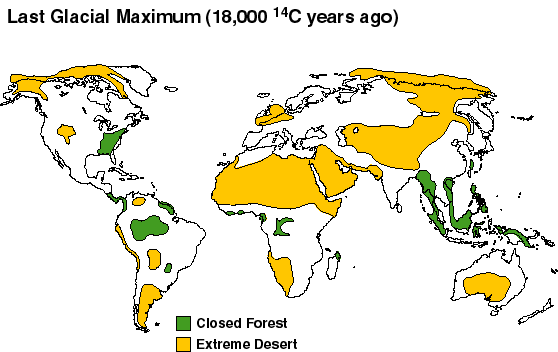
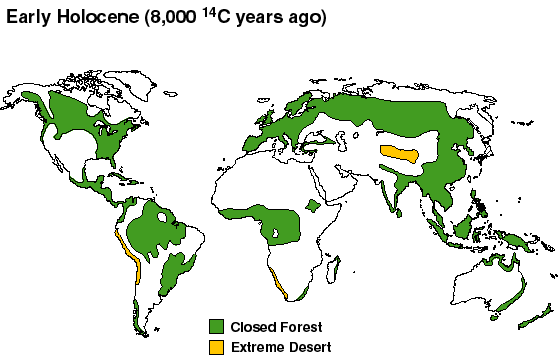
Anyways. If we had started climate research in tropical areas instead of temperate ones the ice ages would probably be known as the dry ages. Looking at our past the correlation between warm = wet and cold = dry is pretty much a reality for most of the planet.


The last ice age.


The last time the planet was a bit warmer than today.

So I don't know why we still believe we live on some sort of climatic optimum where every temperature increase would be catastrophic. Again, looking at the past, we are still on a less-than-ideal-for-life icehouse Earth, not a greenhouse one. As for the oceans - they were much, much hotter and acidic on the Eocene and the Paleocene, and overall biomass and diversity still increased, despite the loss of a number of benthic microorganisms.

Of course the effects of such a rapid climate transition on the environment are still to be known. Historically the planet had centuries and even millenia to adapt to climate change, though a few significant events still happened on the span of a few decades, like the younger dryas.


I don't understand the OPs main point. I see that you are saying that climate change is occuring but you aren't sure whether it is problematic but this seems like a strange point. As with any widespread change, we as humans need to change to keep up and that is where a lot of science is going. A lot of science has looked at what has already happened and are finding ways to compensate for these changes and make systems robust in the face of future changes. Systems like agriculture, hydropower, wildlife conservation, urban planning etc need to keep climate change in mind to maximize efficiency under changing conditions.

I think any large scale change such as this can be considered harmful due to the large changes that must accompany it and I certainly think that a statement such as "Greenlanders like the warmer weather" has virtually no place in this discussion.

Overall, it can be debated whether these effects will be as harmful as some models say, but the point of view that we might as well just wait and see because there is a chance that things might turn out fine is utterly useless in my opinion.


sundin13 said:
I don't understand the OPs main point. I see that you are saying that climate change is occuring but you aren't sure whether it is problematic but this seems like a strange point. As with any widespread change, we as humans need to change to keep up and that is where a lot of science is going. A lot of science has looked at what has already happened and are finding ways to compensate for these changes and make systems robust in the face of future changes. Systems like agriculture, hydropower, wildlife conservation, urban planning etc need to keep climate change in mind to maximize efficiency under changing conditions.

I think any large scale change such as this can be considered harmful due to the large changes that must accompany it and I certainly think that a statement such as "Greenlanders like the warmer weather" has virtually no place in this discussion.

Overall, it can be debated whether these effects will be as harmful as some models say, but the point of view that we might as well just wait and see because there is a chance that things might turn out fine is utterly useless in my opinion.

Oh both Dyson and I support planning for rising oceans, and such. The concern is that an international limitation of carbon emissions can induce huge costs to developing countries like China and India, who depend on fossil fuels in their process of industrialization. We are more concerned about poverty levels and reducing them than minutely reducing greenhouse emissions so that we can buy a few more years to prepare. Industrialization will lead to more innovative technologies and solutions which can prepare us much more suitably for any negative effects. Furthermore, I believe that the cost of fossil fuels will exceed the costs of alternative methods some point in the next few decades, and we will see a market reduction of carbon emissions. So by the time any legislation will go through, it will likely already have been the case that the market was heading in that direction anyway. So the whole movement wasted time and resources that could be spent elsewhere on other environmental concerns and planning methods.

 My main point is that environmentalists seem to crusade against people who aren't as alarmed by climate change and think it is the biggest obstacle humanity will face in the next hundred years. I don't think it is anywhere near close to certain that the predicted negative effects will happen at the magnitude they choose to declare it will, and it baffles me how much the positive effects are ignored. Change is not always bad. I also think if humans are influential enough to accelerate the change in climate, we are also capable enough to adapt to said changing climate through our elaborate shelters. In my opinion, there are more pressing environmental concerns than climate change, and some of the fear-mongering really does bother me. I was watching the episode of the new Cosmos the other day which was about climate change, and Tyson started the episode talking about the runaway greenhouse effect on Venus. While the point was to illustrate how the greenhouse effect works, I don't recall any mention that it is extremely unlikely that such an event can happen on Earth, even according to the current models. It seemed almost intentionally positioned like that to induce fear. In my opinion, this is scientifically unethical. 

Nobody is saying wait and see. We're just saying don't spend massive amounts of time and resources on things we are not certain of. Time and resources that would bring entire human populations out of poverty and could otherwise save lives. I know environmentalists address said poverty issue, but they do it with heterodox economics (marxism and the like) that has never worked. 


Around the Network
sc94597 said:

Nobody is saying wait and see. We're just saying don't spend massive amounts of time and resources on things we are not certain of. Time and resources that would bring entire human populations out of poverty and could otherwise save lives. I know environmentalists address said poverty issue, but they do it with heterodox economics (marxism and the like) that has never worked. 


Interesting...I don't entirely disagree with you, I suppose.

I would like to ask though, if you do not think that the current models are viable, then what alternative do you propose? In order to plan for the future, models are essential. While I think most people in the scientific community acknowledge their limitations, if you do not propose an alternative you really cannot take away the importance of these models.

I also think that downplaying the potential negative effects can have the opposite effect of the one that you hope to see. You say that science and the market will naturally push towards greener energy sources and whatnot, but I think that the environmental push is a large part of the reason we will see this. Numerous companies push towards green off the back of the "green movement", using positive public reception to counteract the (potentially) increased costs. If we take the wind from beneath the wings of this movement, whos to say that advancement will continue at the same rate?


sundin13 said:
sc94597 said:

Nobody is saying wait and see. We're just saying don't spend massive amounts of time and resources on things we are not certain of. Time and resources that would bring entire human populations out of poverty and could otherwise save lives. I know environmentalists address said poverty issue, but they do it with heterodox economics (marxism and the like) that has never worked. 

1. I would like to ask though, if you do not think that the current models are viable, then what alternative do you propose? In order to plan for the future, models are essential. While I think most people in the scientific community acknowledge their limitations, if you do not propose an alternative you really cannot take away the importance of these models.

2. I also think that downplaying the potential negative effects can have the opposite effect of the one that you hope to see. You say that science and the market will naturally push towards greener energy sources and whatnot, but I think that the environmental push is a large part of the reason we will see this. Numerous companies push towards green off the back of the "green movement", using positive public reception to counteract the (potentially) increased costs. If we take the wind from beneath the wings of this movement, whos to say that advancement will continue at the same rate?

1. I think the models give us useful information to inform our understanding, and they do tell us the range of possible futures as well as their likelihoods, but only to an extent, and we must always consider that extent when we make large policy decisions. It just bothers me when environmentalists use what they call their "precautionary principle" and choose to assume the worst case scenario without considering the costs of assuming the worst case scenario to human lives. Some even go as far as to say it is the ethical scientific position, and I disagree. Fearmongering is not an ethical means to educate people about science. People must accept these facts based on reason. 

2. I'm not against pressure for companies to go green. There are many environmental concerns besides global warming that companies should be scrutinized and/or sued for. Pollution isn't a good thing even if global warming weren't a major concern. I am against top-down legislation, however. Mandating that CO2 outputs must be a certain level has huge costs for minute benefits, and will affect different populations unequally. Either way though, fossil fuels are not sustainable. Eventually the cost to obtain them will exceed the declining costs of alternative energy, especially if we targeted and removed the plethora of government subsidies the fossil fuel companies get. In such a situation, we will see a market distribution where alternative energy is more profitable than fossil fuels. Furthermore, sooner or later (likely a few centuries at most), as our technology progresses, we will figure out new cheap means to obtain as much energy as we could need to live on Earth (nuclear fusion, collecting solar energy in space and moving it down to Earth, Geothermal energy, etc, etc.) Renewable non-pollutant energy is inevitable, and if one doesn't believe that it is very likely we will destroy all human civilization due to accelerating climate change, it feels less far away than if one does believe such a scenario will come to be.