By using this site, you agree to our Privacy Policy and our Terms of Use. Close

Forums - Gaming - My problem with review scores

Decided to make another thread today #DealWithIt.

TLDR: video game scores are too high

The video game review system almost universally uses a 1-10 scale to rate their games. By this scale, 5, being the middle/median) number, means "average". This is how standard deviation works. Following this, anything above 5 is above average while anything below 5 is below average. However, if you look on Metacritic (in this instance I used PS3 games cos yolo) you will find that the vast majority of video games (92% found in my example) have a score of 50 or above. In fact the median score I found was a 72; which belongs to several games including: 50 Cent: Blood in the Sand. I'm going to link the game's Metacritic page here so you can read the description and tell me how it sounds (this is anecdotal evidence and completely subjective, but I do think 72 is much too high to be average. There are 6 numbers below and only 3 above on a 1-10 scale):

http://www.metacritic.com/game/playstation-3/50-cent-blood-on-the-sand

I intentionally picked the first critic review on this gangsta's game, since it was the highest. PGNx Media writes: "(the game) is a fairly typical third person shooter". They then rate it an 85. Reading some of their other reviews, the lowest score they have ever given out is a 45 (just below average) and only 29 out of their 929 reviews are below 70.

I won't extrapolate any user scores, but we users are usually worse than critics are, including me (heck, just look at my game ratings if you feel like calling me a hypocrite. I have an average score of 9 over 60+ games :p) (although some do research and avoid bad games). The Witcher 3 has not even released, yet look at its page on the Marketplace (almsot 13000 ratings averaging to 4.5. Another whole new can of worms!):

https://store.xbox.com/en-ca/Xbox-One/Games/The-Witcher-3-Wild-Hunt/810967a8-b286-4eef-b02a-d16bbe55f85f

Here's my biggest question: What does average even mean anymore, if 90% of games are supposedly above average? Why do so many criticize a game, and then give it an above average score? WHy are we seemingly so afraid to give out an average score for an average game?

Discuss.

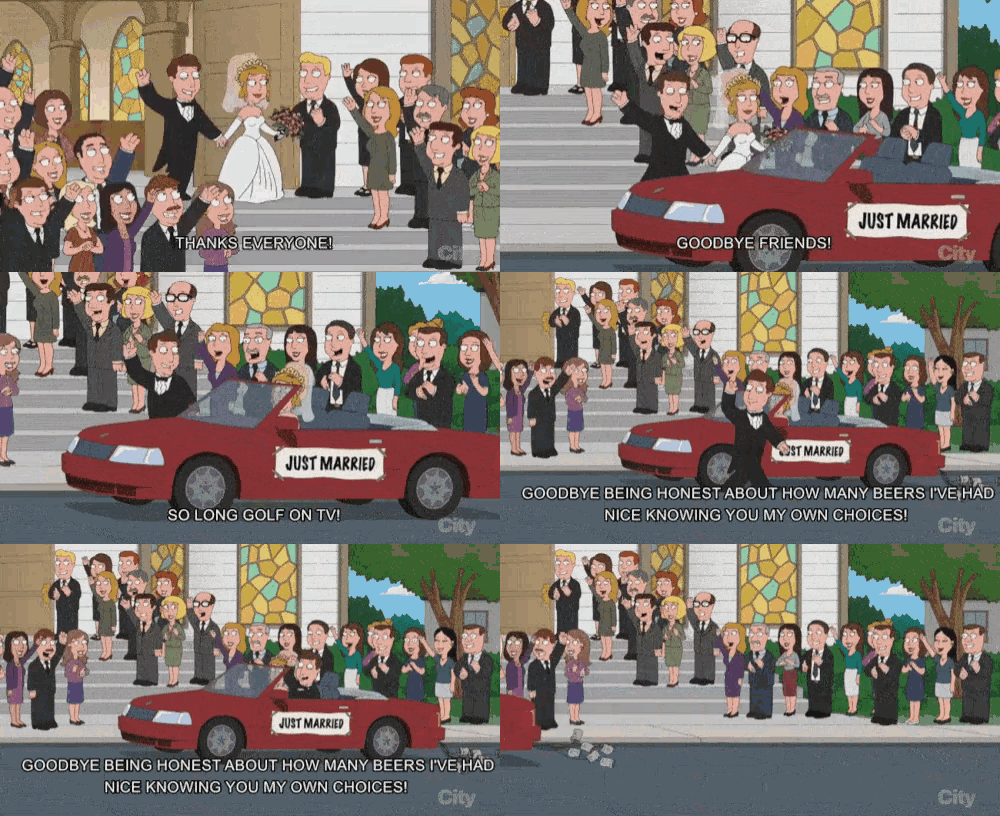
*edit* An image posted by Mummelmann which illustrates my point quite well:

*edit* I have to go to bed soon as I have ball in the morning, but I'll try to get a good discussion going here b4 I leave. I'm quite tired but I hope I built an intriguing set piece

*edit* Stole this from my comment down below but I liked it so I'm adding it here:

In University, you mark by the bell curve based on Standard Deviation, much like a video game review should work IMO. In Uni, you are not marked based on the questions you got right; you are marked based on how you compare to other students. For example; if 60% of the class gets an 80% on a test (and 20% are both above and below them), they all (the 80 guys) get Cs because that is average. All the high review scores have oversaturated the market with "better than average" games. I'm calling for distribution of numbers to the true 1-10 scale so it accurately reflects how each game stands on that scale.


#1 Amb-ass-ador

Around the Network

I feel like the review system is using the school system of grading where 50 or below is a failure and 70 is considered good/average and etc so if you adjust ur scoring like that... Reviews suddenly work and make sense so I don't think there is anything wrong with it

Also, metacritic averages the reviews out from the blind to the haters (if you know what I mean) so the place where it will land should be the consensus is hence why I think metacritic is great

(Sorry for the fail grammer/editing, I am tired today T_T)


PC Specs: CPU: 7800X3D || GPU: Strix 4090 || RAM: 32GB DDR5 6000 || Main SSD: WD 2TB SN850

Review scores are someone's opinion on a particular thing is it not? I don't get how people use these things to determine whether they purchase something or not. I can't think of a single gamer who's not, at one point in their gaming life, gone against the general consensus about a game and have been happy with the result. So why are people so inclined to allow someone else to make up their mind for them?


PC GAMING: BEST GAMES. WORST CONTROLS

A mouse & keyboard are made for sending email and typing internet badassery. Not for playing video games!!!

Captain_Yuri said:

I feel like the review system is using the school system of grading where 50 or below is a failure and 70 is considered good/average and etc so if you adjust ur scoring like that... Reviews suddenly work and make sense so I don't think there is anything wrong with it

Also, metacritic averages the reviews out from the blind to the haters (if you know what I mean) so the place where it will land should be the consensus is hence why I think metacritic is great

(Sorry for the fail grammer/editing, I am tired today T_T)

*edited to make more sense. Also thanks for your response man

I do understand what you mean  about the blind to the haters thing. It may be a tad inconsequential, but the blind will outnumber the haters 9/10 times, the 1/10 regarding examples such as Justin Bieber.

To the school thing: In school, you rate students by questions that they got right. In University, you mark by the bell curve based on Standard Deviation, much like a video game review should work IMO. In Uni, you are not marked based on the questions you got right; you are marked based on how you compare to other students. For example; if 50% of the class gets an 80% on a test (and the same amount of remaining students are above and below them), they all (the 80 guys) get 50s because that is average.

I still think more variety in review scores is needed. Firstly I believe that a 70 still makes a game look like it is above average, if you just look at the number and neglect the write-up. My last point is a little more abstract, but it allows for less deviation in review scores. For example, 50 Cent got the same range as Papo & Yo, NIER and Tales of Xillia 2.  I'd argue that the chosen 4 are needing a much larger discrepancy between them.

Hopefully that made sense I'm dying here


#1 Amb-ass-ador

I think the review score should increase if the price of the game drops


Around the Network
FentonCrackshell said:
Review scores are someone's opinion on a particular thing is it not? I don't get how people use these things to determine whether they purchase something or not. I can't think of a single gamer who's not, at one point in their gaming life, gone against the general consensus about a game and have been happy with the result. So why are people so inclined to allow someone else to make up their mind for them?

Another facet that I wanted to talk about, and specifically why I added the witcher 3 link, albeit out of context


#1 Amb-ass-ador

Ruler said:
I think the review score should increase if the price of the game drops

But, why?


#1 Amb-ass-ador

ReimTime said:

I do understand what you mean  about the blind to the haters thing. It may be a tad inconsequential, but the blind will outnumber the haters 9/10 times, the 1/10 regarding examples such as Justin Bieber.

To the school thing: In school, you rate students by questions that they got right. In University, you mark by the bell curve based on Standard Deviation, much like a video game review is supposed to work. In Uni, you are not marked based on the questions you got right; you are marked based on how you compare to other students. For example; if 50% of the class gets an 80% on a test (and the same amount of remaining students are above and below them), they all (the 80 guys) get 50s because that is average.

I still think more variety in review scores is needed. Firstly I believe that a 70 still makes a game look like it is above average, if you just look at the number and neglect the write-up. In any other example I can think of  My last point is a little more abstract, but it allows for less deviation in review scores. For example, 50 Cent got the same range as Papo & Yo, NIER and Tales of Xillia 2.  I'd argue that the chosen 4 are needing a much larger discrepancy between them.

Hopefully that made sense I'm dying here

Well the concenses thankfully outnumber both so it shouldn't matter too much in terms of where a game should land

I am not sure what you mean by this but maybe its cause its different where I live. The way that it works where I live in both university and school is that on ur report card has a grade based on how you did throughout the year and if your final grade on ur course is above a certain %, you pass and if its below, you fail and neither really has anything to do with other students and what they get. So the institution I went to, the % of failure is 70% or below. If you write a test or anything and get below 70%, regardless of what the class average is and what other students get, it is considered a failure. But either ways, the review system wouldn't use universities or collage because they are so varied from program to program (some are 60% while others are 80% and everything inbetween) and not everyone will go to university or collage but majority will go to schools. The schools I went to all have a passing grade of 50%. If you get anything below, you fail

I think that 70 makes a game be on "you can buy it without having too many second thoughts" side and everything less is seen has "I should probably skip side." Not to say that everyone judges it like that but based on my experience, its like that

And if you are tired, you should get to sleep loll


PC Specs: CPU: 7800X3D || GPU: Strix 4090 || RAM: 32GB DDR5 6000 || Main SSD: WD 2TB SN850

Captain_Yuri said:

Well the concenses thankfully outnumber both so it shouldn't matter too much in terms of where a game should land

I am not sure what you mean by this but maybe its cause its different where I live. The way that it works where I live in both university and school is that on ur report card has a grade based on how you did throughout the year and if your final grade on ur course is above a certain %, you pass and if its below, you fail and neither really has anything to do with other students and what they get. So the institution I went to, the % of failure is 70% or below. If you write a test or anything and get below 70%, regardless of what the class average is and what other students get, it is considered a failure. But either ways, the review system wouldn't use universities or collage because they are so varied from program to program (some are 60% while others are 80% and everything inbetween) and not everyone will go to university or collage but majority will go to schools. The schools I went to all have a passing grade of 50%. If you get anything below, you fail

I think that 70 makes a game be on "you can buy it without having too many second thoughts" side and everything less is seen has "I should probably skip side." Not to say that everyone judges it like that but based on my experience, its like that

And if you are tired, you should get to sleep loll

I promise I'll go to bed after this post (I love debating :p). I got a few things wrong that I'll clear up. You can pretty much disregard my previous comment.

Basically the pass/fail grade is determined after the test is written and dependent entirely on the rest of the class. The way you mention is what I went through in High School (and what I prefer BTW) and some of my Uni classes. The rest of the classes use the bell curve, which is designed to yield a pre-determined distribution of grades among a class (which I do not like in school but would like for rating a product). Off topic but I envy you if you didn't get bell-curve graded :p.

Most Professors using the curve wants to target a grade of C, which equals a 2.0 GPA, as his/her class average. A is reserved for the top 10%, B for the next 10%, C for the next 60%, and D or F for the remaining 20%. The number you get on your test is most likely inconsequential to the grade you will get (Ex: you get a 90, which usually means an A, but 81% of the class has a 92 or above, you get a D on the test; meaning you were below average).

I guess what I'm saying is so many high numbers are thrown around in VG reviews that the high numbers don't necessarily mean what they used to. 7 means above average yet it has become the average score given out. People rate games too high, and they should be bell-curved or distributed to truly fit the scale of 1-10

*edit* goddamnit my grammar is terrible I'm done lol


#1 Amb-ass-ador

ReimTime said:
Ruler said:
I think the review score should increase if the price of the game drops

But, why?


Why not? its about money after why people care about reviews otherwise they would just buy everything