By using this site, you agree to our Privacy Policy and our Terms of Use. Close

Forums - Politics - Miracle or not, Putin on course to win in Russia

Holy fuck at that wall of text.

I will say, however, that i agree that there is a fair bit of bias going into how scholars assess Russia, largely due to the fact that the vast bulk of widely-circulated scholarly thought comes straight from the mouths of NATO citizens, but at the same time one must acknowledge the problems faced on the ground in Russia, namely the stymyieing of free thought in a rather underhanded way


Monster Hunter: pissing me off since 2010.

Around the Network
mai said:

Kasz216 said:

1) To critically use sources means to refrence them and then use them to form your own opinions.

2) Nothing in particular does attract my attention to him, other then the fact that said specific article gives a pretty baseline example of the russian economy.  Most of the actual opinions are relativly pointless over if the russian government will change or not.

The point is, that Russia's economy was built on the reforms of the past, combine with a strong commodities market.  Putin didn't restore a semblence of the economy so much as he did coast to it as reforms completed.

It's like having two apartment managers, one of them gets 85% through building a pool, then the new guy comes in, and when it finishes you thank him for creating the pool, unlike the asshole before him.


It's pretty simply really.  Putin finished earlier agreed on reforms, the economy got better.  He reversed course, and only got buoyed by rising energy costs.

Kaz, I got the idea, you don't need to repeat it multiple times for me. Aslund’s article despite the pretence of being strictly economical is all about politics excluding first few paragraphs. It’s typical and predictable, since Aslund much like our gaming journalists live in their own intellectual and informational ghettos, rarely taking a peek on outside world. There're really not much factual economical information that could be reviewed or critisized, so I critisize what's left.

And, yes, of course, it's build on the reforms of the past, tell me, which economy is built on the reforms of the future? :D It doesn't mean that reforms of the past aren't dead-end with expected and catastrophic results.  Putin achievements are in different field. As I said, it's political article and should be viewed as such, because Putin's decisions that are in the article again are political decisions, which though affects economy. These descisions are mostly last moment reaction to a no-win situation of the late 1990s - early 2000s, so he rightfully might claim the economical results of the last decade regardless of how they might be perceived. And the idea of him getting lucky to get in the office when the "transformation" was over is, pardon me, but a rather bad excuse.

Will publish couple of the reviewes and thoughts of Aslund's sources I was able to find among my old posts, translated and updated for Aslund article. Might come in handy.


Some economic changes are built on the present.  By presidents who make important changing reforms while in office.

Note how Bush is mostly blamed for the economic collapse... and Obama is trying to get credit for there beign any kind of recovery.

As for your articles... I see debates in them... but none of the articles or points seem to remotely deal with the economy.  So... I don't see the point.

There was plenty of economic references in the article.  It's just stuff you didn't critisize, because you couldn't.

To recap the economics arguement,

The reforms of the past, the Yelstin reforms and such were part of a process Putin finished.  His early economic reforms (which were the successful ones) were ones that were pre-planned ahead of his presidency.  At best you could give him credit for keeping with the plan.

His later economic reforms a move back to government ownership (2003 and on) have hurt the economies growth, Russia only benefitting due to the commodities boom... however hurting further growth that could of existed.

An example of something you could try to argue is....

"The Russian renationalization has had a limited, but negative impact on the economy, which is most evident in the current stagnation of oil and gas production, but also in banking, and machine building. Fortunately, two-thirds of the Russian economy is still in private hands, including the metals, retail trade, and construction sectors. The aggregate indicator that has suffered the most is investment, with Russia's official investment ratio remaining rather low despite the economic boom."

Why, if not due to renationalization, did Russian Oil production stagnate and investment stagnate, despite booming economic times in which private companies would generally increase their buisness?  Is it a coincidence that Russian Oil Production growth rates dropped significantly as soon as Russian Oil companies faced renationalization?  If so?  Why?

If not, don't you have to concede renationalization has hurt the Russian economy?  Same with investments.


Khan, bias is the last thing I'd have cared about. I don't have problems with people having bias, I have problems with people who're being stupid.

Kasz216 said:

Some economic changes are built on the present.  By presidents who make important changing reforms while in office.

Note how Bush is mostly blamed for the economic collapse... and Obama is trying to get credit for there beign any kind of recovery.

1) As for your articles... I see debates in them... but none of the articles or points seem to remotely deal with the economy.  So... I don't see the point.

There was plenty of economic references in the article.  It's just stuff you didn't critisize, because you couldn't.

To recap the economics arguement,

2) The reforms of the past, the Yelstin reforms and such were part of a process Putin finished.  His early economic reforms (which were the successful ones) were ones that were pre-planned ahead of his presidency.  At best you could give him credit for keeping with the plan.

His later economic reforms a move back to government ownership (2003 and on) have hurt the economies growth, Russia only benefitting due to the commodities boom... however hurting further growth that could of existed.

3) An example of something you could try to argue is....

"The Russian renationalization has had a limited, but negative impact on the economy, which is most evident in the current stagnation of oil and gas production, but also in banking, and machine building. Fortunately, two-thirds of the Russian economy is still in private hands, including the metals, retail trade, and construction sectors. The aggregate indicator that has suffered the most is investment, with Russia's official investment ratio remaining rather low despite the economic boom."

Why, if not due to renationalization, did Russian Oil production stagnate and investment stagnate, despite booming economic times in which private companies would generally increase their buisness?  Is it a coincidence that Russian Oil Production growth rates dropped significantly as soon as Russian Oil companies faced renationalization?  If so?  Why?

If not, don't you have to concede renationalization has hurt the Russian economy?  Same with investments.

1) That's because Aslund article have nothing to do with the economy except of its main idea (I did mention that, no?) , which backed up by purely demagogic statements, and that spoils any rational tiny grain the article might have. That's why in these articles I've attacked or rather explained why Alsund has became a victim of such stereotypes.

2) None of documents I know have any sort of pre-planned reforms of any sort, except for random vague elections programmes maybe. You should be more specific here.

3) So you basically gave up on defending Aslund article and instead giving me random quotes? Well, ok then, let's move from Aslund article at last. You probably should not have ever mentioned it, but just state some points you find useful, because you'd have hard time defending it in its entirety :D

As for your question(s). Factual mistakes:

- The most prominent one, oil and gas production is actually growing :D

- It could be argued that the pace of growth has slowed down (define stagnation btw?), but government has bought it's shares back somewhere in 2003-2004. Last time I checked no slowdowns unitl 2008, what could be easily explained by more apparent reasons.

- Oil and gas production is among least nationalized big industries in Russia.

Anyway oil market is higly speculation dependant, the production rates may change wildly for numerous reasons, say, prices high - stop production, prices low - ramp up production, as the most banal example. OPEC countries doing it all the time. So if there any changes, I'd start searching for a reasons somewhere else than (re)nationalization. You'd probably should avoid these starightforward comparisons whatsoever, like nationalization = bad, privatization = good for economy - it's tad more complex :D or what you're trying to say? Don't get it.

BTW have you read the most recent Putin's economy-related article? There's a word or two about privatization ;D


UPD: As for the rest of the quote. Banking, not sure what exactly he meant... what kind of banking? As for machine building, bold no. If anything govermental conglomerates like OAK (aircraft building) and OSK (ship building) etc. saved a lot of valuable assets. You know, the business in the early-mid 1990s wasn't really hurry to somehow utilitize such assets with big added costs (let alone hi-tech), concentrating more on natural resources with minimal processing if any, or some 'cheap' industries like building construction, retail chains, light industries, i.e. smth on what you can profit relatively easy and fast. So hi-tech and other 'burden' assets have received bad handling, which desribed in funny word "prikhvatizatsiya", which is Russian compound meaning "looting + privatization" ;D Putin might not be a great economist, but he's a good manager.



mai said:

Khan, bias is the last thing I'd have cared about. I don't have problems with people having bias, I have problems with people who're being stupid.

Kasz216 said:

As for your question(s). Factual mistakes:

- The most prominent one, oil and gas production is actually growing :D

- It could be argued that the pace of growth has slowed down (define stagnation btw?), but government has bought it's shares back somewhere in 2003-2004. Last time I checked no slowdowns unitl 2008, what could be easily explained by more apparent reasons.

- Oil and gas production is among least nationalized big industries in Russia.

Anyway oil market is higly speculation dependant, the production rates may change wildly for numerous reasons, say, prices high - stop production, prices low - ramp up production, as the most banal example. OPEC countries doing it all the time. So if there any changes, I'd start searching for a reasons somewhere else than (re)nationalization. You'd probably should avoid these starightforward comparisons whatsoever, like nationalization = bad, privatization = good for economy - it's tad more complex :D or what you're trying to say? Don't get it.

BTW have you read the most recent Putin's economy-related article? There's a word or two about privatization ;D


UPD: As for the rest of the quote. Banking, not sure what exactly he meant... what kind of banking? As for machine building, bold no. If anything govermental conglomerates like OAK (aircraft building) and OSK (ship building) etc. saved a lot of valuable assets. You know, the business in the early-mid 1990s wasn't really hurry to somehow utilitize such assets with big added costs (let alone hi-tech), concentrating more on natural resources with minimal processing if any, or some 'cheap' industries like building construction, retail chains, light industries, i.e. smth on what you can profit relatively easy and fast. So hi-tech and other 'burden' assets have received bad handling, which desribed in funny word "prikhvatizatsiya", which is Russian compound meaning "looting + privatization" ;D Putin might not be a great economist, but he's a good manager.


Shows how much you've been paying attention.

That quote was from said article.

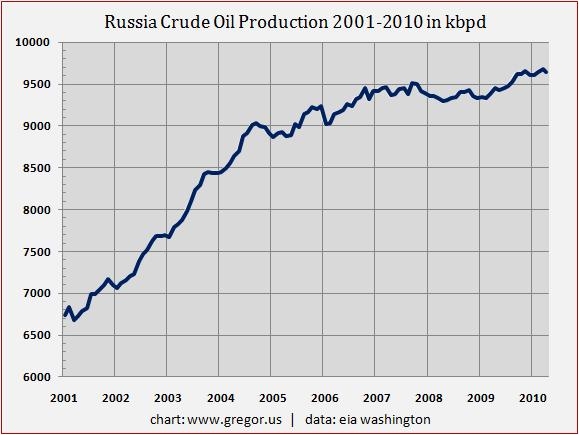
Also no.  Oil production growth slowed in 2004 essentially stanganting in growth rate.  Right after russia taking over and it stagnated by 2005. 


It's so drastic it'd be silly to assume there is any other cause, espiecally when Russia has plenty of untapped oil.


For the rest, economic growth was at least caused by it.  Having zero to little growth in this fields when it comes to production is worse.  Now if he actually tried to improve things honestly, that'd be an advantage.

As for baking... it's pretty obvious. The investment ratios.

For new article, which one?

You seem to be missing the point.  Which was, yes, the previous governments were corrupt, but at least they were corrupt in a way that facilitated growth.  Why Putin is corrupt in a stagnating controlling way.   The Russian economy could do so much more if he let the economy do so.


Around the Network
Kasz216 said:

Shows how much you've been paying attention.

That quote was from said article.

And what do you mean by that?

Kasz216 said:

Also no.  Oil production growth slowed in 2004 essentially stanganting in growth rate.  Right after russia taking over and it stagnated by 2005.

Oh, pretty picture :D Picture wars!

Let's see bigger picture. Russian oil production yearly (note the 1990s gap):

Source: Rosstat + historical trend

World oil production yearly:

Source: BP Statistical Review of World Energy 2011

OMG, what we see here? The oil production has stagnated because Putin nationalized oil industry all over the world :D Seriously speaking though, it perfectly follows world trend (well, except for 1990s gap, lol) with minor negative growth in 2008-2009 (should I explain the reasons why 2008 or that's obvious without my explanations I hope?).

Kaz, now you just being stupid. Stop it! ;D

P.S.:

Kasz216 said: 

...espiecally when Russia has plenty of untapped oil.

True, but do you know what're production costs of this oil? Well, when it's ~$300 then maybe it might worth the effort :D


And other point you've seemed to ignore, and mind you, rather important one, since it completely destroys yours (if what's above is not enough for you :D ). How much actually Russian goverment is involved into oild production? 30%, that's the share of govermentally owned companies, while the rest 70% goes to privately owned in Russia by oil production in 2010:

http://ru.wikipedia.org/wiki/Нефтяные_компании (see first chart). Source: InfoTEK (№1, 2011).

You've ignored my request to define stagnation, ok, at the very least define nationalized industry, 30% is enough?


Kasz216 said:

For the rest, economic growth was at least caused by it.

You and Aslund seem to repeat multiple times like mantra, but give some argumantation for christsake! Your "oild production has stagnated after nationalization" seems not work (see above) :D

And again define economic growth, I do have suspicion you're talking about GDP or smth macro-economical. Not necessarily it means economic growth.

Kasz216 said:

As for baking... it's pretty obvious. The investment ratios.

Oh, investment :D I did investigate that question a while ago, the average investor interest is about 3 months, no? It's purely speculative capital - again a shitload of numerous reasons for them to be up or down, most of which aren't connected in no way to nationalization or Putin (again see world oil trend above).

Kasz216 said:

For new article, which one?

Especially part about privatization:

http://www.vedomosti.ru/politics/news/1488145/o_nashih_ekonomicheskih_zadachah (in Russian, duh!)

Kasz216 said:

You seem to be missing the point.  Which was, yes, the previous governments were corrupt, but at least they were corrupt in a way that facilitated growth.  Why Putin is corrupt in a stagnating controlling way.   The Russian economy could do so much more if he let the economy do so.

Oh my, *facepalm* not this again, the TI article wasn't enough for you? First, define corruption, then give some argumentation... and then it could be a fair point. Why I'm writing these walls of text if the best I get in return is this bollocks? :D


mai said:

And other point you've seemed to ignore, and mind you, rather important one, since it completely destroys yours (if what's above is not enough for you :D ). How much actually Russian goverment is involved into oild production? 30%, that's the share of govermentally owned companies, while the rest 70% goes to privately owned in Russia by oil production in 2010:

http://ru.wikipedia.org/wiki/Нефтяные_компании (see first chart). Source: InfoTEK (№1, 2011).

You've ignored my request to define stagnation, ok, at the very least define nationalized industry, 30% is enough?


A) Most other countries have hit there limit for oil production. 

Russia's oil production has been greatly underrepresented for a while until privitization came... which shows why, coincidentally it skyrocketed once it started.  Then coincdentally dropped as soon as the risk of the government taking your company away started.   The fact that would oil production is down pretty much highlights the problem. 

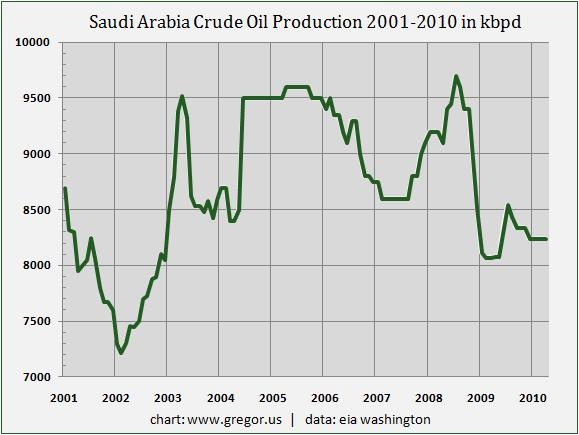
You can tell the difference between stagnation due to external factors and stagnation due to oil avaliability by the way oil production looks.... if it's due to oil availability, Oil production will spike and drop as new forms of cheap oil are found/it becomes more economical to get cheap oil  It will jut and juke like crazy.   If it's due to external factors it will be a steady "neat" graph as less money is put into discovery and the number of new areas being built slows down.   Compare Russia, who's oil troubles come due to political problems, and Saudi Arabia, who has avaiability issues. (and tries to hide it.)

VS


The difference becomes pretty apparent.  If it's not aparent enough, i'll point you to the US a country who's oil production is unquestionably tied more to politics then availability.


And I did define stagnation, a great lowering of the production growth rate as soon as renationalization began.   Is 30% control of the industry enough?  I'd say so, when the message is "do well enough and we'll want to take your oil."

For example markets in war torn areas of the middle east are seen safer then peaceful nations in South American by oil companies because damage can be fixed,  the government stealing your industry? 


As for investment ratios.... not really.  Investment ratios in an unhampered market pretty much rise or fall as the economy does.  When the economy booms, so does investment ratios as people have extra money and a lot of them invest it.  This never really happened.


As for the brevity of my posts.  I'm just not a fan of an ad nauseum approach like yours where I create a giant wall of text where maybe 1 thing is relevent and hope that it causes someone to give up just by the sheer size of it.  I consider it being polite honestly.


Kaz, again:
1) Did I explain why there's a limit to oil production growth in Russia?
2) So if 30% is enough to harm the industry as you say, why 70% is not enough for it to prosper. Logic?

You know I could go on and on and on with posting oil production rates for each country with different balance of govermentally and privately owned assets troughtout last 50 years, and you still won't able to defend this point. If there's be some soild point, it'd have showed some consistency given other things are equal.

BTW you kinda proved it for yourself by posting Saudi's chart :D Correct me if I'm wrong, but govermentally owned Saudi Aramco is like entire Saudi's oil industry, no?