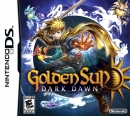
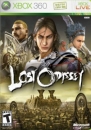
Soriku said:
noname2200 said:
Soriku said:
Been hearing a lot about this game lately...and it turns out the game turned out very good and it's probably one of the DS's last new good games.
|
No to both. It's an utterly average JRPG that has oodles of lost potential.
|
That's not what everyone else is saying but OK :P Any detailed impressions?
|
"Everyone else" being a handful of reviewers and a dozen people who are posting over and over in the official threads over on NeoGAF and gamefaqs?
Anyhow, this game has several fairly basic strikes against it. For starters, all of the areas are pretty small, with few locations reaching a dozen screens, and none going far past that amount. That would be fine, except that because there are so few areas in the game (off the top of my head, I'd put it at around twenty) you'll be going back through these same small areas over and over again, with the only differences being that there are now new pallete-swapped versions of the same enemies you've been fighting.
You can, theoretically, use the overworld map to skip past the tedium of revisiting Gran Plains or Lazvil Hills (the main, but hardly sole, offenders) for the umpteenth time, but only when the game lets you. And it rarely lets you, notwithstanding the fact that you passed through that same area only half an hour ago. This is essentially thinly-veiled filler. The nice thing is that about halfway through the game you learn an ability that basically lets you skip all the random battles. The catch is that you still have to trudge through the same areas time and again, but now without combat to break up the monotony.
Speaking of the combat system, it has a ton of lost potential too. Your team is arbitrarily limited to only three people, notwithstanding that up to four characters are therefore scratching their asses on the sideline for no discernable reason. Even better, inactive characters don't gain as much experience, and characters that are not in your party (a very common occurence, especially with three of the seven) get no experience at all. Combat's main gimmick is that the enemies are on a 3x3 grid, and that you can manipulate their positions so that your attacks hit multiple opponents instead of just one. The other gimmick is the Combo system, in which your attacks get stronger as you string them. To aid in this, you're allowed to switch a character's turn with another character's, or even an enemy, so that you can create larger combos.
Problem #1: for most of the game the combo system is borderline useless. The damage increases are pretty incremental, so that a level 5 hit does only a minor amount more damage than a level 1 hit. Even in the late game, when you get abilities specifially tailored to increase the combo count, the combo-builders do scratch damage, so the increased damage of the follow-up attack set up by the combo barely makes up the difference, assuming it does at all (hint: it often does not).
Problem #2: turn-swapping isn't as useful as it should be. The biggest incentive the game tries to give you to swap your turn with, say, an enemy's is to give you more consecutive turns, and therefore build up bigger combos. But as established above, high combo counts aren't really useful in combat, so there's little point in using it for that. It is handy for getting your healer into play immediately, or for having your position-manipulator go first, but since its primary purpose is a wash, this mechanic doesn't serve its intended purpose.
Problem #3: the grid system is primarily intended to force you to work at hurting multiple enemies with one attack: the game gives you very few attacks that naturally target multiple enemies, and most of those come only in the late-game. Of course, the enemies you clumped together separate as soon as any enemy gets a turn, so the only way to take advantage of this is to use the turn-swapping method to make sure your guys have several consecutive turns.
The problem here is that your incentive to hurt multiple enemies with a single attack is to cut through the enemies quicker, but using the turn-swap system automatically means that your enemies are going to be going before you, so you're not saving much time or health by doing this. Unless you're setting up your magic-user to hurt multiple enemies who are weak to magic (admittedly something that comes up late-game) then you'll take about as much time and damage in using the grid system as you would by attacking normally, with the only difference being that you can't just set auto-battle and watch TV for those two minutes. Admittedly the grid system lets you go through fights quicker when you get a preemptive attack, but there will still be survivors to mop up, and then you face the same dilemma.
Problem #4: nearly every enemy has a ton of health, and no enemy is a real threat. Since enemies scale to your level, most fights will take a fair amount of time to slog through, because they're damage sponges. Enemies from the early game are only slightly better, since you also have better equipment now, but your weaker characters (of which there are many) sometimes need two or three hits notwithstanding the fact that you're ten times stronger now than when you first encountered them. I'm at the endgame now: why can't Marco one-shot a goblin from early in the first chapter?!
But that's okay, because the game is piss-easy. I've had one game over the entire time, and that was the only time when a game over felt like a possibility. The enemies are generally so weak, and items are so abundant and cheap, that there's no real danger in the game. One optional boss, who of course has a ton of health and could one-shot one of your two characters, was a total breeze because by that point I had over eighty revival items, so I could just revive when my weaker character died and attack when she didn't. It was really, really monotonous, but a good example of the system as a whole.
Now to talk about the flaws in the story and characters without spoiling anything. For starters, both of them are filled with the usual JRPG stereotypes. Amnesiac main character, missing prince, spunky and rebellious princess, brave warriors shattered by losing some troops in a battle, vaguely-Christian stand-in is actually evil, etc. If there's anything new or particularly interesting here, I can't think of it. But the worst offender, by far, is the time-travel system. It offers so many interesting possibilities, but ultimately it's just hit-a-roadblock, go-to-other-timeline-to-get-solution, rinse and repeat. The game often doesn't even bother to explain how doing something in one time results in the same thing happening in the other timeline, notwithstanding that the two timelines are polar opposites in nearly every way, but even early on it relies on this deus ex machina to propel the story. It's lazy and uncreative at best.
The sidequests can be a little more complex, but only because you have to remember what that NPC from way back when wanted, and then remember where and when you found that character (something which can be tricky). However, unlike in Chrono Trigger doing the sidequests doesn't have any effect at all on the world: the NPC will say "thank you" from now on, and that's it. Hopefully these things are at least mentioned in the ending, but it's extremely unsatisfying to save a life or complete a quest and see literally zero changes.
The sidequests will also have you bouncing through time a lot, and luckily most of them have a time node conveniently placed nearby, but there are some sidequests where you have to trudge through a dungeon or sit through several cutscenes to get to the NPC you need to briefly talk to. Actually, nearly every node begins with lengthy cutscenes (yes, plural), which is stupid in light of how often you'll be travelling to some of them, although luckily you can skip them. Sure, I've gotten into the habit of mashing the start button and sitting through several seconds of "loading," but it beats the time when I didn't know you could skip them at all (the game never tells you; I guess boredom is supposed to drive you to experiment).
To conclude, it's not a horrible JRPG, but it's certainly not awesome, it's hardly a swan song, and there's a reason few care. If it wasn't published by Atlus, I'm willing to bet those review scores would generally chop off ten to twenty points and call it a day.
Oh, and the soundtrack's overrated too.