

Mistwalker CEO Hironobu Sakaguchi appeared by himself in the first Iwata Asks column for The Last Story. That column brought some surprising news: Sakaguchi is directing the game -- a big revelation considering the Final Fantasy creator hasn't fully directed a game in 18 years.
The second Iwata Asks column for the game hit today (the long time between columns, admitted Iwata, was due to his being too busy preparing for the Nintendo Conference event to check the interview text). This time, Sakaguchi was joined by Mistwalker's Kimihiko Fujisaka, revealed to be the game's concept artist and character designer.
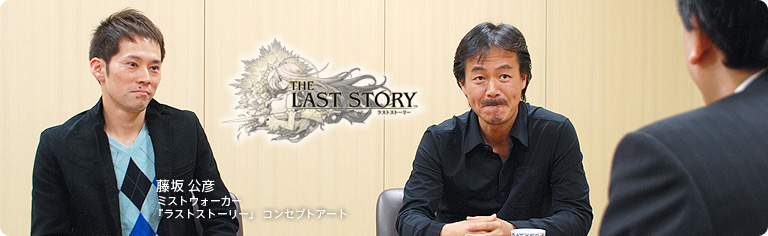
"For me," said Sakaguchi, "Image illustrations and characters are very important." Sakaguchi worked with Fujisaka from the start of the creation of the game's image. He attributes the game's resulting world view to Fujisaka's artwork.
After noting that there are many fans of Fujisaka's work within Nintendo, Iwata asked Fujisaka what kind of requests he received from Sakaguchi. There actually weren't too many requests, explained Fujisaka. Initially, Sakaguchi provided Fujisaka with a simple plot, but let him do as he pleased.
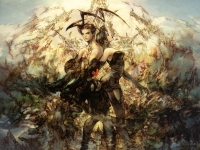
Sakaguchi appears to be a big fan of Fujisaka's artwork himself, particularly Fujisaka's work on female characters. He joked that if the girl whose profile is shown in the logo were real, he's give up everything for her. Iwata joked that many employees within Nintendo have fallen in love with the character.
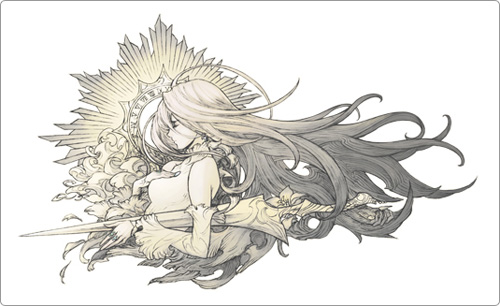
It appears that the two creators truly worked together on The Last Story. Iwata asked Sakaguchi if he found Fujisaka's visuals to be agreeable. While Sakaguchi replied in the affirmative, he added that there were also areas where he modified the character personality and world setting to match the characters that Fujisaka created. This surprised Iwata, as he'd been under the impression that Sakaguchi had the image of his games already preset in his mind.
Early Development
Development on The Last Story began with Sakaguchi, Fujisaka and someone with a programming background (the name was not given) speaking over lunch. The three debated such things as Japanese and Western RPG styles. The game's plot emerged as they engaged in these conversations. In other words, rather than saying that the game's plot was created by just Sakaguchi thinking something up on his own, it came about as the three conversed.
A considerable amount of time was spent doing prototype work for The Last Story, said Sakaguchi. The game slowly changed over a period of about one and a half years. This approach is similar to Final Fantasy VII's creation, explained Sakaguchi, although the prototype phase was longer here. FFVII took about a year for the same phase.
During the prototype phase, the game used blocks for its characters. The team also created a square "test dungeon" which still exists in the ROM. Whenever they make changes to the gameplay systems, they'll go to that room and play.
Sakaguchi joked that they ended up throwing so many gameplay systems away that they could have made two games. Here's one system that didn't make the cut. Early on, the game had something that Fujisaka refers to as a "UFO." The world was set so that UFO-like discs would fly out from enemy spawn points. While this was eventually tossed out, elements of it and other unused systems evolved into subsequent systems.
All this work was going into the gameplay area of the game because, as Sakaguchi has said in the past, he was placing an emphasis on gameplay this time. "The true drama for the story emerges during battle," said Sakaguchi. He believes that if you were to, for example, have someone cover someone else during a story sequence, it's possible to draw out player feeling to a certain level. However, if this happens during actual battle, the player will feel a deeper bond with the ally. "This time, we wanted to make the systems first, then later insert cut scenes that matched up with this."
Iwata seems to be impressed with the results, saying "When I actually saw it for myself, it gave me the impression of a game unlike what I'd seen before."
It looks like Sakaguchi has taken the gameplay first philosophy to the extreme. Continued Iwata about his experience seeing The Last Story, "What particularly impressed me was that even though a climactic point is occurring in the story, the camera view is not forced to that climactic scene." Responded Sakaguchi, "I feel that doing it this way helps connect to the rich feel of the world. If it's a climactic scene, rather than forcing the viewpoint, we're making it so that the world that the player is seeing is everything. For example, if you imagine that something is taking place in an area where you're not looking, don't you get a little excited?"
This approach is something that was born through trial and error. While Sakaguchi admits that it's probably not perfect, he believes that the newness is important for entertainment, and even if it's a bit rough, it will make you feel a lot of excitement.
The unforced camera wasn't all that surprised Iwata, though. He was also surprised to find that you can fast forward through event scenes. Sakaguchi noted that rather than simply skipping the scene, you're actually forwarding through the scene and can read the subtitles to keep up with the story.
One Town
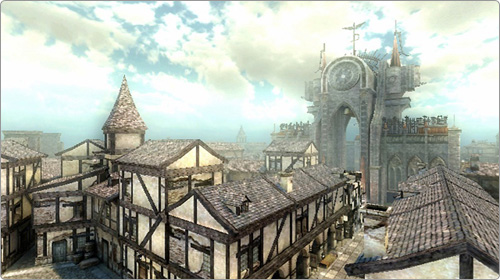
The Last Story has just one town -- Ruli City. Because the player will be in the town for so long, Sakaguchi wanted to make it into a place that players would love. Iwata described the town as astonishingly detailed and deep.
They've filled the town with a variety of nuances, explained Sakaguchi. He mentioned one. When you bump into someone on the street, he might shout at you "What!?". However, once you've become stronger, the person might apologize for the collision.
"It's an extremely big town, where a variety of things will occur. Even I'll still get lost in some back roads," admitted Sakaguchi.
Explained Fujisaka, "The people in town will dance, play the accordion, sit at the fountain -- there are exclusive motions just for the town."
The Last Story's Iwata Asks columns will be continuing through future installments. Sakaguchi and Fujisaka were revealed to be, respectively, director and character designer through the columns, so perhaps we can expect even more staff revelations in future updates.
http://www.andriasang.com/e/blog/2010/10/13/last_story_iwata_asks/
http://www.nintendo.co.jp/wii/interview/slsj/vol1/index2.html