By using this site, you agree to our Privacy Policy and our Terms of Use. Close

Forums - General - Krugman: Spend Now, Save Later

There's more than one kind of debt. When you're house if falling apart and you don't have the cash on hand to fix it, you have to borrow so that you still have a house to live in. It's your own stupid fault if you trashed your own house in the first place to turn it into a dump, but you need a place to live so borrow you must.

But then there's borrowing great wads of cash to spend for hedonistic and frivolous purposes, that ultimately provides no long term value.

Seems to me Krugman thought the deficit spending of the Bush years was mostly of the latter category (2 wars, one that was totally optional, the other was potentially avoidable). What he's advocating now is the sort of deficit spending described in the former category.

It also seems the Neocons thought the Bush deficit spending was of the former type, whereas any deficit spending now (including on the Afghan wart of their making it would seem) is of the latter type.

There is good / clean debt and there is bad / dirty debt. Trouble is after having amassed such a huge pile of stinking bad debt, can there be such a thing as good debt which actually sets things up long term to reduce that stinking pile of bad debt? Or is that debt which would otherwise be seen as clean, just going to end up tainted, simply adding to the pile of bad debt.

Best to not go into such horrible debt in the first place. So that means to me to look to the future and come up with an economic structure that does not rely on people (individuals and families) using debt to drive econmic growth. Because if the basic modus operandi doesn't change then the world is doomed to repeat the same boom bust cycle, over and over again.


“The fundamental cause of the trouble is that in the modern world the stupid are cocksure while the intelligent are full of doubt.” - Bertrand Russell

"When the power of love overcomes the love of power, the world will know peace."

Jimi Hendrix

 

Around the Network

I would have thought that Keynesians would finally realize spending your way out of a recession as being an unworkable strategy by now; unfortunately this approach is driven more by blind faith than rational thought, and they’re unwilling to admit that all the massive spending that has happened has done is delay the crisis, prolong the recession, and indebt people who have yet to be born.

The problems with the US economy (and you could say the economy of the western world) is that individuals, organizations and governments are carrying too much debt to cover their unsustainable spending habits, and people have abandoned rational investing (based on fundamentals) for speculation and gambling. Taking on more debt to encourage further unsustainable spending and to return the gambling addicts to the table makes the problem worse, not better; and any short term gains from this strategy will quickly be erased when the next crisis begins.


binary solo said:

There's more than one kind of debt. When you're house if falling apart and you don't have the cash on hand to fix it, you have to borrow so that you still have a house to live in. It's your own stupid fault if you trashed your own house in the first place to turn it into a dump, but you need a place to live so borrow you must.

But then there's borrowing great wads of cash to spend for hedonistic and frivolous purposes, that ultimately provides no long term value.

Seems to me Krugman thought the deficit spending of the Bush years was mostly of the latter category (2 wars, one that was totally optional, the other was potentially avoidable). What he's advocating now is the sort of deficit spending described in the former category.

It also seems the Neocons thought the Bush deficit spending was of the former type, whereas any deficit spending now (including on the Afghan wart of their making it would seem) is of the latter type.

There is good / clean debt and there is bad / dirty debt. Trouble is after having amassed such a huge pile of stinking bad debt, can there be such a thing as good debt which actually sets things up long term to reduce that stinking pile of bad debt? Or is that debt which would otherwise be seen as clean, just going to end up tainted, simply adding to the pile of bad debt.

Best to not go into such horrible debt in the first place. So that means to me to look to the future and come up with an economic structure that does not rely on people (individuals and families) using debt to drive econmic growth. Because if the basic modus operandi doesn't change then the world is doomed to repeat the same boom bust cycle, over and over again.

Good debt is debt which improves your earning potential by an amount greater than the principle and interest payments on the debt; or debt that is backed by an asset which will appreciate at a rate higher than the interest paid on the debt. A very small portion of the debt of either Bush or Obama can be qualified as good debt ...

 Your analogy of a run down house is not adequate because maintenance and upkeep are costs that an individual should factor into how affordable their house is, and they should have adequate savings to cover those costs. If a person doesn’t have the money to cover these costs than either they were spending money inappropriately elsewhere and they should cut back, or they never could afford the house in the first place.


Akvod said:

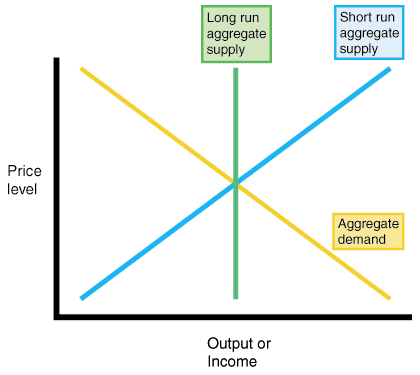
It's a really simple model... just make the yellow line go to the left. What happens when less people are willing to buy at every price level? The price level goes down. Disinflation. What happens when the rate goes below 0%? Deflation.

And what happens when there's deflation?

Shit.

WIth China, India, and Eastern Europe coming on line, there has been downward pressure being put on wages.  You can look at wages for America actually being flat since the 1970s.  This downward pressure has resulted in there being increases in productivity in America, but wages not keeping up.  It causes prices to not go up.  The likes of Walmart, which decided it wanted to incarnate itself as the marketplace, has drove down the costs of certain consumer goods.  And there has been this spiral since 2000, where record productivity gains have resulted in more people getting laid off.  This causes things to be in place no amount of money will fix. Oh, you can end up causing temporary economic activity, but to what end?

And this is what I am talking about.  You will look for strong pressures from all over, that have trashed the sources of production of good and services, it is hard to get them back.  What is needed is to build use useful goods and services, not things that are temporary.

See this video about what I am talking about.  When you create an economy like this (see inner city), exactly how does this remain sustainable:

Look at what developed around the check cashing places. Really, an economy of selling bling is sustainable?  How does throwing more money into this area make things better?


richardhutnik said:
Akvod said:

It's a really simple model... just make the yellow line go to the left. What happens when less people are willing to buy at every price level? The price level goes down. Disinflation. What happens when the rate goes below 0%? Deflation.

And what happens when there's deflation?

Shit.

WIth China, India, and Eastern Europe coming on line, there has been downward pressure being put on wages.  You can look at wages for America actually being flat since the 1970s.  This downward pressure has resulted in there being increases in productivity in America, but wages not keeping up.  It causes prices to not go up.  The likes of Walmart, which decided it wanted to incarnate itself as the marketplace, has drove down the costs of certain consumer goods.  And there has been this spiral since 2000, where record productivity gains have resulted in more people getting laid off.  This causes things to be in place no amount of money will fix. Oh, you can end up causing temporary economic activity, but to what end?

And this is what I am talking about.  You will look for strong pressures from all over, that have trashed the sources of production of good and services, it is hard to get them back.  What is needed is to build use useful goods and services, not things that are temporary.

See this video about what I am talking about.  When you create an economy like this (see inner city), exactly how does this remain sustainable:

Look at what developed around the check cashing places. Really, an economy of selling bling is sustainable?  How does throwing more money into this area make things better?

At work so can't see the video, but I believe we're in a transitional period (US). We need to realize that manufacturing isn't and shouldn't be our speciality, and that what we should specialize in is providing services that require high human capital. Our government should do everything it can to raise it.


Around the Network

The problem with switching to services is, unless they are directly to serving people and physically dependent, either in that it is hardware in an area or a person directly (like a doctor or hair stylist), you are going to have it be something that can be done remotely, opening up the entire world, and driving wages down a LOT in areas.  IT industry professionals got devestated by that happening (count me in that area).  You can also factor that services jobs can scale.  When they scale, you develop pay structures like you see in the entertainment industry and professional sports.  At the top someone gets obscenes amount of money, while others at the bottom get paid the minimum... or even do the work for free, because they don't have a choice.  

As for anything else, well.... we are at a loss as to what the next breakthrough will be to generate growth.  They say Green Jobs, but that is WAY overplayed.


Akvod said:
badgenome said:

It's pretty surreal to watch Krugman throw away all his credibility as an economist on account of his partisanship. When the debt and deficits were much smaller, he went into hysterics and got a fixed-rate mortgage because the sky was falling. But that was when evil old Chimpy "Dumbya" McHitlerburton was president. Just like Jesus turned water into wine, Obama has turned bad debt into good, at least in Krugman's eyes.

Here's a couple of funny (and by "funny" I mean "sad" but also "compelling in the way that watching someone's spiraling descent into madness usually is") Krugman vs. Krugman pieces:

http://www.washingtonpost.com/wp-dyn/content/article/2007/11/20/AR2007112001651.html

http://online.wsj.com/article/SB10001424052748703915204575103720332317434.html

Do you have anything to say at the article at hand, rather than the man who wrote it and his past articles?

Have you tried looking at the economy lately?  The kind of stuff he's talking about isn't working, period.

Also you know... the fact that it's obvious even he doesn't really believe what he's saying is about the article.  It totally discredits it.


HappySqurriel said:

I would have thought that Keynesians would finally realize spending your way out of a recession as being an unworkable strategy by now; unfortunately this approach is driven more by blind faith than rational thought, and they’re unwilling to admit that all the massive spending that has happened has done is delay the crisis, prolong the recession, and indebt people who have yet to be born.

The problems with the US economy (and you could say the economy of the western world) is that individuals, organizations and governments are carrying too much debt to cover their unsustainable spending habits, and people have abandoned rational investing (based on fundamentals) for speculation and gambling. Taking on more debt to encourage further unsustainable spending and to return the gambling addicts to the table makes the problem worse, not better; and any short term gains from this strategy will quickly be erased when the next crisis begins.

Even most Keynseians have, I mean look at New Keynseians.   There is nothing but a small pockets of Neo-Keynsians and their largely non economic political supporters left.

But hey... political support.


Sqrl said:
Akvod said:
richardhutnik said:

If economic activity were studied without the exclusion of money, they won't understand how economics work.  At the core of economics is the exchange of goods and services for other ones.  There has to be a genuine need or want at the bottom, or it doesn't work.

The problem that has been going on is the government has been running debt year after year after year, and has been taxed.  It produced a housing bubble.  There is no other place to get money from unless you keep taking from tomorrow, and they have been.  Eventually the thing can collapse.

Study the numbers regarding employment post 2000.  The job growth hadn't kept up with population growth at all.  More tax cuts and spending and no jobs.  A reason why is employers don't hire for the sake of hiring.  They avoid hiring like the plague unless they have no choice.   And with increased specialization, there was harder for them to find employees.  What they did was make people salaries and increase their hours.  You see this is how America had increased GNP.  It was because Americans had to work harder and longer hours.  With this, corporations felt it a trendy thing to lay people off, even when showing record profits.

If businesses are going to lay people off when they make record profits, how the heck does more money solve this?  Do you have an answer?

Increasing government spending happens to temporarily cause increased economy activity, but there is no guarantee that it is sustainable.  And that is the problem.


Keyensianism does NOT, for fuck's sakes, advocate inflating the economy all the time. I mean, c'mon, you even read the title. What Krugman is advocating is COUNTER-CYCLICAL policy. Krugman is advocating that he wants the governmetn to pull the opposite way in all situations. When the economy is doing fine on its own, that is, when people are spending a normal fraction of their money, and businesses are investing, the government begins taxing and raising the interest rate, to prevent over spending and over producing. The things you've described to hate.

But the government should also spend and lower interest rates, when there is an aggregate demand shock. That is, the decrease in consumer confidence, the "animal spirit".

It is rational, individually, to begin saving when times seem bad. But that's the paradox of thrift, it only makes things worse. In order to combat this self harming, the government picks up the slack and demands goods in place of the consumers, who are making the same ammount of money, but simply not spending it. Why? Because if consumers don't buy, then producers don't invest, even further depressing the economy. With lack of demand, there is a reduction in inflation rates, and eventually there will be deflation. Which will create a liquidity trap. This waiting out crap is waiting to have more oil on the edge of the hole.

If the government simply picks up the slack, then the consumers will regain confidence in the economy again, and begin spending more. Then the government picks up less and less slack, GRADUALLY, and then once things are better again, it lets go. Then it begins to tax more, cut spending more, increasing rates, and worry about paying off the debt it made.


Baisically do you believe in the following things:

http://en.wikipedia.org/wiki/Consumer_confidence

http://en.wikipedia.org/wiki/Sticky_wages


Then I think you'll naturally come out to become a Keynesian on your own.


It is certainly true that saving and lost confidence go hand in hand, and it is certainly true they conspire to create economic downturns and even recessions.  But Keynesianism isn't wrong because it conceptually has it wrong within the frame of a single cycle of policy, it is wrong because it fails to consider the consequences of numerous cycles.

More directly, the problem with Keynesianism has always been that it severely undervalues economic destruction.  It naively advocates that the government can smooth out economic dips continually with no ill effects on the economy in the long term.  The result is that in each such cycle the fat that would have been cut away by a natural dip in the economy is instead preserved.  In the next cycle even more fat is left untouched by the preventative measures of government.  Until eventually the weight of that fat leaves the government to choose between spending itself into oblivion to prevent the impending cycle (which is as big as ever) or allowing the occurrence of what it has naively tried to avoid for a decade or more.  Only now the choice is not so easy, because either way you go at this point you will have the potential to seriously damage the economy in the long term and in some situations (like the one we find ourselves in) the potential to even destroy parts of the economy entirely if not the whole of it becomes very real.  Somewhat ironically the gravity of the situation is then used to justify continued adherence to the need to avoid destruction.

In this respect Keynesianism is similar to the old philosophy of fighting fire where setting a small fire to prevent a large one was viewed as a silly idea.  But we know that like the dry underbrush, the weak businesses, firms, banks, etc... cannot be protected just because we have a fear of economic downturns that might cause some strife for people in our economy.  To continue the analogy, a small control fire will of course cause collateral damage to plant and wildlife as well as getting rid of that dry underbrush, but the damage is miniscule compared to the eventual disastrous fire that will come of it is not done.

This approach is appealing to many politicians because so long as the major downturn that cannot be avoided doesn't happen on their watch they are happy to pass that buck on to the next sucker.  People generally don't understand the longterm effects of economic decisions and politicians often get blamed or get credit for the good and bad decisions of their predecessors or ocassionally of their predecessor's predecessor.  And as most of us know all too well, politicians love to pass the back while being able to appear that they did a fantastic job.

To be fair I think Keynesian philosophy is a valid economic *theory*, I just think it's most common application in avoiding economic destruction is misguided.  And to be fair not all branches of the philosophy ignore this, but unfortunately all branches that find their way into political practice do.


Couldn't be said better.


Spend what you don't have and stack up those credit cards. What great advise.