By using this site, you agree to our Privacy Policy and our Terms of Use. Close

Forums - Gaming - Roger Ebert says video games can never be art

I'd say TV is somewhere between cinema and serialized radio dramas. As a medium it's basically film, but the style makes it much more like radio shows. What makes film film is the ability to use editing to control space and time much quicker than any other medium (you can go in and out of dozens of flashbacks all over the world in a single minute, can't do that in a book or a play or a song), and it took a few decades for filmmakers to discover that and really start to shine. What makes radio radio is the use of stereo to control space through sound, and the fact that it's always serialized and always has to have chapter breaks to go in and out of commercials so it has to have constant epic cliffhangers (although that affects the style and not the medium, you could easily make an audio book/play without commercials). And radio dramas are definitely considered "audio art" or "sound art." Film/TV took that stereo-space controlling from radio and just added visuals and much more powerful space/time editing. So they're almost all the same medium.


Around the Network
Metallicube said:
“One obvious difference between art and games is that you can win a game. It has rules, points, objectives, and an outcome,” Ebert said. “Santiago might cite a [sic] immersive game without points or rules, but I would say then it ceases to be a game and becomes a representation of a story, a novel, a play, dance, a film. Those are things you cannot win; you can only experience them.”

Ebert nailed it with this quote. Games are not art.. they are GAMES. Do you call Yahtzee art? Do you call Monopoly art? I suppose you can put art INTO games, but the games themselves are NOT art.

The game industry is trying too hard to be like Hollywood, and Ebert can see through this.

I'd uh... I'd actually call Monopoly art.  The creation of Monopoly was designing gameplay rules, and a way to win, for an artistic endeavor.  It was a social commentary on the way capitalism forces regular people to become selfish landlords who will stop at nothing to destroy their neighbors, who are now "opponents."  It almost always results in somebody crying or throwing the board.  It's almost like an interactive film in a way, always ending in the horrible defeat of the many and the glorious rise to power of one evil fat cat.  And if Monopoly is art, then Monopoly on the NES is art.  And other games that force you to go down a certain path for a certain feeling or lesson can be art.


The Ghost of RubangB said:
Metallicube said:
“One obvious difference between art and games is that you can win a game. It has rules, points, objectives, and an outcome,” Ebert said. “Santiago might cite a [sic] immersive game without points or rules, but I would say then it ceases to be a game and becomes a representation of a story, a novel, a play, dance, a film. Those are things you cannot win; you can only experience them.”

Ebert nailed it with this quote. Games are not art.. they are GAMES. Do you call Yahtzee art? Do you call Monopoly art? I suppose you can put art INTO games, but the games themselves are NOT art.

The game industry is trying too hard to be like Hollywood, and Ebert can see through this.

I'd uh... I'd actually call Monopoly art.  The creation of Monopoly was designing gameplay rules, and a way to win, for an artistic endeavor.  It was a social commentary on the way capitalism forces regular people to become selfish landlords who will stop at nothing to destroy their neighbors, who are now "opponents."  It almost always results in somebody crying or throwing the board.  It's almost like an interactive film in a way, always ending in the horrible defeat of the many and the glorious rise to power of one evil fat cat.  And if Monopoly is art, then Monopoly on the NES is art.  And other games that force you to go down a certain path for a certain feeling or lesson can be art.

I thought monopoly showed that economics were boring... and that halfway through most people just want to quit and play some Connect 4.

Also the way to get ahead in life is to be more stubborn then your opponent in "no-win" if you both don't act situtions.


@Reasonable I believe all of us have the ability to become Remy, you say Collette is a craftswoman and she certainly is depicted as such in Ratatouille, but the mere fact that she understands food and how flavors work already gives her the tools needed to go one more step into the level of Artist.

Of the 4 years I've spent at the conservatory I've seen Linguini's turn into Collete's and some even go on to become Remys. I've seen players with masterful technique, some with higher technical skills than the teachers, but extremely lacking in musical ideas, and I've seen these players in a mere 2 years mature so much musically I couldn't believe they were the same person.


-=Dew the disco dancing fo da Unco Graham=-

The Ghost of RubangB said:
Metallicube said:
“One obvious difference between art and games is that you can win a game. It has rules, points, objectives, and an outcome,” Ebert said. “Santiago might cite a [sic] immersive game without points or rules, but I would say then it ceases to be a game and becomes a representation of a story, a novel, a play, dance, a film. Those are things you cannot win; you can only experience them.”

Ebert nailed it with this quote. Games are not art.. they are GAMES. Do you call Yahtzee art? Do you call Monopoly art? I suppose you can put art INTO games, but the games themselves are NOT art.

The game industry is trying too hard to be like Hollywood, and Ebert can see through this.

I'd uh... I'd actually call Monopoly art.  The creation of Monopoly was designing gameplay rules, and a way to win, for an artistic endeavor.  It was a social commentary on the way capitalism forces regular people to become selfish landlords who will stop at nothing to destroy their neighbors, who are now "opponents."  It almost always results in somebody crying or throwing the board.  It's almost like an interactive film in a way, always ending in the horrible defeat of the many and the glorious rise to power of one evil fat cat.  And if Monopoly is art, then Monopoly on the NES is art.  And other games that force you to go down a certain path for a certain feeling or lesson can be art.

Like I said, there could be art IN games, but the games themselves are not art. It is never the primary focus of games. Games are related more closely to math and physics than art, in that they are based around rules and specific mechanics. The "art" in games is just the exterior. Monopoly may have an artistic message as you say, but it is not the central focus of the game. People play monopoly to have fun and use their mind to make decisions themselves, not to be moved emotionally or get political messages.

Art and games serve different purposes. Art is meant to "do all the work" for the person experiencing it so to speak. It is meant to move people emotionally, to send a message, comment on society, or wow people visually. Games are meant to entertain people through interaction, and to make the user be maker of the outcome. They give the user an array of options and let the user logically and strategically select from these options what they think is the best outcome to "win" the game. You cannot "win" art.

In a sense, games are really the anti art. Games give an array of options and lets the user provide their own course and experience, art provides it for them.


Around the Network
Kasz216 said:

Also, I feel like... before we could consider videogames art we need to DRASTICALLY change the dynamic as far as remakes are concerned.

I mean, compare the reaction to the changes George Lucas made in Star Wars....

To the reaction to even a HINT that FF7 may be remade, or the remakes of the other Final Fantasy games.

In general we are supportive of the industry remaking and in ways ruining the original artistic quality and intent of the game made itself.

I've got no problems with remakes... although I find it hard to count remakes as "art".  Another reason the "art in reviews" thing doesn't work yet in my mind.

Outside of "presentation" anyway.

Well the reason remakes in games aren't really art is because they're made by the same companies.  They're more like special deluxe enhanced anniversary editions, like colorizing old black and white films, scoring silent films decades later, music going from vinyl to cassette to CD, and films getting re-released on Blu-Ray.  It's always just "hey we added more pixels and a new bonus level."  Miyamoto isn't going to remake SimCity with his own new artistic spin on the gameplay, the way Jan Svankmajer can use stop-motion animation to remake Alice in Wonderland or Rick Moranis and Dave Thomas can write/direct/star in a film remake of Hamlet about beer and hockey.  Film and music allow artists to remake each other's work in creative new ways (though I wish more musicians would cover whole albums instead of just covering individual songs).

In games we kind of get tributes, the way 3D Dot Game Heroes is basically a remake of Legend of Zelda and Xenonauts will be a remake of X-COM, but nobody really makes artistic reinterpretations of prior gameplay-art outside of the modding communities and MUGEN and stuff.

Somebody who has no relation to Namco should remake Pac-Man, but throw in hilarious random stuff like dream sequences and stories behind the fruit.

Or somebody should make the Citizen Kane of games, and by that I mean a video game remake of Citizen Kane.  You play a reporter, and you go interview a couple different people to try to find out what Rosebud is.  Does anybody want to teach me how to program?


Reasonable said:

I'll jump in here if that's okay?

In terms of Art it's so hard to put down something short, but my own, personal view from both academic studies plus just my own, spare time interest in Art, is that:

Art is the deliberate process of using a medium (could be your own body a'la performance art, could be cinema, clay, paint, computer generated, etc) to create a thematic work that invokes emotion, thought or speculation in the observer (or participant if the form of the medium is interactive) regarding the human experience or the Universe we inhabit or aspects of its (and our) nature.

I think I've been overly wordy previously but put simply I've very comfortable the videogame medium can be used to create Art, I just think that a) very few developers are actually trying to create art in the medium and that b) those that do are at the very embryonic phase of the medium's development.


I do see an element of quality, too.  In a sense everyone is capable of anything, be it painting or running or whatever, but of course some of us are terrible at those - to me there is obviously a cut off (that is probably as hard to define as art itself) where someone or the art they create is so poor as to not be worth particularly considering (possibly Mr Bay?).


To use a potentially odd source, consider Ratatouille (which I hope you've seen as it's rather fantastic).  We are given the presupposition that "anyone can cook" and we are then shown a variety of people with various skills and abilities as to cooking.  Within the film there is a clear examination (in my view) of what these differing levels mean and the film mediates this to a reflection or artistic work (as well as, which I won't dive into, the relationship between artistic creation and artistic criticism of the creation).

The conclusion I felt was accurate and summed things up nicely if we look at the core three characters (let's skip Skinner, etc).

Remy simply has natural skills and abilities that enable him to create individual and original works beyond the concept and capability of most other cooks.  He is a Kubrick of cooking.  A Shakespeare of cooking.  He is an Artist and he creates works of Art with food.  Those who eat his food are moved emotionally, and he even gets a bitter critic to recant his ways.

Collete is a craftsman (sorry, craftswoman).  She has been taught, she has studied.  She is a good cook and can recreate or replicate very, very well.  you would love to eat what she cooks.  but she isn't an artist.  she has skill but simply learnt, repetitive skills coupled with a decent native talent but she lacks the creative spark that would make her a true artist on the level of Remy.

Linguini can cook, but you wouldn't want to eat what he cooks.  He lacks both the creative spark or even the talent to be a craftsman.  He is how most of us are at certain things - lacking in anything but basic ability.


Now you could apply this to anything, and that includes Artists and Art.  Quality does matter, and while hard to define exactly where the line in the sand is, there is nonetheless clear differences between artistic masters - be it cooking, film, etc. - craftsmen (and women) and Michael Bay (okay, enough of Mr Bay actually).  The reality I believe from observation is that the majority of us are Linguini's at something or other, there are a smaller number of Collete's (of varying skill levels) and that, perhaps inevitably, there really are only a few at the peak of any human endevour with the skills and talent of a Remy.


However, I don't agree with Ebert that the quality can only be understood or appraised by an educated view.  I think most of us have pretty good abiltiy, if we take a moment to consider, to tell the good stuff from the bad stuff.  Differences of view (one man's Art is another's Trash, etc) will produce differences of exact opinion, but I don't think the ability to evaluate is limited just to academics (I certainly hope this isn't the case).  I will concede though, that if you want to really understand a medium you yourself are going to have to put in some effort and learn some basics about the medium to fully understand it.


I'm personally talking about the quality of the artist and what they produce, not some designated academic quality, and as the basis for attempting to sort out the true creative, origianl artists from the craftspeople who reproduce with skill but no creative ability and the Linguinis.


I am of the opinion that most of what some would argue is art in games is craftmanship, wonderfully done, and relying on artistic skill, but craftmanship nonetheless.

A key missing element for me is the desire (and talent) to use the medium with the goal of producing a work of Art vs a work of entertainment for commercial purposes using gameplay mechanics (this isn't to say Art can't be entertaining or commercial, just that for me there has to be a desire to also create Art even if you intend it to be both entertaining and commercial).

But as I stated there are games that have convinced me the medium can deliver.  Ico, Shadow of the Colossus and Silent Hill 2 for example, all have clear thematic elements beyond being just a game - they have intent in their design and construction to evoke thought, emotions and contemplate aspects of human behaviour and they use the medium of videogames to mediate their themes for the person playing them.

I've no doubt that, looking at current trends, we are going to see more people stepping us to this challenge.

One final point though, I wonder if, as Ebert notes, we'll consider the result a videogame as we currently define them, or something else entirely?

Brevity, Reasonable! Brevity!

I see what you mean. Where I often differ from the academia - I had a very particular set of experience studying critical theory in literature - is that I do not consider "craftsmanship" and "art" to bee inherently separated. I heard an argument to the effect that it was, yes - but you have no idiea how far that was taken. In the thesis I read, it put forth that authors, in fact, were only craftsmen, and that calling them authors lent them too much credit for the function that they served, which was simply the relaying of ofen simple stories. It was in fact the criticism itself that lent art its credence, and to pretend that an author could create a great work on his own was folly.

I took that thesis to heart, though not in the way it was intended. I see somethting intensely masterful in the placement of the first mushroom in Super Mario Bros. - the way that a beginner will not be able to avoid hitting it if they just run and jump, thanks to the placement of the first Goomba. I do not think that introspection is necessary for art, just the ability to control an experience.

If I may, I suggest you play EarthBound or Mother 3 (or preferably the former and then the latter) in the future: I'm curious as to whether or nont they fit your definition of art-like games.


Metallicube said:
The Ghost of RubangB said:
Metallicube said:
“One obvious difference between art and games is that you can win a game. It has rules, points, objectives, and an outcome,” Ebert said. “Santiago might cite a [sic] immersive game without points or rules, but I would say then it ceases to be a game and becomes a representation of a story, a novel, a play, dance, a film. Those are things you cannot win; you can only experience them.”

Ebert nailed it with this quote. Games are not art.. they are GAMES. Do you call Yahtzee art? Do you call Monopoly art? I suppose you can put art INTO games, but the games themselves are NOT art.

The game industry is trying too hard to be like Hollywood, and Ebert can see through this.

I'd uh... I'd actually call Monopoly art.  The creation of Monopoly was designing gameplay rules, and a way to win, for an artistic endeavor.  It was a social commentary on the way capitalism forces regular people to become selfish landlords who will stop at nothing to destroy their neighbors, who are now "opponents."  It almost always results in somebody crying or throwing the board.  It's almost like an interactive film in a way, always ending in the horrible defeat of the many and the glorious rise to power of one evil fat cat.  And if Monopoly is art, then Monopoly on the NES is art.  And other games that force you to go down a certain path for a certain feeling or lesson can be art.

Like I said, there could be art IN games, but the games themselves are not art. It is never the primary focus of games. Games are related more closely to math and physics than art, in that they are based around rules and specific mechanics. The "art" in games is just the exterior. Monopoly may have an artistic message as you say, but it is not the central focus of the game. People play monopoly to have fun and use their mind to make decisions themselves, not to be moved emotionally or get political messages.

Art and games serve different purposes. Art is meant to "do all the work" for the person experiencing it so to speak. It is meant to move people emotionally, to send a message, comment on society, or wow people visually. Games are meant to entertain people through interaction, and to make the user be maker of the outcome. They give the user an array of options and let the user logically and strategically select from these options what they think is the best outcome to "win" the game. You cannot "win" art.

In a sense, games are really the anti art. Games give an array of options and lets the user provide their own course and experience, art provides it for them.

I disagree that art is meant to do all the work.  There are various art installations that require either participation from the observer or movement through a 3-dimensional space.  You can make an amazing hologram, or put 20 stereos on a hallway, and put it in a museum with a sign that says "walk through this and experience my art" and that happens all the time.  If you made a virtual physical art installation that you walk through on your computer (so it could be full of mirrors and 20 stereos and giant dragons or whatever), then that would be art.


Metallicube said:

Like I said, there could be art IN games, but the games themselves are not art. It is never the primary focus of games. Games are related more closely to math and physics than art, in that they are based around rules and specific mechanics. The "art" in games is just the exterior. Monopoly may have an artistic message as you say, but it is not the central focus of the game. People play monopoly to have fun and use their mind to make decisions themselves, not to be moved emotionally or get political messages.

Art and games serve different purposes. Art is meant to "do all the work" for the person experiencing it so to speak. It is meant to move people emotionally, to send a message, comment on society, or wow people visually. Games are meant to entertain people through interaction, and to make the user be maker of the outcome. They give the user an array of options and let the user logically and strategically select from these options what they think is the best outcome to "win" the game. You cannot "win" art.

In a sense, games are really the anti art. Games give an array of options and lets the user provide their own course and experience, art provides it for them.

Art need not be the primary focus of a work for that work to be art, sir. I would argue that Miyamoto creates art all the time, but he intends nothing of the sort at any point, ever.

The problem is that you think of games as jus being sets of rules like perspective and the ability to move and speed and laws put in place, but it's the crafting and application of these laws that make games fun, and fun is one of those experience that can make a game into art if it is very well-made.

Art is not meant to be passive. Not at all. That's needlessly restrictive and too reductive to be representative of the artistic scene on the whole. Interactivity does not preclude art.


Metallicube said:

Like I said, there could be art IN games, but the games themselves are not art. It is never the primary focus of games. Games are related more closely to math and physics than art, in that they are based around rules and specific mechanics. The "art" in games is just the exterior. Monopoly may have an artistic message as you say, but it is not the central focus of the game. People play monopoly to have fun and use their mind to make decisions themselves, not to be moved emotionally or get political messages.

Art and games serve different purposes. Art is meant to "do all the work" for the person experiencing it so to speak. It is meant to move people emotionally, to send a message, comment on society, or wow people visually. Games are meant to entertain people through interaction, and to make the user be maker of the outcome. They give the user an array of options and let the user logically and strategically select from these options what they think is the best outcome to "win" the game. You cannot "win" art.

In a sense, games are really the anti art. Games give an array of options and lets the user provide their own course and experience, art provides it for them.

I absolutely cannot agree. Audience interpretation is a factor in every artistic medium, and not just in videogames. Art often evokes thoughts and feelings that are completely distinct from anything the creator intended. The creator can attempt to guide the experience of the audience, but s/he absolutely cannot define that experience for them. It's this interaction between the artist's creation and the audience's interpretation that makes art so fascinating.

Abstract paintings are about as far from a rigidly defined experience that "does all the work" as you can get, but I rarely see somebody claim that they aren't art.


"The worst part about these reviews is they are [subjective]--and their scores often depend on how drunk you got the media at a Street Fighter event."  — Mona Hamilton, Capcom Senior VP of Marketing
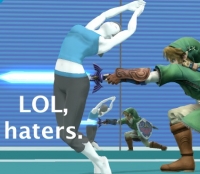
*Image indefinitely borrowed from BrainBoxLtd without his consent.