









I've been kinda reading up on future Nvidia Tegra chips just to see where the Switch line could be going. Right now, the Tegra X2 (Parker) chip is just becoming available to vendors, basically the X2 is a pretty decent upgrade on the X1 in the current Switch. It has two performance mode options, in one mode it can basically perform the same tasks as the Tegra X1 at half the battery consumption. So if Nintendo stuck one of these into a Switch, basically you could go from 3 hours battery life to 5-6 hours if my understanding is correct. Not bad.
But there's even a bigger, badder Tegra, Nvidia is already working on which is slated to be finished by the end of this year -- that's the Tegra Xavier (Tegra X3 basically). This chip is a much bigger chip and is based on Volta, Nvidia's next-gen archtecture. The Xavier is designed primarily for self driving cars and is meant to replace the Drive PX2 chip which has a Tegra X2 on it (two of them I believe) and even a full blown Nvidia GPU on top of that. That Drive PX2 delivers 8 TFLOPS of performance at 80 watts.
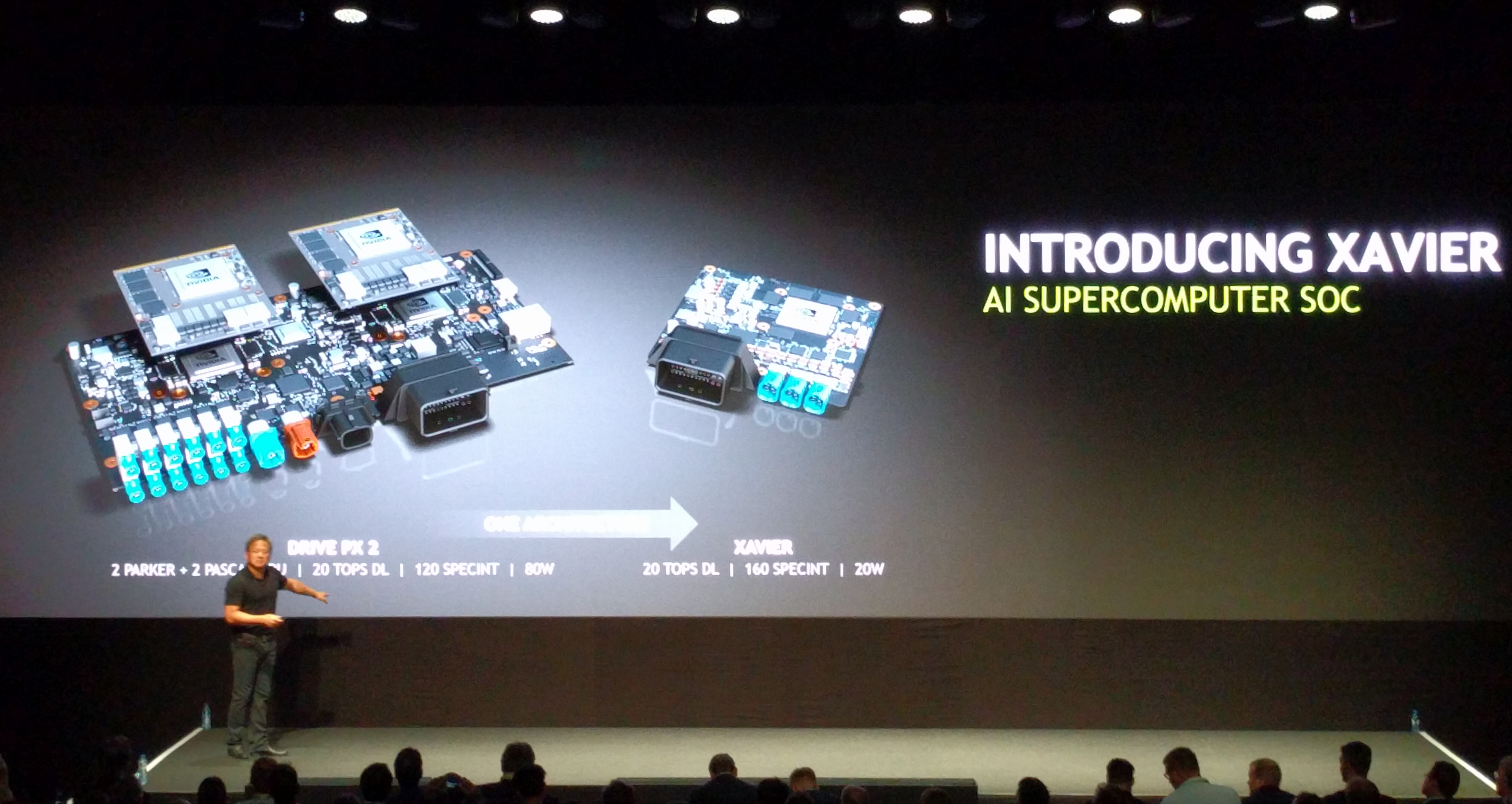
Now Xavier (Tegra X3) is reportedly supposed to do close to Drive PX2 performance .... at only 20 watts! The current Switch for reference runs at 15 watts in docked mode. Nvidia uses a different terms to grade these chips on performance .... DLTOPS (learning FLOPS basically), so Drive PX2 does 24 DLTOPS, Xavier does 20 DLTOPS. Doing some basic math that works out to about 6.6 TFLOPS for the Nvidia Xavier.
That's insane performance for a 20 watt part! Now the Xavier at just under 300mm is a pretty big chip (512 CUDA cores). The current Switch Tegra X1 SoC is only a bit over 121mm. So that Xavier chip is very big. However lets say we slash that in half ... to 256 CUDA cores, you could have 3.3 TFLOP performance docked at only 10 watts, and 1.65 TFLOP if you cut it again in half for a undocked mode at 5 watts for the chip. Basically PS4 level performance in portable mode, and almost PS4 Pro in docked mode.
Not too shabby huh? And this chip will be done by the end of this year, so by 2019/2020, if Ninendo wants to use it as a mid-gen refresh ... it should be more than mature enough to go into a mass produced $300 device. Lets remember the current Tegra X1 is a 2015-era chip, that Nintendo is using in 2017.


