









I haven't done one of these for a non-Nintendo platform yet.
Everyone loves a matyr, and few consoles fill that niche in gaming culture's collective conscience as well as the Dreamcast. Despite its short life and Sega's many failures over the past few years, this console is renowned for its many great games both from Sega and outside developers. Of course, its short life and Sega's leaving the console hardware market means that quite a few games for the Dreamcast were never completed.
Here are 8 of them.
Agartha

Developed by the French company No Cliche, Agartha was a survival horror game in the style of Alone in the Dark and Silent Hill. In fact, the team was led by Frederick Raynal, the director of the original Alone in the Dark back in 1992. Taking place in early 20th century Romania, players would encounter a series of characters, ranging from innocent townspeople and cultists to demons and angels. There would be a morality system based on player actions that would lead to one of multiple endings. One of the endings involved helping demonic invaders destroy the world.
No Cliche had already released multiple Dreamcast games, including the moderately sucessful Toy Commander. Alas, these games were funded and published by Sega of Europe. When the Dreamcast's life ended in 2001, Sega cancelled many projects, including this one. No Cliche soon shut down. Frederick Raynal has not been involved in many renowned projects since; he worked with Ubisoft on that Laser Tag thing they showed at E3 2010.
Castlevania: Resurrection

The transition from generation 5 to 6 was a turbulent time for the Castlevania franchise. On the PlayStation, Symphony of the Night had been a major departure from prior games, finding success despite not leaping into the third dimension. On the N64, the first 3D entries in the series were met with a more mixed reception. Despite the success of the Metroid-like style, the leap to 3D was still tempting. Hence, a new action-adventure entry began development for the Dreamcast, intended as a launch title in America.
Resurrection would have featured a plot involving time travel, with Sonia Belmont, the 15th century founder of the vampire hunting clan, teaming up with her distant descendant Victor Belmont, who was trying to escape his legacy in the year 1666. Interestingly, had this game been released, it would have likely explained the absence of the Belmonts in the Castlevania timeline during the 1800's, as this was Victor's home era. The two protagonists would be playable characters, and compared to its N64 predecessors, this installment would emphasis combat over puzzle-solving and exploration. A new camera and aiming system was also promised by the developers.
Ultimately, Resurrection died due to Konami's lack of faith in the Dreamcast. Konami had been very successful on the PlayStation over the prior few years, with games like Metal Gear Solid, Silent Hill, and Dance Dance Revolution doing well on Sony's console. The announcement of the PS2 in early 2000 led to Konami's cancelling Resurrection almost immediately.
Chakan

The original Chakan was a cult classic sidescroller on the Genesis. Its eponymous protagonist was a great warrior with twin blades who made a deal with Death to gain immortality. However, Death's gift was a curse, causing Chakan eternal torment unless he got rid of the biggest supernatural baddies in the world. Chakan goes through, but Death does not hold up his end of the bargain. Wait a minute... this is the plot of God of War, just with the Greek mythology references replaced!
A Dreamcast sequel to the original was being created by the original's director in 2000, but was dropped after some time for unknown reasons. What's interesting is that one of the sequel's developers was the writer and lead artist for Blood Omen 2, part of the Legacy of Kain series. Some of the artwork and concepts for Chakan appeared in Blood Omen 2. For example, Chakan's concept art resembles how Kain appears in that game and certain older enemy designs appeared in Blood Omen 2. So it seems Steve Ross recycled at least some elements of the lost Dreamcast sequel.
I wonder what else Steve Ross has worked on...
He appears in the credits of both God of War and God of War II. Under the "Special Thanks" category.
I swear I thought of the God of War comparison before learning that!
Gunvalkyrie

This shooter was eventually released for the Xbox in 2002, but was originally intended for the Dreamcast. The Dreamcast version would have been fairly similar to the Xbox version, with a similar Diesel Punk art style, overall design, and story. The key difference was in the controls. The Xbox Gunvalkyrie used the dual analog sticks of the Xbox controller in an unique fashion, with the left analog managing both movement and turning while the right analog was used for aiming. On the Dreamcast though, where there was only one analog, a light gun would have been used along with the regular controller. Weird.
Picassio

Picassio was a stealth game in development by Promethean Designs, a company that had previously made a couple of racing games. The game's premise was that the protagonist had to steal a series of paintings using non-violent means. However, the game's development was interrupted on a number of ocassions. For example, the original protagonist was changed at some point, from a man to the woman shown above. After the release of Shenmue, adventure elements were added to what was originally a strict stealth game. And it was in development for the Dreamcast until Sega abandoned the platform, at which point development was shifted to the PS2 and GameCube. Afterwards though, Promethean Designs was having trouble paying its employees and had nothing resembling a finished product. And so this art heist game died.
Propeller Arena

This game was made specifically to use the Dreamcast's online play. Propeller Arena was a flight/action game developed by Sega AM2 where players would battle World War 2 era airplanes. Modes included a Campaign, Quick Battles, Local Splitscreen for up to four players, and Online Battles. Online battles would have featured voice chat, something that SOME COMPANIES (Nintendo) still can't manage 14 years later. It was meant to be one of Sega's last Dreamcast games, released in November 2001. However, the 9/11 terrorist attacks occured a few weeks before the game was due to be shipped. This alone would have made the game's release awkward, but throw in the "Tower Stage," a level based on New York City including twin towers, Sega was terrified of the public reaction. Propeller Arena was simply never released in order to save the cost of shipping, marketing, and bad PR.
Skies
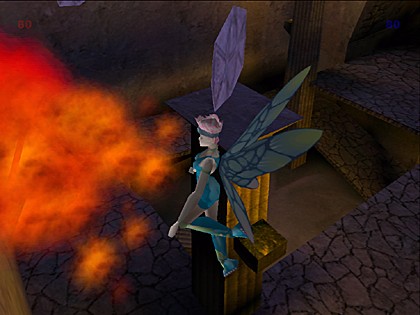
Phantasy Star Online wasn't the only MMO in the works for the Dreamcast. A collaborative efffort between SegaSoft and Paradigm Enertainment (makers of Pilotwings 64) meant for release on both the PC and Dreamcast, Skies was going to feature a 3D fantasy world full of flying characters, both players and NPCs. Players would develop their characters via skills rather than levels, based on player actions over the course of the game. Combat was planned to be heavily based on collected magic abilities, and races/factions would have unique quests and abilities. The PvP system was also interesting; there were meant to be a mixture of areas where PvP was allowed and safe zones, and the game's mechanics would have discouraged killing off weaker players by granting minimal rewards.
So, what happened? SegaSoft was restructured into Sega.com, and the newly organized group was not permitted to finish the game. Sometimes it's pretty simple.
Streets of Rage 4
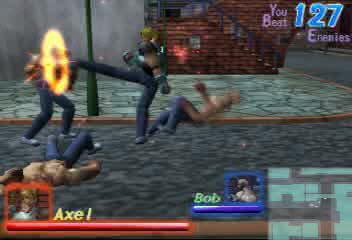
The Streets of Rage trilogy was one of the most popular series on the Genesis, even though the third game was poorly localized. So it was strange that the series never saw a fourth installment. During the Dreamcast's development though, Sega of Japan made a tech demo called Streets of Rage 4. The demo featured series protagonist Axel fighting multiple characters in a 3D environment, with new features such as multi-character attacks and a first-person mode being included to show off the Dreamcast and pitch the continuation of the classic series.
Unfortunately for fans, Sega of America did not show interest in the idea. The commonly accepted rumor is that Sega of America's new president, Bernie Stolar, was unaware of the original trilogy's popularity in America. Considering how Bernie Stolar was one of the worst things to ever happen to Sega (he shifted focus away from the Saturn as early as E3 1997), this sounds entirely possible.
Unreleased Games by Platform


