









They may not all be obscure and loved, but there is one game that I've really enjoyed but never hear anyone else talk about.
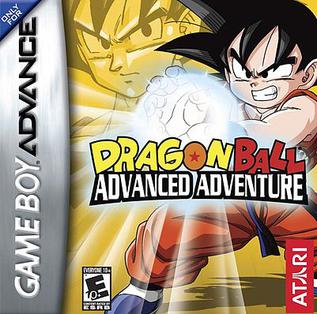
Dragon Ball: Advanced Adventure is an action/platforming/brawler/fighter/thingy adaptation of the famous anime for the Game Boy Advance. Unlike most game adaptations of the franchise, which emphasize the "Z" era, this game focused on Goku's adventures back when he has a cute kid who flew around using a magic cloud. I appreciate this; although DBZ is more popular, and mostly for good reasons, I think Goku's earlier days are a better fit for most games outside your standard fighters.
There are a couple of distinct modes, but the main focus is the main storyline. It loosely recreates the early adventures of Goku. This means the story is something of a mess, but it manages to set up the levels and enemies for you to face. There are 15(ish) levels total, which are replayable, which are typically fairly long and contain variety within them. We'll get to that in a minute.
Despite being seems to be a fairly simple action game, Advanced Adventure gives Goku quite a few options.There's the standard walking, running, jumping, and a basic melee option, but there's a hidden amount of depth, especially as you find upgrades via finding collectables and progressing through the story. Goku can use his trusty power pole to deflect bullets and bombs, use said pole to perform attacks over larger areas and bash multiple enemies, charge and use energy attacks, wall jump, etc.

Levels are diverse enough to give players a chance to use this entire arsenal. Most sections of levels are structured similarly to standard platforming levels, albeit with a design philosophy more akin to the Final Fight school of action games. Fighting opponents is the most important task, and even many regular enemies will need to be dealt with, but traditional platforming and exploration are regularly rewarded, especially in some of the later maze-like levels. The second type of "section" is the flying section, autoscrolling levels where Goku travels on his Nimbus cloud through the air. Despite my usual dislike of many autoscrolling levels in this sort of game, the controls' being similar to the usual and cooperative behavior of your ride make these a fun change of pace.
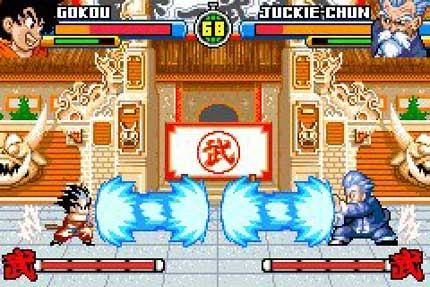
The third and most distinct type of a level is "Fighting" mode. The game's controls are slightly different here, becoming more akin to a traditional fighting game, albeit one with an emphasis on mobility and juggling opponents over picking the correct move. This mode is a bit more different than normal to be ideal, but can still be easily picked up and dropped after the other sections. The same buttons do the same things, even though the game's mechanics change. This "Fighting" mode lends the game two big gifts. First, it helps recreate the "Martial Arts" aspect of many Dragon Ball fights, especially in the tournaments. Not all bosses are fought this way, but many are. Second, it is the basis of the game's multiplayer. Two players can select fighters and compete in a traditional fighting game. The character roster is apparently pretty large for the GBA, with something like 20 or so playable fighters. Unlocking them all is far from simple, but this still adds a fair amount of value to the package.
Regular enemies in this game are largely forgettable, including a combination of humanoid and robotic foes with both close and long ranged options. Seeing as how you are going to be defeating a bunch of them at once though, and they have to be able to fit in a wide diversity of environments, that is acceptable. Bosses, on the other hand, are quite enjohyable. Even ignoring tournament stages, which are essentially Fighting Mode boss rushes, the game will offer quite a few bosses, which are generally quite distinct and colorful. Unlike DBZ, early Dragon Ball had Goku fighting a wider array of opponents than the technicolor humanoid destroyer of worlds that day. You get to face giant beast men, teams of mechs, a magical shapeshifting pig, an obese Kirby that hates cold weather, and so on. Even the humanoid enemies have their own unique flavors. The super ninja is actually a team of five identical brothers who tagteam opponents, the flamboyant Brownshirt wannabe uses psychic powers to stun Goku, the blue devil flies around attacking you with a trident while you avoid falling into an endless pit, and so on. Even though they're taken from the source material, bosses are adapted to the specific genre in interesting ways to make fighting them enjoyable while feeling like they originally did in Dragon Ball.

Before I finish, a few things: there are dozens of items to collect from the various levels, which often provide great rewards for exploring and replaying old levels; beating the game lets you play the story as Krillin, who has a slightly different skillset than Goku; the graphics are perfectly fine for the GBA and stylistically on the mark; music is only okay, but the sound effects are excellent; minigames that show up are intuitive and can be replayed for high scores.
This game was a bit overshadowed by coming out right after the DS and PSP were launched, but I recommend playing this game if you come across it.


