megafenix said:
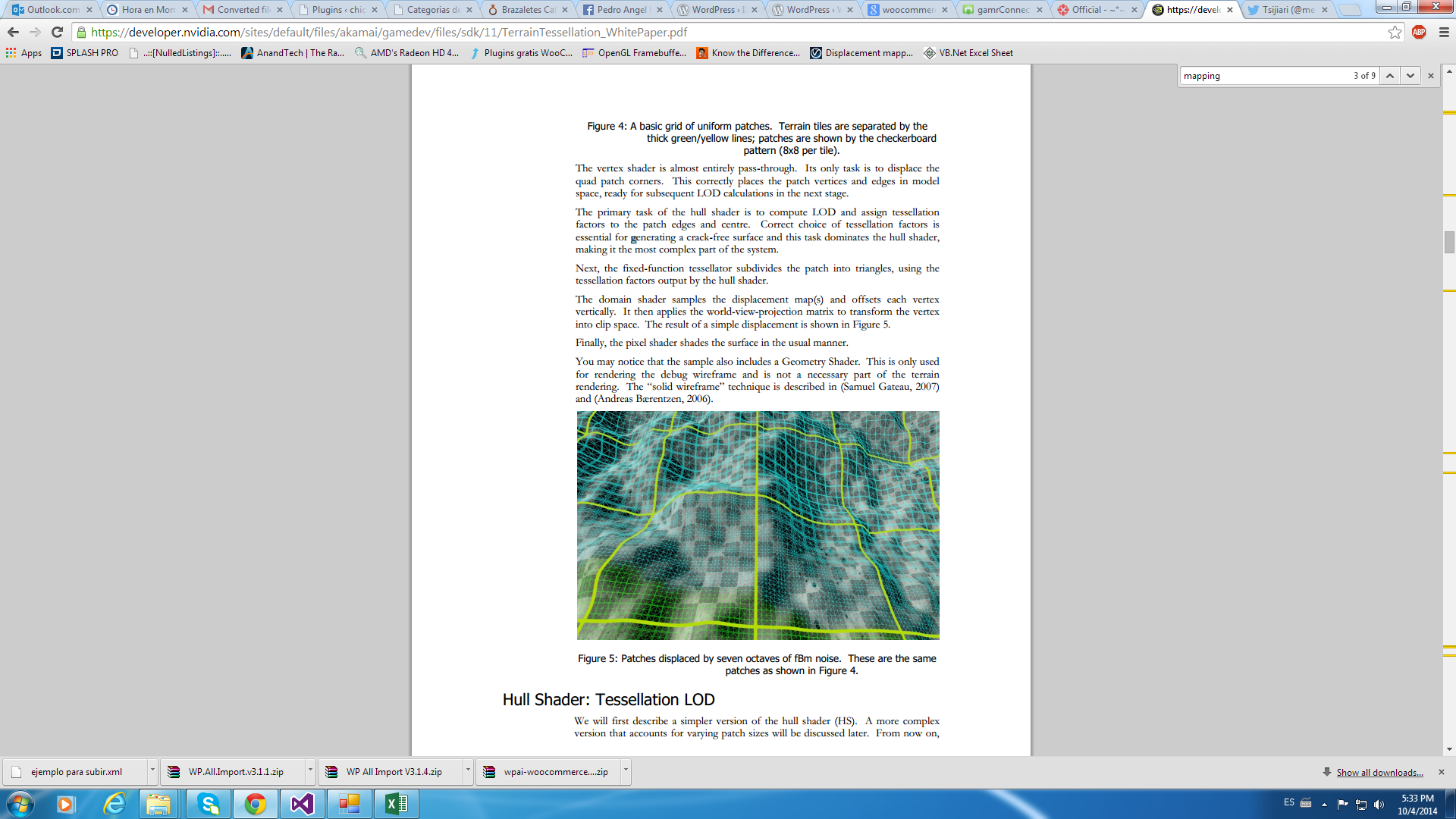
Indeed. Somebody told me that the tiles are done through texture syntesis and that due to that reason he though that they werent using tesselation or dispalcement at least on the terain, but since the terrain has good bumps i decided to investigate a bit more on the technique and foud that tiles can be used on purpose to later apply tesselation
https://developer.nvidia.com/sites/...les/sdk/11/TerrainTessellation_WhitePaper.pdf
Seems like tiled texture can be used on purpose to later tesselate them
"
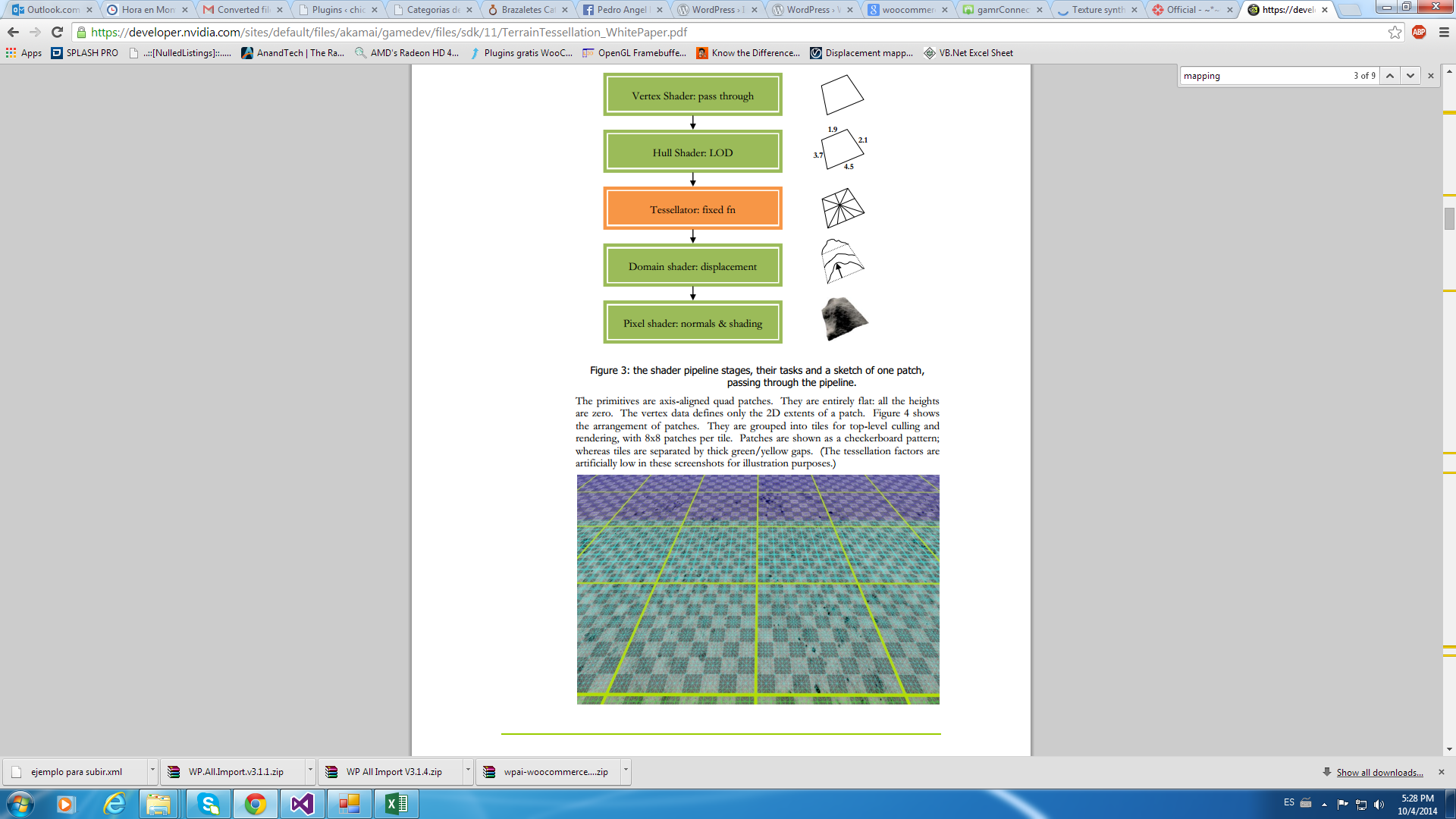
Mapping to the Tessellation
Pipeline
Figure 3 below shows how the technique maps onto the stages of the shader
pipeline. On the left are the various shader stages; on the right is an approximate
sketch of the status of one patch at the corresponding pipeline stages
Non-Uniform Patch Sizes
Motivation – Range of Scales
Terrain engines often support large world sizes (or level sizes in games). For
example, Tom Clancy’s H.A.W.X. 2 uses levels that are an impressive 128x128km.
To render a world of this size and maintain a roughly constant triangle size in
screen-space requires a huge range of triangle sizes in world space. Triangles closest
to the view-point may be only a few centimeters wide; the most distant triangles may
be several kilometers across. Figure 8 below is typical – the foreground polygons
are smaller than footprints, say 5cm, but the distant polygons are maybe hundreds
of meters across. And the view distance in this image is fairly short.
DirectX 11 limits tessellation factors to the range 1 to 64. This is not nearly
sufficient to represent the range of scales required for a large, detailed world. To
continue the example above, the smallest polygons are 5cm. If they are
implemented with the finest tessellation factor of 64, the largest polygon can only be
64 x 5 = 320cm. Whereas terrain may require a range of scales like 5cm to 1km or
20,000 to 1.
The solution is of course to employ patches of differing sizes. Terrain engines
commonly implement LOD with tiles of differing sizes, for example (Ulrich, 2002).
We apply this to our patch sizes, as shown in Figure 9. Our TileRing C++ class
implements the varying size. (Ring is not an entirely accurate term – they are
concentric squares.) Recall that a tile is 8x8 patches. Each successive TileRing
increases the tile size by 2x; the 2x scaling considerably simplifies the crack-free
algorithm below.
"
That terrain deformation example kind of resebles the one on fast racing neo, and since the terrain may use tiles and doesnt look flat i think there is a good chance for it to be using tesselation. Seems that what shinen said was right, you cant just apply tesselation, you must think over how and when t use it
|









 Currently Online