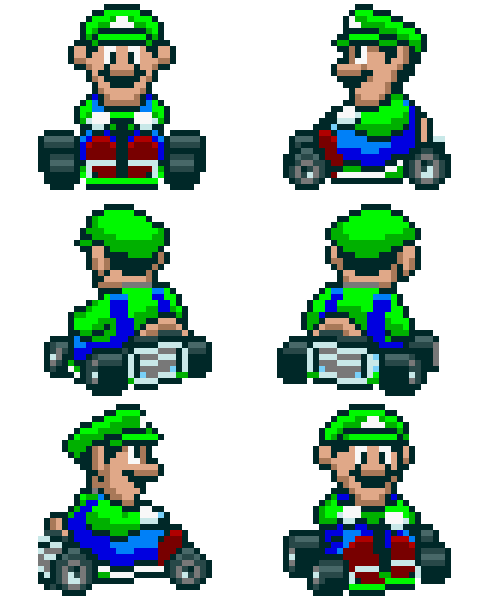


Games began with balloons and have gradually evolved into voice acting. Please go see the videogaming history. Real-time anymations exist in games such as Gran Turismo, FIFA or Skate. Each collision is a collision. Each goal kick is a goal kick. Each skate trick is a skate trick. But, among the balloon-based games Nintendo has, such as Pokémon, you don't control the character to perform your unique attacks (that would be character full-control). You just order the attack and the attack "X" has always the same animation (it's not real-time). You may tell that Nintendo has never evolved Pokémon into this level (so much desired by the fans) not because it would be massive money spending but because it would not be good for the gamers. But then I just don't believe you. My conclusions are different.
Of course it is. To buy cameras, to hire professionals to travel and shoot real places, to hire designers to recreate those environments, to spend the time to make sure that the result in the game is similar to the real thing. And realistic HD graphics demand eagle-eye and a thorough work. Cartoonish SD graphics don't require any of that.
|
So your complaint is that a Turn-Based Strategy game is not real-time? How does that even make sense to you?
It's also interesting that you use pokemon as an example that Nintendo puts no effort into their games when it is the exact opposite. Over 700 unique pokemon 3D character models were created for Pokemon X/Y. Each with 2 (or 3, I believe) attack animations, to be used with various attacks. This would align well with your cherry-picked criteria for a good game being one with a very large number of unique characters.
One problem with your assertion that only photo-realistic graphics require effort: they require no artistic skill. To say that artistic creation is not valuable, difficult, requiring 'eagle-eye' or thorough work is ludicrous. Conversely, one could argue that photo-realism is easier, because it requires no creativity, only pure technical effort.