











Tachikoma said:
These games were built for the MVS and ported to other systems by SNK, the develop/publisher that released the system, do you honestly think if Sony, Microsoft or Nintendo were to release one of their first party titles on another system of the same gen they'd aim for parity in quality? As i've mentioned twice now, the overclocked 68000 in the mvs and aes is still not as powerful as the 5A22 in the snes, the zilog 80 doesn't offset this difference, leaving the snes the victor in terms of raw power, larger texture tiling is an offset from a result of the higher texture memory provided for the higher resolutions, a benefit if you will, of which the snes has many the neogeo does not - but the argument is 'the most powerful system has never won a gen', putting the graphics aside, the sound processor, and CPU/GPU solutions in the Snes are more powerful than the neogeo's, in raw form, and that's entirely the point here. |


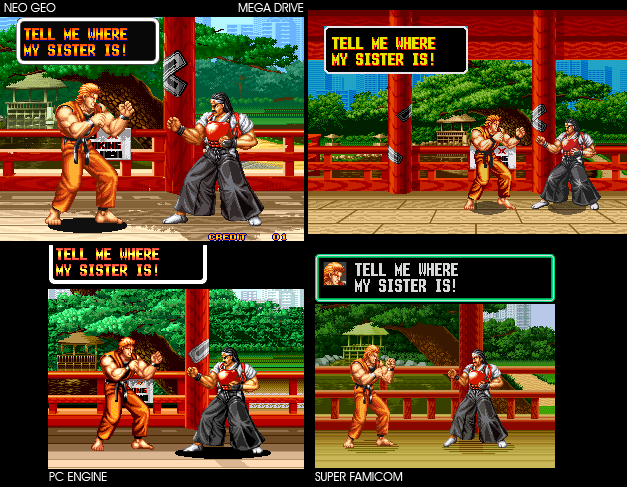
Ok, keep your opinion :) Not worth to argue as images and the video speak for themself.
But I want to share some additional info to others:
http://en.wikipedia.org/wiki/History_of_video_game_consoles_(fourth_generation)#Neo_Geo
"Released by SNK in 1990, the Neo Geo was a home console version of the major arcade platform. Compared to its console competition, the Neo Geo had much better graphics and sound, but the prohibitively expensive launch price of $649.99 USD made the console only accessible to a niche market. A less expensive version, retailing for $399.99, did not include a memory card, pack-in game or extra joystick."
http://en.wikipedia.org/wiki/Neo_Geo_(console)#Graphical_development
"The Neo Geo was particularly notable for its ability to bring arcade-quality graphics directly into the home. As time went on, programmers were able to further tune the games to produce higher quality graphics than previous years and eventually beyond what was initially thought possible for the system.
One of the pack-in games with the original Japanese release was NAM-1975, a side-scrolling rail-shooting game that featured multi-layer scrolling backgrounds. Another pack-in game that was bundled with later runs of the Neo Geo system was "Magician Lord", an action-platform game that showed off the Neo Geo's ability to expand and contract sprites, and the detailed graphics of the Neo Geo's color palate at the time. However, the initial Neo Geo games were, graphically speaking, a little less polished than SNK's non-Neo Geo games. By 1991, games like King of the Monsters demonstrated the Neo Geo's ability to produce graphic detail that matched or surpassed contemporary arcade games from the period.
In 1992, SNK's Art of Fighting marked the beginning of a series of 2-D fighting game innovations. This landmark game brought visual graphic damage to the characters' faces when hit, as well as large character sprites in combination with zoom effects to intensify the action. This zoom feature was also used in the following year's Samurai Shodown, whose even more elaborate graphics and gameplay won it Electronic Gaming Monthly's award as the 1993 Game of the Year and launched a successful franchise. The Neo Geo also became known for its shooters, with the first successful title coming with 1994's Aero Fighters 2. The following year's Pulstar managed to up the ante on both graphics and gameplay.
Top Hunter, released in 1994 featured extremely fluid and crisp graphics, such as the trees on the wind stage of the game. Fatal Fury 2 also featured fluid and detailed graphics for the time. Top Hunter, and Fatal Fury 2 do contain some slowdown, but later games largely avoided slowdown issues (with the exception of Metal Slug 2, which is quite notorious for its copious amounts of slowdown).
By the mid-1990s, SNK was trying to move onto a new platform, notably the Hyper-64. When the new 3-D system failed to take off, however, SNK found itself still developing games for its old 2-D engine. This led programmers to come up with ways to increase the limits of what was initially thought possible for the system. One of the games for the Hyper-64 was ported to the Playstation, and it was "Fatal Fury: Wild Ambition".
Six years after the Neo Geo's initial launch, Nazca Corporation surprised the video game industry with Metal Slug. A take from the Contra series, Metal Slug is a run and gun game that featured cartoonish, hyper-active graphics and gameplay that also launched a very successful franchise. Since the Neo Geo was unable to produce the 3-D games that began dominating arcades in the mid-1990s, SNK instead focused on mastering the realm of 2-D. With the launch of The Last Blade in 1997, SNK programmers demonstrated that the Neo Geo was still capable of producing artistically rendered graphics to match the gameplay.
While the system became primarily known for its fighting games in the late-1990s, notably the King of Fighters series, 1998's Blazing Star updated the previous Pulstar with more detail. This trend of adding more detail to 2-D environments reached a plateau with 1999's Garou: Mark of the Wolves, an update of the Fatal Fury series, as well as 2000's Metal Slug 3."
I don't know any game on Snes that even remotely matches Art of Fighting graphics or draws so many sprites while keeping frame-rate like Metal Slug does.
Another video showing great graphics by NeoGeo:
But really, nothing to argue.


