


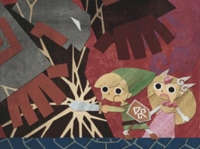


Finished up Death Mountain + lots of childhood side-quest frolicking.
I was struck by the implications of the game's relatively open-ended structure today. It's interesting how the game uses what seems to be a prototypal template for world-exploration - the main plot is completely linear, but the way you make your way across the world isn't.
The freedom is nice, but it does have some consequences for the narrative. The fact that you always start at a fixed location only exasperates this phenomenon - though it functions well as a means to control the pacing. In particular, the gravitas of Link's departure from the forest isn't quite so impactful when one realizes he returns almost immediately (upon saving and quitting). It's not a problem by any means - particularly since the pathos of that particular plot isn't completely unraveled until later on - but it makes me wonder why Nintendo didn't just let the player start the game where he last left off. Compare this to Link's departure from Outset (and the player's relative lack of freedom) in The Wind Waker.
On the plus side, Ocarina offers an elegant diegetic solution to the problem of re-treading; the Lost Woods. It is fortunate that the original concept (carried over from LoZ) of a magic forest where the paths led nowhere and everywhere, also made the starting location a perfect hub of shortcuts.
The fact that the Temple of Time turns up in the Lost Woods in Twilight Princess is perfectly in-line with the forest's function in Ocarina of Time, which I thought was a nice touch.




Existing User Log In
New User Registration

Register for a free account to gain full access to the VGChartz Network and join our thriving community.


