






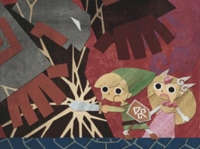


Ixis: The warring and strife that ravaged Hyrule as people fought for the Triforce is a long running motif of the series, dating back to at least to ALttP, though Twilight Princess is the first game to make it a focal point of the story. I cover the rest in more detail when I address Khuutra.
Khuutra:
1. On the King of Hyrule and the gods: I'm not sure I ever said the King acted against the will of the gods, and for the record, I don't think he did. The King realized he had to let go of the past, and perhaps he did confine in the wisdom of the gods. Be that as it may, I don't believe the goddesses had any real say in the matter - the future was decided by those people that had been chosen to represent mankind alone. I believe Hyrule was preserved precisely for that reason.
The true meaning of the King's wish, that man no longer relies upon the old creed of the gods, is what I find to be most significant about the Wind Waker's ending.
2. On Ganondorf and the gods: Ganondorf did put up a display of anti-god activities in relation to the goddesses when he desecrated their statues in Twilight Princess, not to mention his comment about them destroying the world in the Wind Waker. You could argue that the former was a symbolic act, and the latter a rhetoric quibble, but it is evident that he is not on good terms with the goddesses.
3. On the goddesses taking action in Twilight Princess: Ah... I don't want this to turn into a drawn out quote war. Suffice to say, everything that is said about the banishment of the Twili is this:
What do you think happened to the magic wielders who tried to rule the Sacred Realm? They were banished. They were chased across the sacred lands of Hyrule and driven into another realm by the goddesses.
...
Though the goddesses forbade us to return to the world of light, they left one link between the light and the darkness. Something called the Mirror of Twilight was passed to the protectors of Hyrule...
- Midna
I will admit that is open to interpretation, but the light spirits are only said to have sealed away the Fused Shadow, not the Twili themselves. Ultimately, what does it matter if the goddesses act by proxy or not?
4. On the deluge of Hyrule: So you're saying Ganondorf prevented the gods from destroying Hyrule? That is an interesting theory, but what support do you have for it? The King of Hyrule says the gods intended for Hyrule to slumber so long as Ganondorf did not escape, and I always thought of it as a fitting and ironic punishment. The King suffered the opposite fate, being removed from his kingdom as he searched for the Hero that would finally defeat Ganondorf.
5. On the machinations of the gods: I am afraid I shall have to disagree with you about that. My interpretations of both the Wind Waker and Twilight Princess hinge upon the gods being the masters of fate, and I feel I have good reason to believe that. Twilight Princess in particular takes that theme to heart, as Zelda's statement during the ending scene makes evident.
6. On destiny: Like I said, I do not deny the reality of freedom of will or individual agency in the Zelda mythos. Ganondorf is entirely responsible for his actions. However, the role Ganondorf plays, that of the King of Evil, is one ordained by the gods, as part of the Hero of Time prophesy. Ganondorf chose to play that part, and that is wherein his freedom lies. However, in being the King of Evil, he is also a pawn in the game of the gods; that of the eternal struggle between good and evil.
That game, I feel, is what the King puts an end to at the end of the Wind Waker.
7. On the Deku Tree: Like the King, I would argue that land would not be Hyrule.


