













Procrastinato said:
...you really confused me, ssj12. Some reasons I find your post confusing: * Aegia PhysX was a software (i.e. CPU) physics middleware engine, which is now NVidia PhysX, and runs with (not "on", because the work is shared between the CPU and GPU) modern NVidia GPUs only. * Its usually a waste of GPU horsepower to do physics with it -- namely because math in only part of the issue with physics, and accessing large amounts of collision data is really the majority of the time. The CPU (or SPUs) is/are often better than the GPU in this regard. In most games, the physics expenses are minimal, because no one wants to waste the horsepower on simulating all that stuff, or the manpower/money on creating efficient physics geometry and data for it. * NVidia (owns PhysX), and Intel (owns Havok), are both looking into providing hardware physics solutions, in new chips. * "Explosions" have nothing to do with physics, unless they impart forces to physics objects, or fluff objects (which the game characters cannot interact with, like debris objects), which is rare, outside of games like Red Faction. They almost always incur a particle/GPU fill hit, however, for their visual representation, unless they are offscreen. * CryEngine is complete and handles physics, or physics middleware, as well as graphics, etc. * The Source Engine is complete, and handles physics and graphics, and a host of other stuff.
Back on topic: Certainly animation, physics, etc. all play into the look and feel of a game. Perhaps HVS is commenting on how they intend to up the bar, in this regard, with future games... although I doubt games like their upcoming gladitoral fighter? would need much in the way of physics. |
Physx wasn't just software... it was hardware. What is pictured is an Aegia Physx PPU producted by BFG. It is a dedicated physics processing unit.
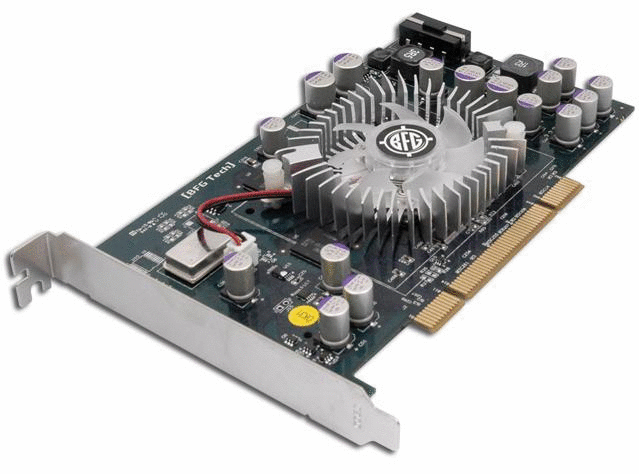
You seem to not understand some tech history. Let me explain.
Valve designed the Source Engine to handle physics as best it can. Yes it has amazing graphics behind it but the main design is the physics part of it. This is why Half-Life and Portal are littered with physics puzzles.
Crytek designed the CryEngine 2 to create the most realistic graphics possible on current PC hardware. They accomplish this. They also made it so physics reacted realistically but their original intensions was the visual realism that we all know Crysis and Crysis Warhead are known for.
Now for your other arguements I want to point out that explosions have just started making much more of a physics impact in the last few years. Before the age of physics, just what I'm calling the dawn of real-time physics interactions, explosions were only effects like you said that if your hit you died. Now we have environmental destruction, object based physics, fluid physics, etc. All that impact the game both visually and how a game is played. If you want to throw a brick at someone's head you can and the toss will fly as if you yourself threw it. Destroy a building, you just made it so you need a new route. Shot a explosive barrel floating in the matter, after it starts catching on fire it will continue to float down and blow the hell out of anything in its way.
Without physics graphics now a days wouldn't look correct and things wouldn't be possible today. We wouldn't have flared bullet holes in Killzone 2, you wouldn't have vehicle destruction in MotorStorm or Dirt, you wouldn't have basic gernade physics because a nade would hit the dirt and stop cold where it landed instead of bouncing.


