






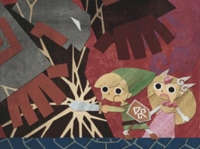


"Story wise... what? There was one?"
"most modern gamers do not grasp stories that are not broken down to the lowest common denominator."
Thank you, Spedfrom, for proving the point.
Seriously, as mentioned, The Wind Waker's story is based on the Deluge myth, which deals with the god's "destruction" of the civilized world, and uses this to great effect throughout the game. The tragic story of Ganondorf and the King - in many ways, it is their story - is the most obvious example of this. The ending, in my opinion, is one of the single best moments of any game, and the overal narrative is better than most, dealing with such themes as fate and free will, man's relation to god, and the abolition of any simple "good vs. evil" morality - while also retaining the classic coming-of-age story, only with a lot more character than previous entries in the series.
"Majora's Mask is another beast entirely. This game has nothing to do with Good-vs-Evil, and everything to do with much more complex themes of isolation, loneliness, dreams, and the human experience. Pretty deep stuff for a Zelda game."
Indeed. Majora's Mask is proof that a simple plot can carry a lot of depth. Besides the explicit theme of friendship (which is fairly deep in itself), the game delves into numerous other issues, most notably it's study of a person's identity (what does it mean to (not) hide behind a mask?) - going so far as to question the nature of it's protagonist (addressing the player as well as Link) - and uses parallelism, symbolism and black irony in a way that few other games do. It's also one of very few games to truly tie it's narrative to it's gameplay, which something else I admire about it.


