Despite every company and their dog making these ‘casual’ games, the so-called casual audience is not buying them (just as they didn’t buy the platformer clones of the 8-bit generation, the fighter clones of the 16-bit generation, the GTA clones of last generation, and so on). When seeing their ‘casual games’ flop while seeing Nintendo’s ‘casual’ games in the bestsellers, the third parties growl and say, “IT IS ALL NINTENDO’S FAULT! People only buy Nintendo games! Third parties can’t succeed on this platform!”
...
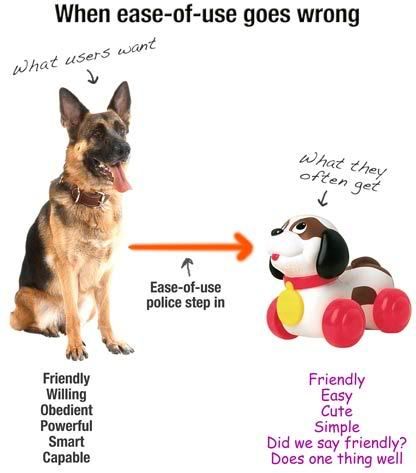
The above picture illustrates the Casual Fallacy well. Wii Sports is a game stuffed with complexity (of its physics), replay value, and many game modes. It is what people want: a friendly but powerful game. Consumers want more games like Wii Sports but they get the plastic dog instead. Sure the game is ‘friendly’, but the power behind it is gone. It is a neutered game castrated from any purpose.
...
Birdmen can only make plastic dogs. In order to make the real dog, they would have to study the concept of flight instead of studying the wings. Passionate developers also tend to create passionate products (which is why Blizzard puts on any business contract that its developers will be free to make the games they want). Will hardcore developers have a passion to create downmarket products? They certainly didn’t become game developers to make competitors to Peggle and online flash games. What we will end up with are more plastic dogs.
...
Nintendo’s worldview is simple: aim at making hits on the downmarket to make the Wii platform dominate the lower tiers. Then slowly move upmarket.
The rest of the industry has a completely different worldview: view the ‘explosion’ in downmarket games as a unique phenomenon (in this case, the fictional “Casual Games Phenomenon”), and then assign many teams to make these ‘casual games’. Instead of trying to understand Nintendo’s flight, they are putting on wings and trying to flap. Wii gamers become frustrated while Playstation 3 and Xbox 360 gamers laugh and say, “If you want to play REAL games, buy a real gaming console! Hah! Hah!”
...
What happens when Nintendo moves upstream? Competitors have two choices:
1) Flee. Many companies will gladly ‘cede’ this new market. After all, this new market is not very profitable to the competitor and, besides, the competitor clearly is getting tons of money through the upmarket. While this choice works for the short term, the problem is that the encroaching company will swim upstream and begin to take customers away. Fleeing to the upmarket means ceding more and more of the market to the newcomer. Eventually, the competitor will have nowhere else to flee and will go out of business or be reduced to a niche.
...
Casual game phenomenon? No. It is a disruptive game phenomenon. Despite all the talk about ‘casual games’, do you ever hear Nintendo (whose games are creating the big so-called ‘casual’ boom) join the ‘casual games are the future’ chorus? Of course not! It is because they are following the path of disruption, not the path of casual games (whatever that means). If there is a fad, it is the Industry’s sudden romance with ‘casual games’ for they see them as easy money (which they will soon discover that there is no easy money in this business).
...
Nintendo: “We are following the strategy of disruption!”
NPD: “Nintendo wins!”
Journalist: “How are you winning, Nintendo?”
Nintendo: “We are following the strategy of disruption!”
Journalist: (ignores Nintendo) “What is going on here, analysts and third parties?”
Analyst: “It is a casual gamer boom!”
Third Parties: “OMG! Easy money! Quick guys, everyone start making casual games!”
Nintendo: “We are following the strategy of disruption!”
Journalist: (philosophically) “Will casual games cause the downfall of the hardcore games? Let me write many editorials about this!”
Analyst: (philosophically) “Is the casual game boom a fad? Let us pontificate over this.”
Third Parties: “Hey guys! How you like my casual games? They sure are snazzy! I will make millions! I am such the business whiz!”
Nintendo: “We are following the strategy of disruption!”
Journalist: (scratches head) “You hear something?”
Analyst: “It was just Nintendo speaking. They are saying the same thing.”
Journalist: “Yeah! Haha! Same old marketing speak. I am so much smarter about business than Nintendo. In my next interview with Iwata, I’ll give him some business lessons.”
Third Parties: (cries) “Oh no! My casual games are not selling!”
Journalist: “Obviously, this is because people buy Nintendo consoles for Nintendo games.”
Analyst: “Nintendo needs to assist these third parties in getting their casual games to sell.”
Third Parties: “That’s right! They need to do what WE want them to!”
Nintendo: “We are following the strategy of disruption!”
Journalist: (yawns) “Is that all they say? (becomes excited) Ohhh! Look! A new hardcore game is being made with fresh textures.” (runs off)
Analyst: “Obviously, Sony and Microsoft are branching with casual games themselves. Poor Nintendo. Too bad they are out of tricks. I expect Playstation 3 to be surpassing them in a year or two. The market revolves around technology you know.”
Third Parties: “My casual games aren’t selling? Why!? I do not understand!”
Is it not amazing how everyone talks about the casual gamer boom except Nintendo? Instead, Nintendo keeps talking disruption while everyone either ignores these quotes or misinterpret ‘disruption’ to mean ‘change’ or ‘innovation’.
...
The Low Tier Train has Already Passed
”But Malstrom!” you say. “If the lowest tier was passed over, then isn’t it good that all these companies are aiming at it? This abandoned tier is now priority number one.”
Fool! It is a gold rush. There is a saying: there is not much gold when everyone fishes from the same stream. There is also a saying that when a business opportunity hits the newspapers, it is way too late for investment.
...
The solution is for these publishers to create bridge games and aim more at Tier 2 and Tier 3 titles rather than have all of them aim at Tier 1. This strategy… no idiocy, of them all aiming at the same person is going to backfire. I haven’t seen this stupidity in this industry since… well… since them all making PS3/Xbox 360 HD games because “Top Box systems are the next wave, Malstrom! LOL!”
...
You can tell much about someone by their criticisms. The Industry criticizing the Wii because it is a “fad” aptly describes the Industry. That is all they do, chase one fad after the next. Now, my birdmen, what is the fad are you going to chase once the ‘casual games’ have run their course? Why would someone invest in an entertainment company that is doing exactly what everyone else is? Imitation is suicide, and mimicry is the masking of the talent-less.
...
The fad was not in Nintendo’s strategy but in third parties (incorrect) interpretation of Nintendo’s strategy. Trying to escape their hardcore labyrinth, many are donning waxy casual wings to fly over the vast Blue Ocean. Those wings will melt and many millions will be lost as they plunge into the deep.
http://malstrom.50webs.com/birdman.html


























 Pixel Art can be fun.







 This time let's play as a shark and a squid. I'll buy that first day. As for De Blob 2. Make the game more than just painting or the game will be stale