By using this site, you agree to our Privacy Policy and our Terms of Use. Close

Forums - General - An evolution question I've often wondered about.

NJ5 said:
Unless contraction starts at some point Kasz. Then the universe may visit us (but it probably won't feel very nice).

Hah true.  Contraction probably will start... as it's the most logical thing as far as the univserse being "self renewing" but I felt like being optimistic.

I don't know how it'd "feel" bad though... well until another galaxy crashed into ours anyway.


Around the Network
highwaystar101 said:
Slimebeast said:
highwaystar101 said:
What I find interesting is that the evolution of the dog has happened within 13,000 years. This is because of the human domestication of the dog. Different environments cause different evolution and the early ancestor of all the dogs (Canis Canis I believe) were domesticated and used for hundreds of different purposes.

Humans only used the dogs that were best suited for the job they had domesticated them for, the others didn't survive, this is evolution that is extremely rapid. Dogs that were used for protection became increasingly vicious, dogs that were used to plough fields became big and strong and so on. All this change has happened over just a few millenniums.

So to answer your question stof, yes these dogs are the same species and can mate with each other. However, they will continue to drift apart and in a few more thousand years you might find that they will actually become different species all together, and the difference between species becomes ever more vast.

And despite this extreme selective pressure by the environtment (in this case mediated by humans) over the course of thousands of years dogs are still dogs.

So dogs are a great example of the creationist claim that micro evolution occurs but not macro evolution.

But the fact is they wont be just dogs forever Slimebeast, look into the future. They evolve at an accelerated rate, but this is only over a 13,000 year period, even accelerated evolution would be hard pressed to create several separate species of mammal from one in that time period. It has created many subspecies though.

What I'm saying is that micro and macro are simply an illusion. Dogs have taken 13,000 years to get this far, but they have changed a lot. In 13,000 years do you see dogs being the same as they are today? No of course not, they will evolve further. How about 13,000 years after that, and another 13,000 years after that and so on? They will just continue to grow more and more diverse.

In an extremely simplified manner micro evolution is just small stages that add up to a macro evolution.

Do you believe that a hundred cycles of these 13,000 year periods of increasing genetic difference, what you will have left is essentially still a dog? 

My example does not prove that micro evolution is the only way things evolve at all imho.

...

Evolutionists have already proved micro evolution to just about everyone because the evidence is overwhelming. Evidence for macro evolution, despite being a lot harder to find and test for than micro, is building up quite nicely.

...

I think I've said it once before, but I'll say it again (and I really hope I don't offend you). You are different to a lot of debaters Slimebeast, I can tell you have read about evolution, I know you read links given to you, you digest the information and you are a very intelligent person so you understand it. I always get this feeling that you accept evolution as a valid scientific theory in the back of your mind, I can just tell when I talk about it to you. You're *different* to a lot of people who argue creationism.

...

That said, I don't know why creationists refuse to accept evolution so forcefully, macro included. If a creator created Earth billions of years ago, then why can't the original animals macro evolve? If the animals macro evolve into something else over millions, or even billions, of years then does that mean that they weren't created in the first place? no, of course not, it doesn't suggest that.

First, I'm not easily offended and second, you are always very polite man. And you have your analysis right about me roughly speaking.

What I would like to know about dogs in those 13,000 years is how much they have changed genetically. Each mammal has rufly 50,000 genes and each gene code for a protein. Now, typically just the existing variants of each gene accounts for the differences we see between individuals, like length, hair color, eye color etc. But in dogs I can imagine that also small new mutations in some genes determine some specific and unique characterics for some breeds, for example the chinese naked dog having almost no fur, mutations that were not present in the original dog/domesticated wolf gene pool 13,000 years ago.

What I wonder though, and this should be able to be analysed on a statistical level actually, is if there's completely new genes underway in some dog breeds? I mean there should be at least a few completely new genes, because those 13,000 years with extremely varied environmental and selection pressure on the gene pool (and many of them being isolated from each other) are magnitudes more powerful than it ever is in nature, and should translate to 100's of thousands of years or even millions of years of 'natural' evolution (if we compare to the 'normal' evolution rate typically, according to neo-Darwinism).


Slimebeast according to this article, wolves have even received a new gene from dogs:

http://www.sciencenews.org/view/generic/id/40621/title/Dog_gene_heeds_call_of_the_wild


My Mario Kart Wii friend code: 2707-1866-0957

NJ5 said:
Slimebeast according to this article, wolves have even received a new gene from dogs:

http://www.sciencenews.org/view/generic/id/40621/title/Dog_gene_heeds_call_of_the_wild

Actually it's not a new gene, it's just a new variant of a fur coding gene which has the mutation for black color that wolfes got from shepherd dogs or something. (corresponds to my example with the "post-13000 years" point mutations giving the Chinese naked dog almost no fur).


famousringo said:
makingmusic476 said:

@izaaz:

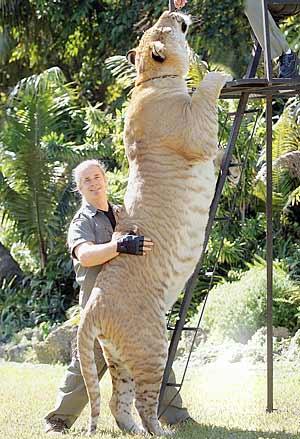
That's not quite as fierce as I have imagined.

I wonder how crossbreeding effects their natural instinct and pack mentality. Would they be ostracized by other lions/tigers? Would they ostracize each other?

Wait. This monster isn't scary enough for you?

He wieghs over half a ton. Thank God you don't see these things happen outside captivity.

Thats the Liger, I watched in discovery or animal planet that they are big because they breed  male tiger with a female lion because its the female tiger and the male lion that have genes that stop the growing at certain age, so this is not the case with the Liger, it never stops growing. Dont know if I have it rght with the male tiger and female lion, but thats the idea.


Around the Network
NJ5 said:
Slimebeast according to this article, wolves have even received a new gene from dogs:

http://www.sciencenews.org/view/generic/id/40621/title/Dog_gene_heeds_call_of_the_wild

Yeah, i've read that before.

I want to see Red Wolves are supposed to be a hybrid offshoot of Coyotes and Grey Wolves as well... though i know that's been debated in the past.


Kasz216 said:
highwaystar101 said:

Young Earth creationists tend to try and get round that fact by asserting that the speed of light used to be much faster, and that it has slowed down over the past few centuries... It's crap to be honest, there is no evidence to even suggest the speed of light has slowed down. did something happen to all the photons at once? Did the laws of physics suddenly change?.

Well to say that there is no evidence the speed of light has slowed down isn't exactly true.

I mean afterall there are some galaxies that are assumed to be moving away from us at speeds faster then light due to the expansion of space.

Theoretically if we were a part of this pehenomena caused by the expansion of space more at one point then another, then theoretically light that was younger would look older.

For example if space worked like a bunched up bedsheet.

Not so much the speed of light being faster... but it'd cause the same effects.

Not very likely, but i wouldn't rule it out, since there is a lot yet still unknown about space expansion and it's properties.

It makes it even more interesting when you realize that means we'll never be able to explore all of space... since large parts of it are actually moving away faster from us then we could ever catch up.

Haha, you don't need to tell me about this kind of stuff Kasz, I'm pretty nifty when it comes to space.

Anyway, young Earth creationists assert that the actual light is slowing down. Light is a physical constant, it travels at just under 300,000Km/s through a vacuum. It always has done, we have no evidence of varying speeds at all in these conditions. Light is made up of photons, the carriers of electromagnetism, and as I'm sure you know, have no mass. A photon travels at 300,000Km/s, because it is massless the only thing that could increase that speed is if the actual laws of physics themselves have changed to allow them to move faster, a change in mass or energy wouldn't speed it up. The chances of light slowing down would be so remote that it wouldn't even register to me.

As for the expansion of the Universe being faster than the speed of light, I don't think that supports their argument at all. Galaxies that move away faster than the speed of light from us do so because dark energy is adding more acceleration to the expansion of the Universe. Although we know very little about dark energy right now, in three years we should know a lot more hopefully. But I don't see how it would support the idea that light was once faster than it is today I'm afraid.


I found a video that uses a great analogy to explain why macro and micro evolution are an illusion and it is essentially all part of the same mechanism...

Although the fact at the end about the scientists is a bit dubious, I think he meant evolutionary biologists.


They are still the same species. The only way they become a new specie is if they differ to the point where they could never breed again.

Take the horse and donkey for instance, even though they can breed to make a mule, they are different species due to the fact that mules cannot breed.


highwaystar101 said:
Kasz216 said:
highwaystar101 said:

Young Earth creationists tend to try and get round that fact by asserting that the speed of light used to be much faster, and that it has slowed down over the past few centuries... It's crap to be honest, there is no evidence to even suggest the speed of light has slowed down. did something happen to all the photons at once? Did the laws of physics suddenly change?.

Well to say that there is no evidence the speed of light has slowed down isn't exactly true.

I mean afterall there are some galaxies that are assumed to be moving away from us at speeds faster then light due to the expansion of space.

Theoretically if we were a part of this pehenomena caused by the expansion of space more at one point then another, then theoretically light that was younger would look older.

For example if space worked like a bunched up bedsheet.

Not so much the speed of light being faster... but it'd cause the same effects.

Not very likely, but i wouldn't rule it out, since there is a lot yet still unknown about space expansion and it's properties.

It makes it even more interesting when you realize that means we'll never be able to explore all of space... since large parts of it are actually moving away faster from us then we could ever catch up.

Haha, you don't need to tell me about this kind of stuff Kasz, I'm pretty nifty when it comes to space.

Anyway, young Earth creationists assert that the actual light is slowing down. Light is a physical constant, it travels at just under 300,000Km/s through a vacuum. It always has done, we have no evidence of varying speeds at all in these conditions. Light is made up of photons, the carriers of electromagnetism, and as I'm sure you know, have no mass. A photon travels at 300,000Km/s, because it is massless the only thing that could increase that speed is if the actual laws of physics themselves have changed to allow them to move faster, a change in mass or energy wouldn't speed it up. The chances of light slowing down would be so remote that it wouldn't even register to me.

As for the expansion of the Universe being faster than the speed of light, I don't think that supports their argument at all. Galaxies that move away faster than the speed of light from us do so because dark energy is adding more acceleration to the expansion of the Universe. Although we know very little about dark energy right now, in three years we should know a lot more hopefully. But I don't see how it would support the idea that light was once faster than it is today I'm afraid.

It wouldn't completly.  It really depends how the universe expands though.  Like imagine the universe was a pokadotted tabelcloth... with the dots being planets.

Now lets say an ant is on one dot crawling to another at a consistant speed... but then the tablecloth is opened up more, increasing the distance between them.

That ant is still moving at the same speed, but since it takes longer to get to our dot then it did in the past.... it gives the illusion of it "slowing down".

If you thought earth was created 6,000 years ago.  One could argue that we were previously caught up in such a "dark energy" wave but now are out of it... so that light that is reaching us now, that is more then 6,000 years away... used to be much closer then 6,000 years away... but the earth was caught up in a wave that moved it say 8,000 light years in what would take light to move 2,000 light years. (made up numbers for an eaxmple.)


It does seem unlikely though i mean light does "slow down" or has the illusion of slowing down I should say, but that's in a situation where space is contraced, like with strong gravity fields and the like.

If anything the speed of light might have increased if space really is like a tabelcloth and there is only so much of it. Since as space would stretch it would look as if the speed of light was increasing.  Though really it would just be moving the same speed along a medium that was stretched.

Wait... how does light slowing down help their arguement again?  Thinking about it logically... that light is speeding up seems like the arguement they'd want to make.